On this page
A closer look
What exactly is being compared?
The video described offside as being "closer to the opponent's goal than your teammates," but strictly speaking, under Law 11 of the Laws of the Game (IFAB), the reference point isn't your teammates. It's the ball and the second-to-last opponent. Being closer to the opponent's goal than both of those is called being in an "offside position." If you're in that position at the moment a teammate plays the ball, and you then become involved in play, it's an offense. We cover the detailed rules in the articles under "Further reading."
In other words, the assistant referee (the "linesman" in the video; the official term in the Laws of the Game is "assistant referee") has to judge, at the instant the pass is played, whether the receiving player is ahead of or behind the defenders. The passer and the receiver are often far apart, and it's hard to see both clearly at the same time. That's what makes this call so difficult.
The assistant referee lines up with the "offside line"
IFAB's guidelines for match officials set out the assistant referee's position like this:
- Stay level with the second-to-last defender (or level with the ball if it's closer to the goal line).
- Always face the field, even while running. Use sideways steps to move short distances.
The guidelines explain that this gives a better view for judging offside. The video's "keeping their body parallel to the players' line" can be taken to mean this rule. Note, though, that the assistant referee lines up with the defenders (the offside line), not with the attackers.
There's a theory that if you watch from a position off that line, you're looking at a diagonal, which makes it easier to misjudge who's in front. It was proposed by Dutch researchers in 2000 and is called the "optical error" hypothesis.
The human eye still makes mistakes
So how accurate are calls made from this position? A research team including scientists from KU Leuven in Belgium reviewed video of 337 offside situations across all 64 matches of the 2002 World Cup. The error rate was 26.2%, and it was especially high in the first 15 minutes of matches, at 38.5%.
Of those errors, 86.6% involved raising the flag when the player wasn't actually offside. The researchers explained this with the "flash-lag effect": a quirk of the eye and brain where a moving object appears, at a given instant (here, the moment of the pass), to be slightly further ahead than it really is. A player who has started running forward looks closer to the goal than they actually are.
In this study, assistant referees stood on average about 0.8 m ahead of the offside line, whether their calls were right or wrong, and no difference based on position was found. However, the researchers who first proposed the optical error hypothesis pushed back, arguing that the way the data was analyzed was flawed. A Spanish study of the 2009 Confederations Cup found that distance from the line wasn't related to accuracy, but that errors decreased at certain viewing angles. What the research tells us is that positioning certainly matters, but it doesn't eliminate errors on its own.
Good assistant referees know the eye's quirks
Calls have improved since then. At the 2006 World Cup, only 10.0% of the flags raised by assistant referees were wrong, a big drop from 26.1% in 2002. Across all 342 tight situations, where attackers and defenders were within 2 m of each other, the error rate was 7.6%.
Interestingly, top assistant referees don't seem to simply "see better." In a 2013 experiment (a lab task using video clips), international assistant referees and amateur players showed no difference in their actual ability to tell positions apart. What differed was how they decided: assistant referees shifted their threshold toward not raising the flag in harder situations. Knowing the eye's quirks, they make a judgment call to favor the attacker when in doubt. The trade-off is that they miss more players who really are offside.
In the end, VAR and machines back them up
So rather than "spotting it accurately in an instant," the reality is closer to this: "the human eye has limits, so layers of systems are added to make up for them."
In matches using VAR, IFAB's VAR protocol allows the assistant referee to briefly delay raising the flag, but only in clear attacking situations likely to lead to a goal. If the play then leads to a goal or similar outcome after the delay, the assistant referee must raise the flag.
On top of that, since the 2022 World Cup, semi-automated offside technology using dedicated cameras and a sensor in the ball has also been used. FIFA positions it as a "support tool" that helps make faster, more accurate decisions; the final decision still rests with the referee. We go into how it works and how accurate it is in the articles under "Further reading."
Next time you watch a match, notice who the assistant referee is lining up with, and whether they hold off on raising the flag in tight situations.
Further reading
What the video says

The most hotly disputed call in soccer? Offside.
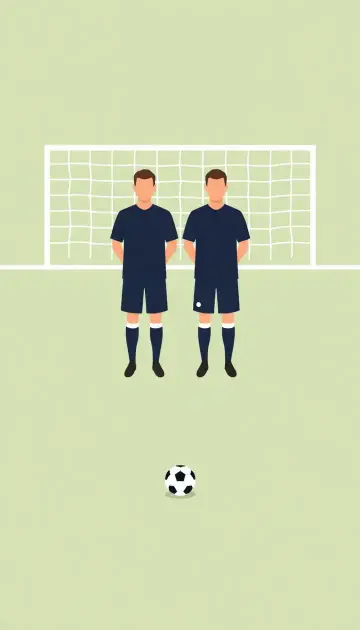
If a player is closer to the opponent's goal than their teammates at the moment the ball is passed to them, they're offside.
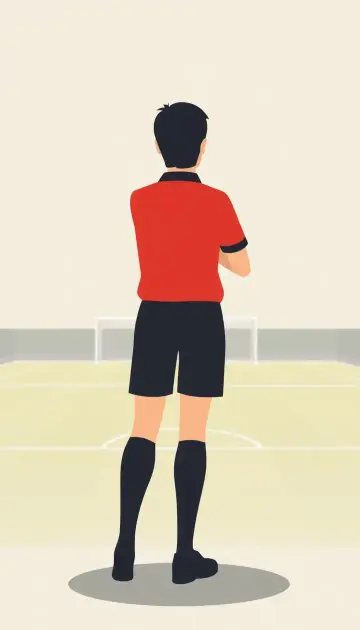
But surely the human eye can't detect a positional difference of a fraction of a second, right?
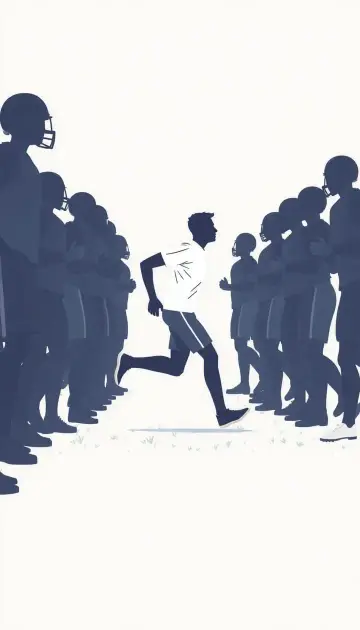
Actually, the linesman runs parallel to the players, keeping their gaze fixed along a straight horizontal line.
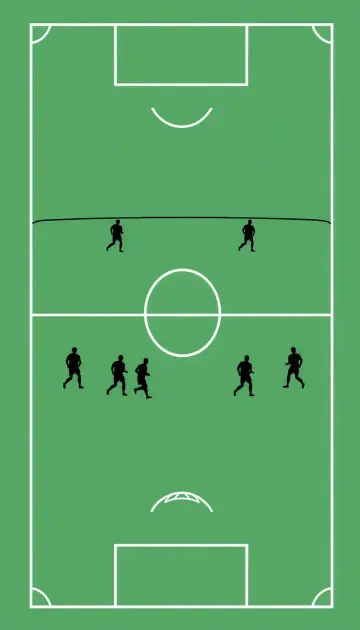
By keeping their body parallel to the players' line, they avoid misjudging who's in front of whom.

Next time you watch a match, keep an eye on how the linesman runs alongside the players.
Sources
- Law 11 - OffsideThe International Football Association Board (IFAB)
- Positioning, movement and teamwork(Guidelines for Match Officials)The International Football Association Board (IFAB)
- Video Assistant Referee (VAR) protocolThe International Football Association Board (IFAB)
- Errors in judging "offside" in association football: test of the optical error versus the perceptual flash-lag hypothesisHelsen W. et al., Journal of Sports Sciences, 2006
- Helsen, Gilis and Weston (2006) err in testing the optical error hypothesisOudejans R.R. et al., Journal of Sports Sciences, 2007
- Offside decision making in the 2002 and 2006 FIFA World CupsCatteeuw P. et al., Journal of Sports Sciences, 2010
- Effect of positioning on the accuracy of decision making of association football top-class referees and assistant referees during competitive matchesMallo J. et al., Journal of Sports Sciences, 2012
- Experts in offside decision making learn to compensate for their illusory perceptionsPut K. et al., Journal of Sport and Exercise Psychology, 2013
- Semi-automated offside technology(FIFA World Cup Qatar 2022)FIFA
Spotted a mistake in the article or the translation? Let us know.
Report an error (contact form in Japanese, opens in a new tab)