On this page
A closer look
Body heat escapes in three ways
As the video explains, a fan doesn't cool the air in the room. The reason it still feels cool is that it helps heat escape from your body.
According to a report by Japan's Ministry of the Environment, body heat mainly escapes through these three routes:
- Convection: Heat moving from your skin to the surrounding air. When the air is cooler than your skin, the bigger the temperature difference and the stronger the wind, the more heat escapes.
- Thermal radiation: Heat leaving your skin as invisible light (infrared) toward surrounding walls and other surfaces.
- Evaporation: Heat being carried away as sweat and other moisture on your skin turns into water vapor. The same report notes that if you sweat 150 g in an hour and that sweat evaporates efficiently, you can release roughly 100 watts' worth of heat.
Of these, a fan's breeze helps with "convection" and "evaporation."
Wind strips away the "warm, humid air layer"
Without any breeze, the air right around your skin tends to stay put, warmed by your body heat and dampened by sweat and water vapor from your skin. That shrinks both the temperature difference and the humidity difference between your skin and the surrounding air, making it harder for heat to escape.
A fan's breeze keeps blowing this air away and replacing it with room air. The Ministry of the Environment report also explains that the amount of heat lost through convection depends on "the temperature difference between skin and air" and "the wind conditions," and that sweat evaporates better "the lower the humidity and the stronger the wind."
The video summed it up as "a fan helps sweat evaporate and lowers how hot you feel," but to be precise, it's best to think of it as helping heat escape through convection, not just sweat evaporation. When you're barely sweating and a breeze still feels cool, that's mainly thanks to convection.
Also, the video's statement that "skin is constantly evaporating moisture" is correct. Even when you aren't sweating, moisture evaporates from your skin and breath without you noticing (this is called insensible water loss). The report also states that the heat lost through evaporation includes both sweat and this insensible water loss.
Be careful when the air is close to body temperature
Heat escapes through convection only when the air is cooler than your skin. The Ministry of the Environment report also notes that when the surrounding temperature approaches skin temperature or rises above it, sweat evaporation becomes the main way to release heat. If the air is hotter than your skin, the more wind you get, the more heat you actually absorb from that hot air.
For this reason, guidelines have been set for the temperatures at which it's okay to rely on a fan alone.
- The U.S. Centers for Disease Control and Prevention (CDC) advises using a fan only when the room temperature is below 90°F (about 32°C), cautioning that above that, a fan can raise your body temperature.
- According to a 2021 study, the World Health Organization (WHO) recommends limiting fan use to temperatures below 35°C.
However, these threshold temperatures are debated among researchers. A research team including the University of Sydney used a model that calculates how heat flows into and out of the body and reported that the range in which fans are helpful is wider than current guidelines suggest (2015). In addition, a 2021 study using weather data from 108 cities around the world proposed temperature thresholds below which fans don't backfire: under 39°C for healthy young adults and under 38°C for healthy people aged 65 and over. Keep in mind that the results also vary with humidity.
On the other hand, some findings suggest older people should be cautious. A U.S. research team ran an experiment in which healthy people aged 61 to 71 spent time in a 42°C room while the humidity was raised from 30% to 70%. On the days they had a fan blowing on them (at about 4 m per second), both their heart rate and core body temperature tended to rise more. In young people, a breeze increases the amount of sweat, but in the older participants in this experiment it did not. The researchers think that because the ability to sweat declines with age, fans may become less effective. That said, 42°C is a very extreme condition.
How to use a fan to prevent heatstroke
Japan's Ministry of the Environment and Ministry of Health, Labour and Welfare recommend that on hot days indoors, you control the temperature with an air conditioner and use a fan or air circulator along with it. It's a division of labor: the air conditioner cools the air in the room, and the fan delivers that air to your body.
- Don't hold back because you're worried about the electricity bill; use the air conditioner appropriately, including at night and while you sleep (Ministry of the Environment).
- Check the room temperature often, and also refer to the heat index known as WBGT (Wet Bulb Globe Temperature) (Ministry of Health, Labour and Welfare).
If heatstroke is suspected, such as with dizziness or lightheadedness when standing, people are advised to move to a cool place, loosen their clothing, cool the neck, armpits, and groin, and take in fluids and salt. If the person can't drink water on their own or doesn't respond when spoken to, don't hesitate to call an ambulance (119 in Japan). If you're concerned about your health, please consult a medical professional.
Related reads
What the video says
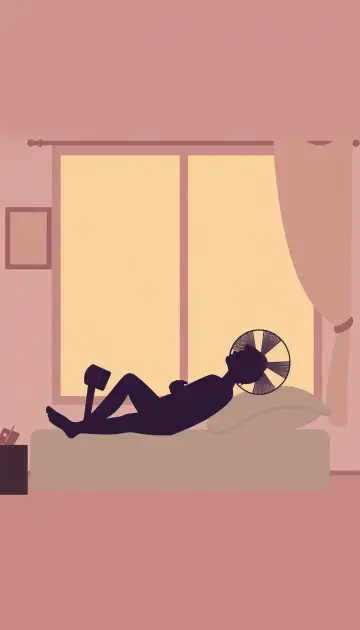
In a midsummer room, the temperature doesn't change, yet you feel cooler when a fan blows on you, right? The thing is, the temperature isn't actually going down.

Our skin is constantly evaporating sweat and moisture to release heat. And it's wind that helps that evaporation happen smoothly.
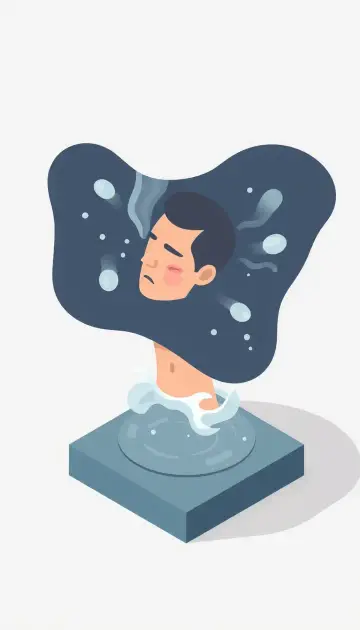
Without a breeze, a layer of humid air forms around your skin, making it harder for sweat to evaporate. When wind hits you, that layer gets replaced, evaporation speeds up, and heat is carried away.
In other words, a fan doesn't lower the air temperature. It helps your sweat evaporate, which lowers how hot you feel.
Sources
- 平成26年度ヒートアイランド現象に対する適応策及び震災後におけるヒートアイランド対策検討調査業務報告書「4.1 暑熱ストレスと適応策のメカニズムの解説手法の検討」Japanese“FY2014 Report on Studies of Adaptation Measures to the Urban Heat Island Phenomenon and Post-Earthquake Heat Island Countermeasures, "4.1 Examination of Methods for Explaining the Mechanisms of Heat Stress and Adaptation Measures"”Ministry of the Environment (Japan)
- あなたの熱中症対策 本当に大丈夫ですか?Japanese“Are Your Heatstroke Precautions Really Enough?”Ministry of the Environment (Japan), Heatstroke Prevention Information Website
- 熱中症を防ぎましょう(熱中症予防のための情報・資料サイト)Japanese“Let's Prevent Heatstroke (Information and Materials Website for Heatstroke Prevention)”Ministry of Health, Labour and Welfare (Japan)
- 熱中症が疑われる人を見かけたら(熱中症予防のための情報・資料サイト)Japanese“If You See Someone Who May Have Heatstroke (Information and Materials Website for Heatstroke Prevention)”Ministry of Health, Labour and Welfare (Japan)
- About Heat and Your HealthU.S. Centers for Disease Control and Prevention (CDC)
- Electric fan use for cooling during hot weather: a biophysical modelling studyMorris N.B. et al., The Lancet Planetary Health, 2021
- Should electric fans be used during a heat wave?Jay O. et al., Applied Ergonomics, 2015
- Electric fan use during heat waves: Turn off for the elderly?Gagnon D. & Crandall C.G., Temperature, 2017
Spotted a mistake in the article or the translation? Let us know.
Report an error (contact form in Japanese, opens in a new tab)