On this page
A closer look
First, why are clouds white?
Before thinking about the color of sunset clouds, let's look at why clouds are white during the day.
The sky is blue because air molecules are much smaller than the wavelengths of light, and they scatter shorter-wavelength blue light more strongly (Rayleigh scattering; for more, see our article on sunrises and sunsets).
According to the Hong Kong Observatory, the water droplets and ice particles in clouds are 10 micrometers or larger, much bigger than the wavelengths of visible light. Particles this size scatter all colors of light roughly equally. This is called Mie scattering. Because all colors are scattered equally and mixed together, clouds look white.
In other words, a cloud is a "white screen" that doesn't play favorites with colors.
In the evening, a red light shines on the screen
According to the UK's Met Office, in the morning and evening the sun is low, and its light passes through a thicker layer of atmosphere. Over that long journey, blue light gets scattered off to the side, and the light that arrives contains more red and orange.
The Hong Kong Observatory explains that clouds reflect this leftover red and orange light that wasn't scattered away, so they appear that color. Its analogy: it's "like shining a red spotlight on a white sheet."
The cloud itself hasn't changed color. The color of the light hitting the white screen has changed, so the cloud looks orange.
NOAA (the U.S. National Oceanic and Atmospheric Administration) meteorologist Corfidi also writes that clouds catch the last red and orange rays of the setting sun and reflect them back to the ground, like a movie theater screen.
Cloud bottoms that are dark by day glow in the evening
According to the Hong Kong Observatory, the bottoms of thick clouds look gray during the day because little sunlight reaches the underside of the cloud, so little light is scattered there. The sun is above the clouds, so light hits them from above and weakens as it passes through the thick cloud.
In the evening, the sun drops close to the horizon. Light comes in from the side, and in some places from below the clouds, so it reaches even the cloud bottoms that get no sun during the day. When the video says the light "hits the bottoms of clouds," this evening-only angle of light is what it means. That's why cloud bottoms that are usually gray can sometimes glow orange in the evening.
Low clouds color first, high clouds later
According to the Hong Kong Observatory, just before sunset, low clouds such as stratus turn red first. A little after sunset, high clouds such as cirrus gradually turn a deeper red and stand out against the darkening sky.
That's because even after the sun has set as seen from the ground, sunlight is still reaching clouds high up. Just as only a mountain's summit glows red in the setting sun, the higher a cloud is, the longer it catches the sunset light.
Corfidi says the clouds most likely to turn vivid red or orange are cirrus and altocumulus, while it's rare for low clouds such as stratus and stratocumulus. His explanation is that to get vivid colors, a cloud has to be high enough to catch "clean" light before it's weakened by dust and haze near the ground.
Even on the same evening, each cloud has a different color
If you look at a sunset sky, you may see gray or purplish clouds right next to clouds glowing orange.
That's because a cloud's height, thickness, and position relative to the sun change what colors of light hit it, and how much. Sides that catch the light glow orange, while shadowed sides sink into darkness. As the sun goes down, the clouds that light up shift from low ones to high ones, so the same sky changes its look every few minutes.
Next time you see a sunset, notice whether the low clouds or the high clouds are lit up, and you'll get a sense of how high the sun is right now.
Related reading
What the video says
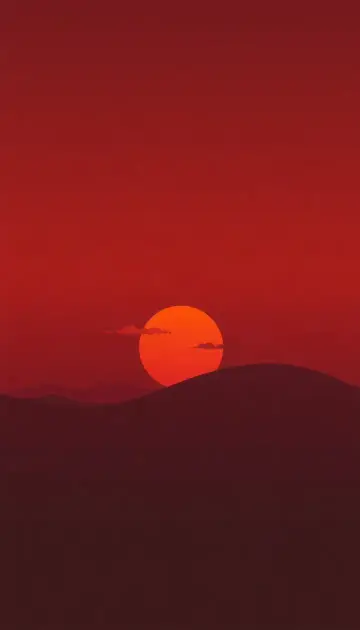
In the evening, as the western sky turns red, clouds can take on orange or red tints, too.

This has to do with the fact that evening sunlight travels a long distance through the air.
Around sunset, blue light gets scattered away as sunlight travels that long distance, so more red and orange light reaches us.
When that red light hits the bottoms of clouds, the clouds scatter it in all directions, so they look tinted orange.
Even in the same evening sky, the depth of color changes depending on the path the light takes. It's one of nature's little mechanisms.
Sources
- Colours of CloudsHong Kong Observatory, 2011
- The Colors of Sunset and TwilightStephen F. Corfidi, NOAA/NWS Storm Prediction Center, 2014
- Why the sky is blue and sunsets redMet Office (UK)
Spotted a mistake in the article or the translation? Let us know.
Report an error (contact form in Japanese, opens in a new tab)