On this page
A closer look
Contrails are made of ice crystals, not water vapor
The video describes contrails as "tiny particles of water vapor contained in the exhaust," but to be precise, what you see as white is ice crystals. Water vapor is an invisible gas, not particles.
According to a fact sheet put together by the U.S. Environmental Protection Agency, the Federal Aviation Administration and the National Oceanic and Atmospheric Administration, contrails form when hot, humid exhaust from the engines mixes with the cold air at high altitude. As it mixes and cools suddenly, the water vapor in the exhaust first condenses into tiny water droplets around fine particles such as soot, and those droplets quickly freeze into ice crystals. When the video says it "freezes in an instant," it's lumping together this whole process of becoming droplets and then quickly freezing.
The video also says "high up in the sky, it's below freezing," but contrails don't form just anywhere below freezing. A 2018 review by a researcher at the German Aerospace Center (DLR) states that contrails usually form at altitudes of about 8 km (roughly 26,000 feet) or higher, when the temperature is below about -40°C (-40°F). It's a very similar mechanism to how your breath turns white on a cold day (→ Why can you see your breath on cold days?).
What decides whether they vanish or linger: humidity relative to ice
As the video says, whether a contrail vanishes quickly or lingers depends on the humidity high up. But what matters here is not ordinary humidity (humidity relative to water), but humidity relative to ice.
At the same temperature, the air around ice reaches the point where it "can't hold any more" (saturation) with less water vapor than the air around water droplets. The IPCC special report (1999) also explains that because of this difference, ice crystals take up water vapor more easily than water droplets do. That's why the upper atmosphere often has air that is "dry for water droplets but too humid for ice" (supersaturated with respect to ice).
- When the air is dry relative to ice: The ice crystals quickly turn back into water vapor (sublimation), and the contrail disappears within seconds to minutes.
- When the air is supersaturated relative to ice: The ice crystals take up water vapor from the surrounding air and grow, sometimes lasting from minutes to more than a day. When winds aloft are strong, contrails can spread out sideways until they become indistinguishable from natural cirrus clouds (wispy, streaky clouds).
According to the DLR review, about 10–15% of the air where planes actually fly is supersaturated with respect to ice (the IPCC report likewise cites measurements from instruments on passenger aircraft showing 14% of flight time). The IPCC report notes that this air isn't humid enough for ice crystals to start forming on their own, so it often looks clear and cloudless. The plane's exhaust acts as a "trigger," and only then does a cloud form there.
In other words, long-lasting contrails aren't made only of the water vapor in the exhaust. The moisture that lets the ice crystals grow is water vapor taken from the surrounding air.
The "sky's humidity gauge" and the "weather turning worse" folklore
The video's comparison to a "humidity gauge for the sky" is a good fit. However, humidity at ground level and humidity high up can be very different. What contrails tell you about is only the humidity at the altitude where planes fly. When a plane passes in and out of dry and humid layers along its route, its contrail can also appear broken up.
The saying that "when contrails linger, the weather is turning worse" is one of the long-standing bits of folklore about predicting the weather by reading the sky (known in Japan as kanten bōki). The U.S. National Weather Service's Flagstaff office also notes that sailors have long known that when contrails disappear quickly, fair weather tends to continue, and when they linger, the weather may change. It's a sign that the upper air is getting more humid, but only as a rough guide of what "may" happen. Contrails alone don't determine the weather, so it's best to enjoy them alongside the weather forecast.
Further reading
What the video says
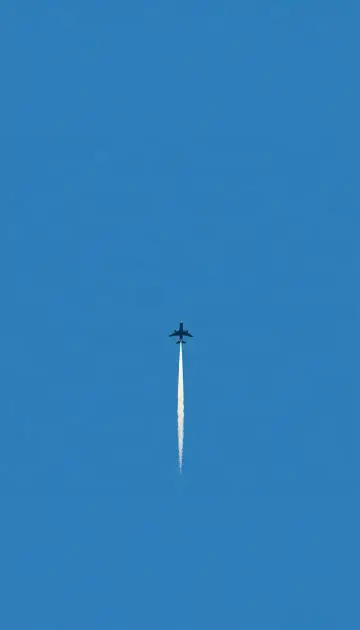
When you look up at the sky, you sometimes see a white line left behind after a plane passes, right? But did you know that on some days that line disappears right away, while on others it stays in the sky for dozens of minutes?
That line is actually made of tiny particles of water vapor contained in the exhaust from the plane's engines. High up in the sky, it's below freezing, so the water vapor freezes in an instant and turns into fine ice crystals.
If the air up there is dry, the ice crystals quickly evaporate and the cloud disappears in seconds. But if the air is humid, the crystals keep growing and stay in the sky as a long cloud.
In other words, the way a contrail fades reflects the humidity high in the sky that day. It's like a humidity gauge for the sky. It's also said that on days when contrails linger, the weather is more likely to take a turn for the worse.
Sources
- Contrails Fact SheetU.S. Environmental Protection Agency (EPA), Federal Aviation Administration (FAA) and National Oceanic and Atmospheric Administration (NOAA)
- Formation and radiative forcing of contrail cirrusKärcher B. (German Aerospace Center, DLR), Nature Communications, 2018
- Aviation and the Global Atmosphere 3.4: Contrail Occurrence and Persistence and Impact of Aircraft Exhaust on CirrusIntergovernmental Panel on Climate Change (IPCC) Special Report, 1999 (GRID-Arendal edition)
- The Science of ContrailsNASA GLOBE Program
- Clouds and ContrailsU.S. National Weather Service (NWS) Flagstaff Forecast Office
Spotted a mistake in the article or the translation? Let us know.
Report an error (contact form in Japanese, opens in a new tab)