On this page
A closer look
Window frost is a collection of ice crystals
On winter mornings, you may find white patterns on your windows that look like feathers or fern leaves. This is called window frost.
The Japan Meteorological Agency describes frost as "ice crystals formed by the deposition of water vapor in the atmosphere, attached to the ground or objects on the ground." Deposition here means that gaseous water vapor turns straight into ice without becoming liquid water first.
According to Dr. Libbrecht, who studies snow crystals at the California Institute of Technology, each branch of window frost is about 3 millimeters long, and just like snow crystals, they show flat faces and branching shapes. The patterns on a window are made of many of these small crystals gathered together.
Frost forms on the inside of the window
Window frost forms on the room side of the glass, not the outside.
As Dr. Libbrecht explains, window frost forms when the outside of the glass is exposed to below-freezing air and there is humid air on the inside. Water vapor in the room's air touches the chilled inner surface of the glass and becomes frost.
What matters isn't the outdoor temperature, but whether the inner surface of the glass is colder than 0°C. Even if it's cold outside, frost won't form unless the inside of the glass gets that cold.
Frost is not "frozen dew"
You might think that when a window gets cold, water droplets form first and then freeze.
Dr. Libbrecht writes that "snow is not frozen rain, and frost is not frozen dew." His explanation is that when water vapor turns directly into ice, you get snow or frost.
However, the Nakaya Ukichiro Museum of Snow and Ice explains that there is another way window patterns can form. If water droplets form first, the whole pane gets covered in a film of water, and that film freezes, complex patterns appear as well. This is called window ice (madogōri), and it's different from window frost. Because the two are hard to tell apart by sight, the museum writes, both are often called window frost.
The patterns start at tiny scratches and smudges on the glass
The patterns of window frost depend heavily on the glass surface.
According to Dr. Libbrecht, scratches on the glass and streaks of leftover soap change how crystals are born and how they grow. The crystals get their start at spots like these and spread out, branching as they go.
That the condition of the glass surface changes the shape of frost has also been confirmed by observations in Japan. Hisao Shinohara of the Utsunomiya Local Meteorological Observatory placed glass slides outdoors and observed the frost. Usually, column-like crystals extended outward from a single point, but on a morning when the glass was wet from the previous day's rain, an unusual plate-like frost grew instead. When he coated the glass with oil, yet another shape of frost formed.
The video said that "scratches and dust act as a foundation," but what the sources confirm is things like scratches and soap residue. Dust was not mentioned in the materials we used.
Temperature and humidity change the shape of the crystals
The fact that snow crystal shapes change with temperature and humidity has been studied for a long time.
According to a paper by Dr. Libbrecht, in the 1930s Ukichiro Nakaya studied how crystal shapes change when you vary temperature and supersaturation (a state where the air holds more water vapor than its normal limit), and summarized the results in a diagram. Roughly speaking, crystals form plates at around −2°C, columns at around −5°C, and plates again at around −15°C. Temperature mainly decides whether you get plates or columns, and the more water vapor there is, the more complex the shapes become.
However, this diagram is about snow crystals growing freely in the air. With window frost, the influence of the glass surface plays a big role. The video said that "crystal shapes change with temperature and humidity," but for window patterns, it's more accurate to think that small differences such as scratches, smudges, and how wet the glass is also add up to determine the shape. That's why the same pattern rarely appears twice.
Why window frost is rare in today's homes
Window frost isn't seen as often as it used to be.
Dr. Libbrecht explains that window frost was common back when most windows were single-pane, and that newer double-pane windows don't conduct heat as easily, so their inner surfaces don't get as cold. The Nakaya Ukichiro Museum of Snow and Ice also writes that buildings have become better insulated, so window frost is rarely seen anymore.
How cold the inside of a window gets depends on the room's temperature and humidity, the outdoor temperature, and how well the window resists heat flow. An explainer from the Forest Products Research Institute in Hokkaido states that in a room at 20°C and 60% humidity, condensation (water vapor in the air turning into water droplets) begins when the window surface drops below about 12°C. The better a window resists heat flow, the less likely it is to fog up with condensation.
When it's really cold outside, the air in the room is humid, and the window lets heat through easily — when all three of these line up, window frost forms more easily.
Related reads
What the video says
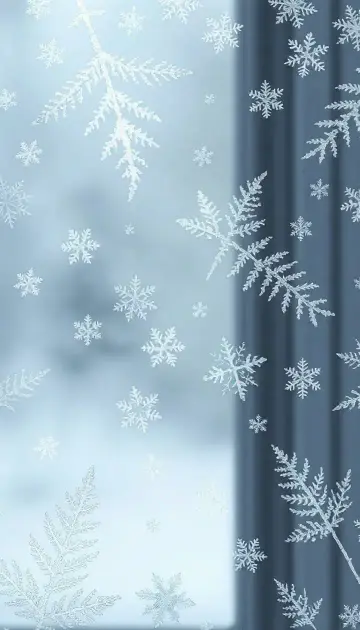
On winter mornings, those white patterns spreading across the window glass are actually made of countless tiny ice crystals gathered together.
These patterns form when water vapor from inside the room touches glass chilled below 0°C by the cold air outside and turns into ice crystals.
Tiny scratches or bits of dust on the glass surface act as a foundation, and the crystals grow from there, branching out as they go.
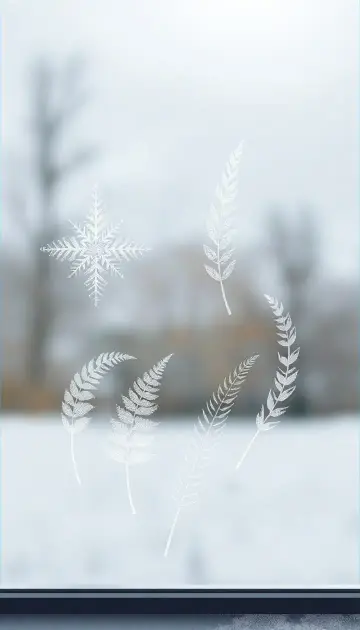
That's why the pattern is a little different every time, and the shape of the crystals also changes with the temperature and how humid it is.
Frost forms on windows most easily on mornings when it's really cold outside and the air in the room is humid.
Sources
- Guide to FrostKenneth G. Libbrecht, California Institute of Technology, SnowCrystals.com
- 窓霜Japanese“Window Frost”Nakaya Ukichiro Museum of Snow and Ice, 2022
- 霜・結氷の観測Japanese“Observation of Frost and Ice”Japan Meteorological Agency
- The physics of snow crystalsK. G. Libbrecht, Reports on Progress in Physics 68, 855–895, 2005
- 同一のガラス面に成長した霜Japanese“Frost Grown on the Same Glass Surface”Hisao Shinohara, Tenki (Meteorological Society of Japan), 1972
- Q&A 先月の技術相談から(窓の結露)Japanese“Q&A from Last Month's Technical Consultations (Window Condensation)”Forest Products Research Institute, Hokkaido Research Organization, Rinsanshi Dayori, 2004
Spotted a mistake in the article or the translation? Let us know.
Report an error (contact form in Japanese, opens in a new tab)