On this page
A closer look
Even a "thin film" has thickness
Toho University's Virtual Laboratory starts by pointing out something obvious.
No matter how thin a film may look, it actually has thickness.
That's where everything begins. To the eye, a soap bubble's film looks like a single surface, but it has a front side and a back side. When light hits it, it reflects in two places.
A, B: light reflected at the surface of the film A1, B1: light reflected at the surface of the film A2, B2: light that passed through the surface of the film and reflected off the back side of the film
There's light that bounces off the front surface, and light that goes through the film, bounces off the back, and comes back out. These two take slightly different paths, so when they return, the peaks and troughs of their waves are out of step.
The A2 and B1 light interfere with each other, producing effects where they reinforce or cancel each other out. This changes depending on the size of the waves at each wavelength.
When peak meets peak, the light gets brighter; when peak meets trough, it disappears. And how the waves line up differs for each wavelength of light—in other words, for each color.
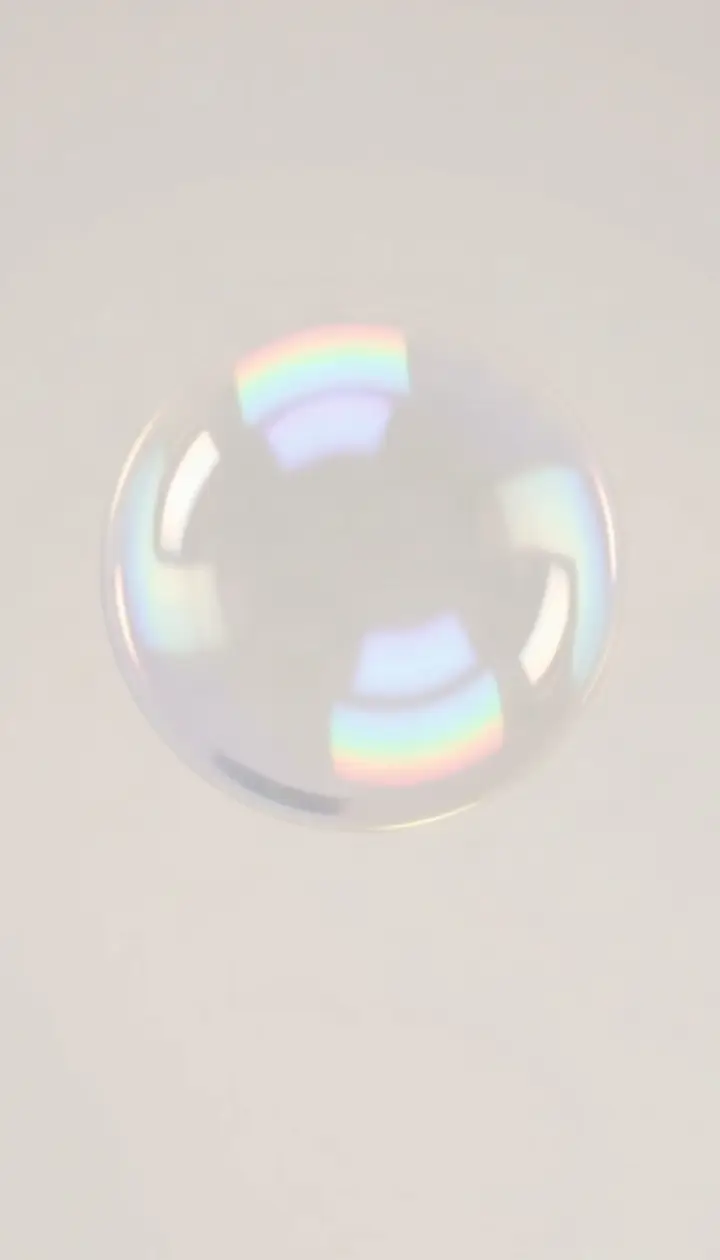
The rainbow-colored patterns that appear on the surface of a soap bubble are caused by this thin-film interference.
There's no pigment involved
The key point is that soap bubbles contain nothing that gives them color. Soapy water is colorless and transparent.
Toho University's explanation distinguishes between color from pigments and color from structure.
The colored paper in the earlier example has red pigment (reflecting red) or yellow pigment (reflecting red and green light) in it, but some substances show colors that aren't their own inherent color. For example, when sunlight hits a film of oil floating on water, complex layers of color appear on the surface. This isn't because the oil has pigments in many colors—it's the result of complex refraction and interference of light by the thin film of oil.
The rainbow sheen of an oil slick in a parking lot after the rain and the rainbow colors of a soap bubble work the same way. In both cases, something transparent looks colored simply because it's thin.
This kind of color has a name.
Structural color can be described as color produced by the interference, diffraction, scattering, and so on of light.
Soap bubbles are structural color produced by interference—the easiest example to understand of a mechanism that creates color without any pigment at all.
When the film's thickness changes, the color changes
The color that gets reinforced by interference depends on the film's thickness. That's why a soap bubble's surface shows different colors in different places.
Gravity pulls the soapy water downward, so the film is thinner at the top and thicker at the bottom. The bands of color line up horizontally and seem to slowly slide downward because the thickness distribution is moving. The swirling color patterns you see right after blowing a bubble, or when it's jostled by the wind, also happen because the film's thickness is changing.
When the film gets thinner than a certain limit, the reflections from the front and back nearly cancel each other out, and that area loses its color. When dark patches spread across a bubble just before it pops, that's a sign the film has gotten that thin.
A completely different mechanism from rainbows
We call them "rainbow colors," but the principle is different from a rainbow in the sky. Here's how the Japan Meteorological Agency explains rainbows:
A rainbow is a phenomenon that occurs when sunlight is refracted (bent) and reflected (bounced back) by water droplets in the air.
A rainbow comes from refraction and reflection inside water droplets. Each wavelength bends at a different angle, so the colors separate by direction. That's why the order of a rainbow's colors is fixed.
An ordinary rainbow is always red on the outside and violet on the inside.
Soap bubbles are different. Because it's thin-film interference, the order of colors depends on the film's thickness. Green might sit next to red, or yellow might sit next to purple. Rainbow colors without a fixed order are a telltale sign of color from interference.
They're both "rainbow colors," but in the sky the angle decides the color, while on a soap bubble the thickness decides it. That's how to tell them apart.
Related reads
What the video says

You know how soap bubbles in the sunlight seem to shift through colors like a rainbow?

That film is actually made of water, and it's only about one-hundredth the thickness of a human hair.
When light hits a thin film, you get two beams: one that reflects off the surface, and one that travels through the film and then reflects.
When those two beams overlap, some colors reinforce each other and others cancel out, so rainbow patterns appear.

And since the film's thickness is always changing, the colors seem to swirl and shift too.
Sources
- 青い魚はなぜ青い-魚の体色変化の不思議を探る-(バーチャルラボラトリ)Japanese“Why Are Blue Fish Blue? Exploring the Mysteries of Color Change in Fish (Virtual Laboratory)”Toho University
- 雲・大気現象・大気光象について(よくある質問)Japanese“About Clouds, Atmospheric Phenomena, and Atmospheric Optical Phenomena (FAQ)”Japan Meteorological Agency
Spotted a mistake in the article or the translation? Let us know.
Report an error (contact form in Japanese, opens in a new tab)