On this page
A closer look
First, the rules for an ordinary rainbow
The Japan Meteorological Agency's FAQ sums up the basics of rainbows.
A rainbow is a phenomenon caused by sunlight being refracted (bent) and reflected (bounced back) by water droplets in the air. Because it is caused by reflected sunlight, a rainbow always appears in the direction opposite the sun, with the sun at your back.
And the order of the colors is fixed.
An ordinary rainbow always has red on the outside and violet on the inside. From the outside of the rainbow inward, the colors are red, orange, yellow, green, blue, and violet.
It even explains what determines how vivid a rainbow looks.
Sometimes a rainbow looks vivid, and sometimes it looks only faint. This depends on the size of the water droplets in the air. The larger the droplets, the more sharply the colors appear.
It also explains why snow doesn't produce rainbows.
Because snow is solid, sunlight can't be refracted and reflected by it the way it is by water droplets, so rainbows don't form while snow is falling or after it has fallen.
Keep this "red on the outside" rule in mind, and you'll be able to tell the two bows of a double rainbow apart.
The outer rainbow has its colors reversed
The Hiroshima City Ebayama Museum of Meteorology wrote an explanation starting from a real double rainbow seen after a typhoon.
The rainbow we usually see is called the "primary rainbow," and a rainbow that forms outside the primary rainbow is called the "secondary rainbow." The secondary rainbow is dimmer and slightly wider than the primary rainbow, and its colors are in the reverse order of the primary (violet on the outside, red on the inside).
The primary rainbow has red on the outside. The secondary rainbow has violet on the outside. The two bows line up with their red edges facing each other in the middle.
The secondary rainbow has three features: it's dimmer, slightly wider, and reversed in color. If you look at a photo of a double rainbow and trace the colors of the outer band, you'll see they really do run in this order.
Why are they reversed? A different number of reflections
The museum's explanation continues:
Why are the colors in the opposite order? It's because sunlight reflects a different number of times inside the water droplet for the primary and secondary rainbows. The primary rainbow is made of light that reflects once inside the droplet before coming out.
The secondary rainbow is different.
However, for the secondary rainbow, sunlight enters the droplet at a different angle than for the primary rainbow. It is made of light that reflects twice inside the droplet and comes out along a different path from the primary rainbow. In this case, the light separates into colors in the opposite way from the primary rainbow, so the colors of the resulting secondary rainbow are also in reverse order.
Light that bounces once inside a raindrop and comes out forms the primary rainbow; light that bounces twice forms the secondary rainbow. That one extra reflection changes the direction in which light leaves the droplet, and flips the order of the colors.
The secondary rainbow is dimmer because with each extra reflection, more light escapes out of the droplet along the way. Far less light makes it through two reflections than comes out after just one. That's why its contrast is weaker than the primary rainbow's.
HyperPhysics explains the same mechanism with diagrams, noting that the primary rainbow appears at about 42 degrees and the secondary at about 51 degrees. This difference in angle is why the secondary rainbow sits "outside" the primary.
Secondary rainbows aren't "rare"—they're just overlooked
Here's the fun part. In theory, a secondary rainbow always forms whenever there's a primary rainbow. The reason we don't see it is that it's so faint it gets lost in the brightness of the sky.
The museum encourages readers:
If you see a rainbow after the rain, look closely, because besides the most noticeable primary rainbow, there might be a double rainbow. There may be a double rainbow out there that we simply don't notice.
The trick to finding one is that once you spot the primary rainbow, widen your gaze outside it. Look past its red edge and keep going outward. On days when the sky is on the darker side and the primary rainbow is strong, your chances of spotting it go way up.
There are other kinds of double rainbows, too
The same explanation introduces patterns besides the secondary rainbow.
Besides the secondary rainbow, there are other unusual double rainbows, such as "supernumerary rainbows (interference rainbows)," where one or two more rainbows appear in succession inside the primary rainbow, and "reflection rainbows," formed by sunlight reflected off water surfaces such as ponds, so please try to find them yourself.
- Supernumerary rainbows (interference rainbows): Faint, stripe-like bows appear layered inside the primary rainbow. They're caused by the interference of light, a different mechanism from the secondary rainbow
- Reflection rainbows: Rainbows made by sunlight that first reflects off the surface of a pond or lake. The water on the ground acts as a mirror, so they appear at an unusual angle
The same JMA FAQ also cautions that rainbow-like light seen near the sun is something else entirely. Colored bands beside the sun are "halos" or "sun dogs," which are caused by ice crystals, not rainbows. Only light that appears with the sun at your back gets to be called a rainbow.
Related reading
What the video says

After the rain, you may sometimes see a second, fainter rainbow layered over the first.

This happens because sunlight reflects either once or twice inside the raindrops.
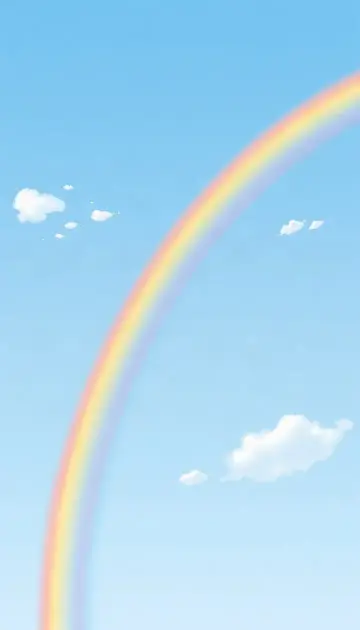
Light that reflects once creates the bright, clear inner rainbow.
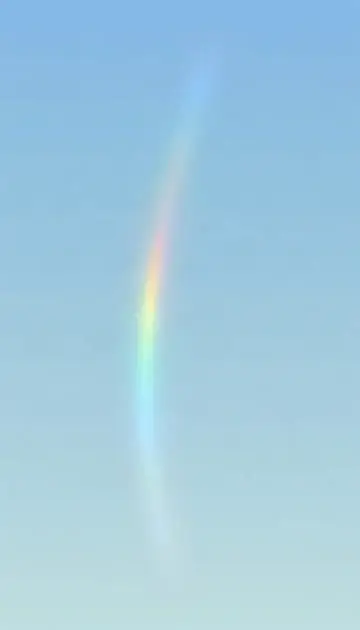
Light that reflects twice creates a second rainbow outside it, but with the colors in reverse order.

That's why a double rainbow is such a curious sight: the colors run in opposite order on the inner and outer bows.
Sources
- 雲・大気現象・大気光象について(よくある質問)Japanese“About Clouds, Atmospheric Phenomena, and Optical Phenomena (FAQ)”Japan Meteorological Agency
- 二重の虹〜主虹と副虹〜(気象館メールマガジン 2018年10月号)Japanese“Double Rainbows: Primary and Secondary Rainbows (Museum of Meteorology Newsletter, October 2018)”Hiroshima City Ebayama Museum of Meteorology
- Primary and Secondary RainbowsGeorgia State University HyperPhysics
Spotted a mistake in the article or the translation? Let us know.
Report an error (contact form in Japanese, opens in a new tab)