On this page
A closer look
"Frost" and "frost needles" are completely different things
First, let's separate the terms. The Japan Meteorological Agency's list of forecast terms includes "frost," but not "frost needles" (shimobashira, literally "frost pillars"). That's because they're different phenomena.
- Frost: Water vapor in the air that turns directly into ice on cold ground or on the surface of leaves
- Frost needles: Water from underground that gets drawn up and freezes into columns at the surface
Frost comes from above (or more precisely, from the air), while frost needles come from below. Their sources are opposite. That's why frost settles as a thin white coating over everything, while frost needles grow upward as if lifting the ground.
Below 0°C at the surface, above 0°C underground
This is the heart of the conditions they need.
The surface cools and drops below 0°C. But underground it's still above 0°C, so water stays liquid. This temperature boundary needs to form just below the surface.
The Japan Meteorological Agency's forecast terms define the mechanism that cools the surface:
Radiative cooling: A drop in temperature caused by heat being lost from the ground surface through radiation.
On clear nights with little wind, the ground surface throws its heat off toward space and cools down. But below the surface, heat stored during the day remains, so it doesn't get that cold.
As a result, ice forms just at the surface, and water arriving from below keeps freezing onto the bottom of that ice. Because the ice grows by being pushed up from below, it forms columns.
The reason you often see soil sitting on top of frost needles is that the part that froze first keeps holding up the topsoil as the column grows.
Capillary action pulls the water up
So how does underground water make its way up? It's thought to be due to capillary action, in which water travels through the gaps between soil particles.
If you dip a thin straw in water, the water rises on its own without you doing anything. The same thing happens in the gaps between soil particles. When water at the top turns to ice and gets used up, more water is pulled up from below to replace it.
This mechanism explains how long frost needles get. If it were just water vapor in the air freezing, you'd get a thin layer of frost at most. But when the ice is connected to a large water supply underground, it can grow over several hours into columns a few centimeters tall.
A phenomenon that's picky about soil
The most surprising thing is that frost needles don't form just anywhere. Here's a passage from research by Tatsutaro Kinko (Technical Bulletin of the Faculty of Horticulture, Chiba University, No. 30, 1982), quoted in a blog post from the National Museum of Emerging Science and Innovation (Miraikan):
Frost needles are a phenomenon commonly seen on the ground surface in regions that combine both the weather condition of winter low temperatures often reaching 0°C to −10°C and the soil condition of containing volcanic ash, and that also get little snow. In Japan, the Kanto Plain is the representative region, with the plains of the Chubu region and southern Tohoku region added to it.
That lists three conditions:
- Low temperatures of 0°C to −10°C
- Soil containing volcanic ash
- Little snow
The Kanto Plain (the region around Tokyo) is named as the representative area. The Kanto loam layer is soil derived from volcanic ash, and its particle size is just right for capillary action. In sandy soil, the grains are too coarse to hold water, and in clay they're too fine for water to move.
Little snow is also a requirement. When snow piles up, it's like laying a blanket over the ground, which breaks the basic setup of only the surface being chilled by radiative cooling. That's why frost needles rarely form in snowy regions.
A rare sight overseas
What prompted that blog post is interesting, so here it is:
It's because the other day, I was so surprised by a line in a book by Ukichiro Nakaya, famous for his snow research, that I almost shouted out loud! "Frost needles... (omitted)... are said not to form in places like Germany (rest omitted)"
A book by Ukichiro Nakaya, known for his research on snow crystals, said frost needles don't form in Germany. And Kinko's report also cites the situation in Britain:
"From around 1870 to around 1880, fragmentary reports of people seeing frost needles were frequently published in the correspondence section of Nature (the British scientific journal). However, they attracted interest only because it was a rare phenomenon in Britain (rest omitted)"
In 19th-century Britain, sightings of frost needles were published in the letters section of Nature. Because they were rare.
If you live in Japan, they seem like something that just naturally appears every winter, but they're actually a local phenomenon of regions where weather and soil conditions come together in a specific combination.
A real problem in farming and civil engineering
They may be charming, but in practical terms they're a nuisance. Here's another passage from the same report:
Frost needles pose major problems in the fields of agriculture, civil engineering, and landscaping. Namely, they push up the roots of winter crops and hinder their growth, cause long-lasting muddy conditions on playing fields as they thaw, damage roads, and in some cases can even cause hillsides and slopes to collapse.
They push up crop roots. They turn schoolyards into mud. They damage roads. They can even make slopes collapse.
The force with which frost needles lift the ground is connected to a phenomenon known in civil engineering as "frost heave." When roads and foundations get pushed up and damaged in cold regions in winter, it's the same physics. Water underground expands in volume when it turns to ice, and since capillary action keeps supplying more water, the lifting force keeps building.
The fun ice columns that crunch under your feet and the force that wrecks roads both come from the same mechanism.
Related reading
What the video says
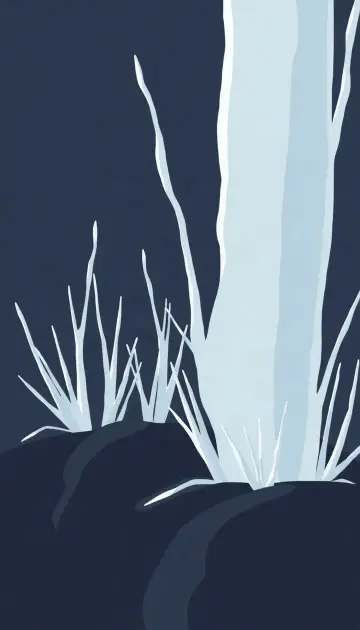
Frost needles aren't made of water vapor from the air that froze. They form from water drawn up out of the soil.
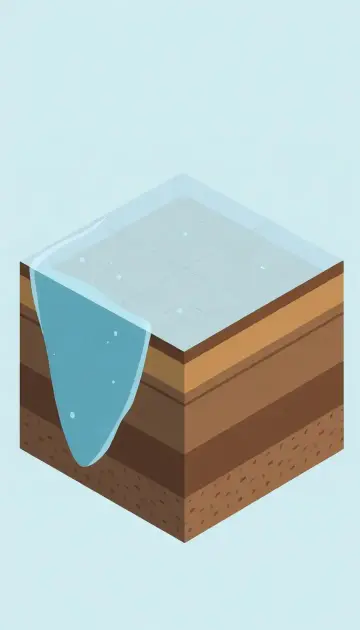
When the ground surface drops below freezing, the moisture at the surface of the soil freezes first.
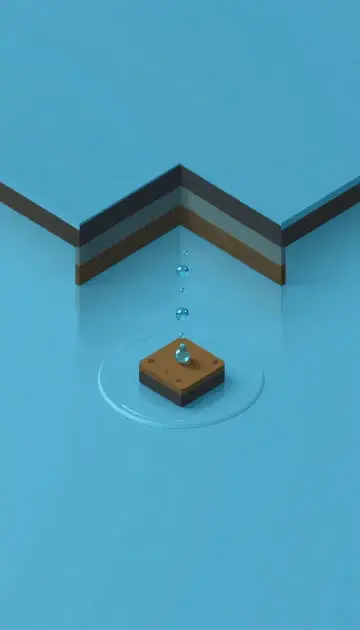
Then water in the ground gets pulled steadily upward by capillary action.

As that water freezes, layer after layer, the ice columns get pushed up little by little, lifting the soil along with them.
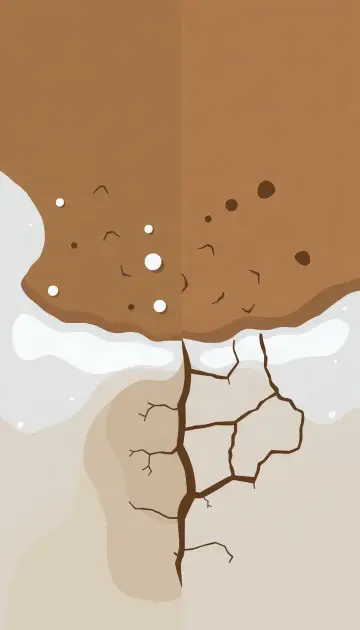
So frost needles need more than just cold temperatures. They only form in soil that holds moisture.
Sources
- 霜柱実験① ~そうだったのか!霜柱!~(科学コミュニケーターブログ)Japanese“Frost Needle Experiment #1: So That's How It Works! Frost Needles! (Science Communicator Blog)”National Museum of Emerging Science and Innovation (Miraikan)
- 氷、霜、霧、雷、日照時間(予報用語)Japanese“Ice, Frost, Fog, Thunder, Sunshine Duration (Forecast Terms)”Japan Meteorological Agency
- 気温、湿度に関する用語(予報用語)Japanese“Terms Related to Temperature and Humidity (Forecast Terms)”Japan Meteorological Agency
Spotted a mistake in the article or the translation? Let us know.
Report an error (contact form in Japanese, opens in a new tab)