On this page
A closer look
First, why do droplets form in the morning?
Dew doesn't fall from the sky. It's water vapor that was already in the air, turning back into liquid water on a cold surface.
The Japan Meteorological Agency defines the temperature at which that switch happens:
Dew point: The temperature at which relative humidity reaches 100% when air is cooled while its water vapor pressure is held constant. The temperature at which water vapor in the air condenses and forms dew.
So what cools the leaves? The answer is in the agency's forecasting glossary:
Radiative cooling: A drop in temperature caused by heat being lost from the ground surface through radiation.
On clear nights with little wind, the ground and leaves keep giving off their heat toward outer space. Clouds act like a blanket and send some of that heat back, but without clouds, things just keep getting colder. Leaves are thin and light, so they cool faster than the ground. That's why morning dew shows up on leaves first.
There's less dew on cloudy or windy nights because this cooling is weaker. A morning covered in dew is also a sign that the night before was clear and calm.
It's round because water wants to pull itself together
Now for the shape. An explainer from Toyo University lists some familiar examples:
Water droplets hanging from things, water bulging up above the rim of a cup, water striders floating on water: all of these phenomena are caused by "surface tension."
It also explains what makes water special:
Because water molecules attract each other strongly, water has high surface tension and curls up into a ball more easily. Oil, on the other hand, has weak attraction between its molecules, so its surface tension is low, and its droplets spread out instead of balling up.
Water molecules pull strongly on one another. As a result, water tries to shrink into the shape with the smallest possible surface area. For a given volume, a sphere has the smallest surface area, so water gets as close to a sphere as it can. The roundness of morning dew is the attraction between water molecules made visible.
Spill oil and it smears out flat; spill water and it forms beads. That's the difference in the strength of this force.
The same water changes shape depending on what it sits on
But surface tension isn't the whole story. The same explainer continues:
Also, even with the same water, the shape of a droplet changes depending on what it's placed on: sometimes it's repelled, and sometimes it spreads out.
The way to measure that difference is the contact angle:
Changes in droplet shape are expressed by the "contact angle." The contact angle is the angle formed between the surface of a droplet and the surface of a solid where the two meet. When a surface repels water ("water-repellent"), the contact angle is large; when water spreads out on it ("hydrophilic"), the contact angle is small. This difference in how liquid spreads is called "wettability" (water repellency vs. hydrophilicity).
Leaves where morning dew stays in neat, round beads are highly water-repellent. On the other hand, some plants have dew that spreads into a flat film, leaving the whole leaf wet. That's why dew looks different from plant to plant, even on the same morning at the same humidity.
The "roughness" of the leaf surface matters
The contact angle isn't determined by the material alone.
Furthermore, the contact angle is affected not only by the type of molecules but also by the shape of the surface. For example, there is the Wenzel state, in which a droplet sinks into the grooves of a bumpy surface, and the Cassie-Baxter state, in which it rests on top of the bumps.
Water-repellent leaves have tiny bumps on their surface. When a droplet rests only on the tips of those bumps, with air trapped in the grooves below (the Cassie-Baxter state), the water is barely touching the leaf at all. The contact angle becomes extremely large, the droplet stays almost perfectly spherical, and it rolls off with just a slight tilt.
If the water instead seeps down into the grooves (the Wenzel state), it clings to the leaf, even if the material is the same. So the difference between a leaf where dew wobbles in round beads and one where it hangs there wet comes not only from the chemistry of the material but also from differences in this microscopic surface terrain.
The Toyo University explainer also notes that this principle is used in engineering: "By combining these phenomena to change the contact angle, it is possible to artificially create superhydrophobic or superhydrophilic surfaces." Water-repellent sprays and fog-free mirrors are built on the same physics as round drops of morning dew.
Related reads
What the video says

Have you ever noticed perfectly round water droplets sitting on blades of grass in the morning?
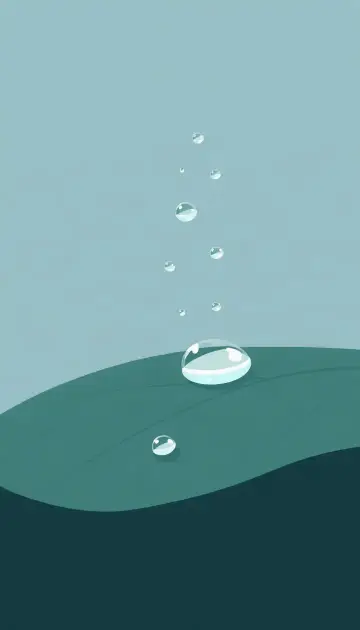
Those droplets actually come from water vapor in the air that cooled overnight and clung to the surface of the leaves.

Water tends to keep its surface area as small as possible, and this property is called surface tension.
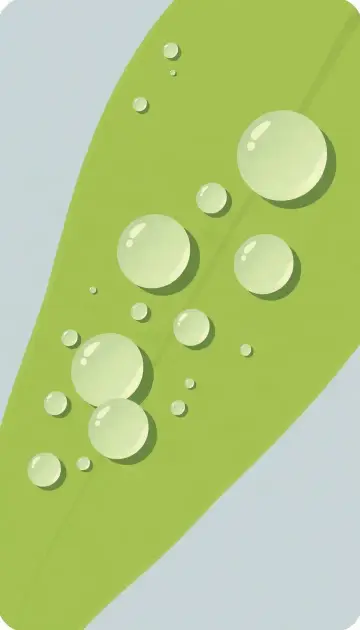
That's why droplets don't spread out flat. Instead, they take a round shape close to a sphere, the shape with the smallest surface area.

On top of that, leaf surfaces have tiny bumps that help repel water, which is another part of the reason.
Sources
- 気温、湿度に関する用語(予報用語)Japanese“Terms Related to Temperature and Humidity (Forecast Terminology)”Japan Meteorological Agency
- 表面張力と濡れ性Japanese“Surface Tension and Wettability”Toyo University
- 氷、霜、霧、雷、日照時間(予報用語)Japanese“Ice, Frost, Fog, Thunder, and Sunshine Duration (Forecast Terminology)”Japan Meteorological Agency
Spotted a mistake in the article or the translation? Let us know.
Report an error (contact form in Japanese, opens in a new tab)