On this page
A closer look
4°C: The turning point
The "flip at 4 degrees" mentioned in the video is explained this way in a piece from Kyoto University:
Under atmospheric pressure, it is heaviest (densest) at about 4°C. Most liquids contract and become denser as their temperature drops, but water expands and becomes lighter below 4°C.
A column from NIMS (Japan's National Institute for Materials Science) describes the same thing from a different angle: "Its density is highest at 4°C. And as you cool it further from 4°C, the density of water goes down."
This leads to an interesting consequence. According to the same column, "In theory, the water at the bottom of a glass of ice water will be at about 4°C." Even though it's being chilled with ice, the bottom isn't the coldest part.
4°C water can be "made by mixing"
The Kyoto University piece describes an experiment you can do in a tank. Mix 2°C water with 6°C water, and you get water at the in-between temperature of 4°C, which sinks.
Neither batch is as heavy as 4°C water, yet the moment they mix, the heaviest water appears. This happens because the relationship between temperature and density isn't a straight line.
This has been observed in nature, too. According to the same piece, "If the temperature of a lake and the temperature of the river water flowing into it are on opposite sides of 4°C (which happens in spring and fall), the water that mixes at the boundary sinks to the lake bottom, just as it does in the tank." There aren't many observed cases in Japan, but it has reportedly been seen often at Lake Baikal in Russia and Kamloops Lake in Canada.
"Ice floats on water" isn't a given either
The NIMS column stresses that this is exceptional among substances. For most substances, the solid is denser than the liquid. Water is the reverse: "Water is denser than ice, meaning it's heavier. That's why ice floats in a glass of ice water."
The even more surprising part comes next. According to the same column, there are at least 13 kinds of ice that have been identified. Because their densities differ depending on their crystal structure, some of them are ice that sinks in water.
The "floating ice" we see is just one type, formed under conditions of 1 atmosphere of pressure. In other words, the ice on a pond floats thanks to Earth's air pressure.
Why life can survive the winter under the ice
Freezing from the top down makes all the difference for creatures living in the water. If water froze from the bottom up, a shallow pond would turn into solid ice.
The ice that forms on the surface also acts like a lid. Since the water below is no longer directly exposed to the outside air, it cools down more slowly from there. That one fact — water is densest at 4°C — creates an environment where fish can survive the winter.
Related reads
What the video says

When a pond or lake freezes, the ice usually forms at the surface first.

It turns out this is thanks to a slightly unusual property of water.

Most liquids get heavier and sink as they cool, but water flips at 4 degrees.

Water colder than 4 degrees becomes lighter, so it doesn't sink and stays at the surface.
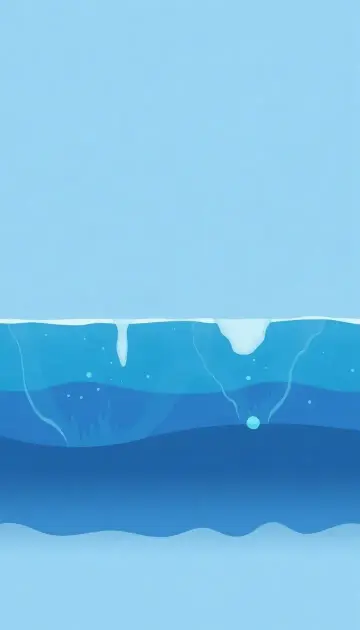
So the coldest part stays at the surface, and that's where freezing begins.

Thanks to this property, fish can make it through the winter under the ice.
Sources
- 水と海の話(秋友和典)Japanese“On Water and the Ocean (Kazunori Akitomo)”Division of Earth and Planetary Sciences, Graduate School of Science, Kyoto University
- コラム「水」— 水に沈む氷?ネバネバする水?? ふしぎな水の世界Japanese“Column "Water" — Ice That Sinks in Water? Sticky Water?? The Mysterious World of Water”National Institute for Materials Science (NIMS)
Spotted a mistake in the article or the translation? Let us know.
Report an error (contact form in Japanese, opens in a new tab)