On this page
- A closer look
- The Japan Meteorological Agency says it's "the same with fireworks"
- With fireworks, too, light and sound start out together
- Count the seconds to find the distance
- The speed of sound changes with temperature
- Distant fireworks sound quieter and duller
- With thunder, it becomes a safety issue
- Up close, they arrive almost together
- Related reads
- What the video says
- Sources
A closer look
The Japan Meteorological Agency says it's "the same with fireworks"
In an explanation about thunder, the Japan Meteorological Agency also mentions fireworks.
The sound of thunder travels as vibrations in the air, moving about 340 meters per second.
Light, on the other hand, is an electromagnetic wave, which allows it to travel about 300,000 kilometers per second.
And:
That is roughly a million times the speed of sound
It also states clearly that the two are produced at the same time.
When thunder rumbles, the light and sound are produced at almost the same moment, but because light travels much faster than sound, the sound reaches us later
Right after this, it adds in parentheses: "The same goes for fireworks." The agency itself says it's the same phenomenon.
With fireworks, too, light and sound start out together
When a firework bursts, its light and sound are produced at the same instant. As the Chemical Society of Japan explains, a firework shell opens when its bursting charge explodes in the air.
Next, the bursting charge ignites and explodes, and the force scatters the stars inside in every direction. At this moment the stars catch fire and burn, giving off light in various colors.
At the moment of the explosion:
- Light: The light from the burning stars reaches your eyes at 300,000 km per second
- Sound: The vibration created as the explosion pushes the air reaches your ears at 340 m per second
They set off at the same time but arrive at different times.
Count the seconds to find the distance
Since sound travels at 340 m per second, the math is easy.
| Seconds from flash to sound | Approximate distance |
|---|---|
| 1 second | 340 m |
| 3 seconds | About 1 km |
| 6 seconds | About 2 km |
| 15 seconds | About 5 km |
If you hear the boom 3 seconds after the flash at a fireworks show, the launch site is about 1 km away.
Light takes just 0.0000033 seconds to travel 1 km, so you can safely ignore it. In practice, "sound delay = distance ÷ 340 m."
The speed of sound changes with temperature
Strictly speaking, the speed of sound depends on air temperature. The warmer the air, the faster its molecules move, so vibrations travel faster.
It's about 331 m/s at 0°C (32°F), about 340 m/s at 15°C (59°F), and about 349 m/s at 30°C (86°F). At a summer fireworks show, sound travels a bit faster than 340 m/s.
Still, a difference this small doesn't break the "3 seconds ≈ 1 km" rule of thumb.
Distant fireworks sound quieter and duller
As distance increases, the quality of the sound changes too.
High-pitched sounds fade first. As sound travels through the air, higher frequencies weaken more easily. That's why distant fireworks sound less like a "pop" and more like a "boom."
Sound bounces off terrain and buildings. Sound reflected off mountains and buildings arrives later, making the boom seem drawn out. That's why venues in valleys echo so much.
Air temperature overhead bends sound. Sound refracts at the boundaries between air layers of different temperatures. At night, the ground cools and the air higher up can be warmer, and when that happens, sound bends back down toward the ground. That's why sound carries farther at night.
This refraction is why you can sometimes hear only the sound of a faraway fireworks show at night.
With thunder, it becomes a safety issue
The phenomenon is the same, but with thunder it means something different. The Japan Meteorological Agency gives a warning about counting the seconds.
Its explanation of thunder introduces counting seconds as a way to estimate distance, but its disaster-prevention page says, "If you hear thunder in the distance, you are already in danger." We covered this in detail in our article on thunder.
Fireworks are launched from a fixed spot, and spectators are at a safe distance. So counting the seconds is just for fun. Lightning doesn't strike in a set place, so you shouldn't use the same calculation to judge whether you're safe. Same physics, different uses.
Up close, they arrive almost together
If you watch fireworks at close range (within a few hundred meters), the light and sound arrive almost simultaneously. And because the sound pressure is high, you feel it in your body.
The "shock" of sound you feel in the front row of a fireworks show comes from sound waves arriving with almost no delay and almost no weakening. It's a completely different experience from watching fireworks far away.
If you want to enjoy the gap between light and sound, watch from a little farther away. With a 3-second pause, you get that strange moment where "the sound of what I'm seeing hasn't arrived yet."
Related reads
What the video says

At a summer fireworks show, you see a big firework burst open, and then a moment later you hear the BOOM, right?
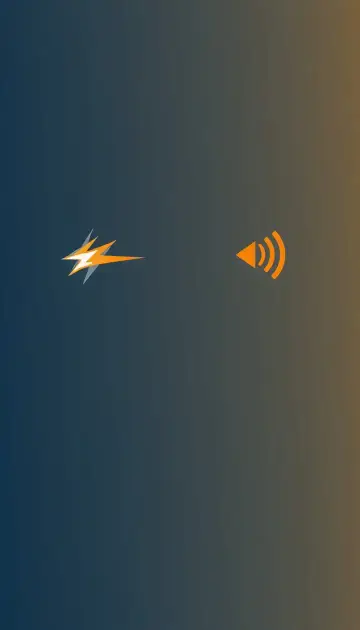
That happens because light and sound travel at completely different speeds. Light arrives almost instantly, but sound moves much more slowly, at about 340 meters per second.
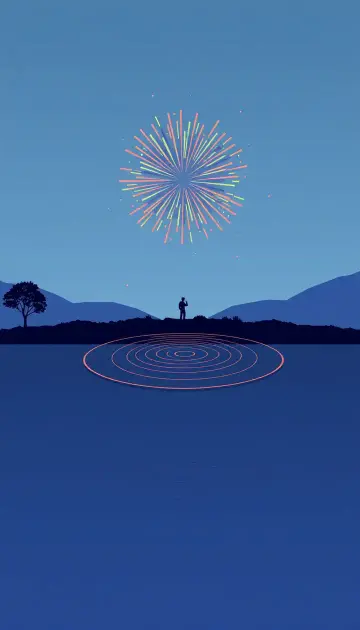
So if you count the seconds between the flash and the sound, you can tell roughly how far away the firework is. A 3-second delay means it's going off about 1 kilometer away.
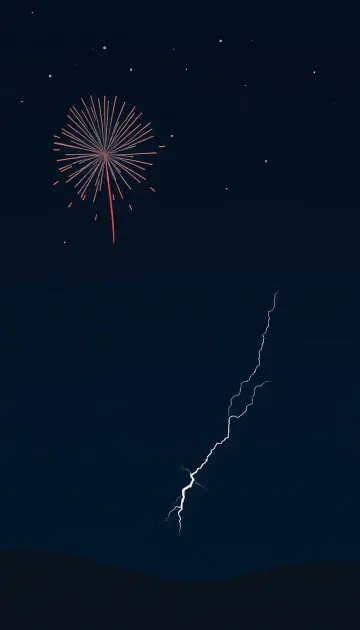
It's the same principle as thunder: a familiar but fascinating property of nature created by the difference between the speeds of light and sound.
Sources
- 雷(かみなり)が光ってから、音が聞こえるまでに差があるのはどうしてなの?Japanese“Why is there a gap between seeing lightning and hearing thunder?”Japan Meteorological Agency
- 暮らしの化学 夏の夜空を彩る化学「花火」の秘密(化学だいすきクラブ)Japanese“Chemistry in Daily Life: The Secrets of "Fireworks," the Chemistry That Colors the Summer Night Sky (Chemistry Lovers' Club)”The Chemical Society of Japan
Spotted a mistake in the article or the translation? Let us know.
Report an error (contact form in Japanese, opens in a new tab)