On this page
A closer look
Colors are set by "elements"
The Chemical Society of Japan's explainer starts by laying out the basic principle.
For example, what color of light a firework gives off is determined by the "elements" it contains.
Then it gives specific examples.
Strontium oxalate is a white powder, but because it contains strontium (Sr), it gives off red light when it burns. Likewise, sodium nitrate gives off yellow light because of its sodium, and copper powder gives off blue-green light.
The key part is "strontium oxalate is a white powder." The material itself has no color. The color of the light it gives off when burned is determined by the elements it contains.
It's not like mixing in something colored, the way you would with paint. Instead, makers choose elements that give off a particular color of light when burned. That's why firework powder looks like plain, unremarkable powder.
Why does each element have its own color?
The same explainer describes how it works.
Fireworks are "combustion"—things burning. Combustion raises the temperature, so the elements involved take in energy. When they return to their original energy state, they release that energy as light, and the amount of energy determines the color of the light.
To break down the process:
- Combustion raises the temperature
- The element (or rather, its electrons) takes in energy and moves to a higher state
- When it returns to its original state, it releases the energy it took in as light
- The amount of that energy determines the light's color (wavelength)
This is the crucial point: the amount of energy involved is fixed for each element, because the states its electrons can occupy are fixed for each element.
That's why each element produces its own specific color. Because this works like a "fingerprint," the flame test is also used to analyze elements.
When you heat a substance in a flame like this, it gives off light in a color unique to the elements it contains. This is called the "flame test reaction."
Main elements and their colors
Combining the explainer with basic chemistry, here's how they line up.
| Element | Color | Example substance used |
|---|---|---|
| Strontium (Sr) | Red | Strontium oxalate |
| Sodium (Na) | Yellow | Sodium nitrate |
| Copper (Cu) | Blue-green | Copper powder |
| Barium (Ba) | Green | — |
| Calcium (Ca) | Orange | — |
| Potassium (K) | Purple | — |
When you put table salt (sodium chloride) over a flame and the flame turns yellow, that's sodium's flame test reaction. The Chemical Society of Japan has even published a guide to an experiment called "Flame Tests in the Kitchen." Sprinkle salt water onto a gas stove flame, and a yellow flame flares up.
Not every color comes from the flame test reaction
Here the explainer adds an important note.
By the way, the flame test reaction isn't the only thing that determines the color of light. For example, a candle's red flame comes from soot that's been heated to high temperatures glowing orange, which works differently from the flame test reaction.
The color of a candle flame isn't a flame test reaction. It's unburned carbon (soot) glowing because it's so hot.
This distinction matters. The flame test reaction is a phenomenon in which "an element gives off light at specific wavelengths." A hot solid glowing is a phenomenon in which "it gives off light across a broad range of wavelengths depending on its temperature" (thermal radiation), a completely different mechanism.
The gold and silver light in fireworks comes from metal powders like aluminum, magnesium, and iron burning at high temperatures. This is closer to thermal radiation than to the flame test reaction. So fireworks mix two different kinds of light emission.
Designing the gunpowder
The explainer also describes what firework powder is made of.
Gunpowder is made of a "fuel," a burnable substance like those in Table 1, and an "oxidizer," a substance that supplies oxygen. Then, once you light it, all three elements of combustion are in place, and it can be launched. Mixing in the substances that are the source of the colored light we just talked about is what creates colorful fireworks.
The three elements of combustion are "fuel," "oxygen," and "heat." Up in the air there isn't enough oxygen, so an oxidizer is packed in along with the fuel.
Then the substances that produce color (colorants) are mixed in. Firework powder is designed as a combination of fuel, oxidizer, and colorant.
From launch to burst
The explainer also covers how a firework shell bursts open.
When you light the fuse connected to the firework shell, the lift charge ignites first and its explosion launches the shell. Next, the burst charge ignites and explodes, and that force scatters the stars inside in all directions. At that moment, the stars catch fire and burn, giving off light in various colors.
There are three kinds of powder:
- Lift charge: launches the firework shell
- Burst charge: breaks the shell open and flings out its contents
- Stars: pellets that give off colored light
The "stars" are small pellets containing colorants. They burn as they scatter in all directions, creating a spherical firework.
Fireworks that change color midway
Some fireworks change color after they open. That's because their "stars" are built in layers.
If you layer a blue-green colorant on the outside and a red colorant on the inside, the color changes once the outer layer burns away. By stacking layers like an onion, a single star can produce several colors one after another.
A fireworks maker's skill lies in designing these layers and making the stars uniform in size and placement. A firework opens into a neat sphere because countless stars are made to fly at the same speed, travel the same distance, and burn out at the same moment.
Related reads
What the video says

Fireworks light up the summer night sky, but did you know those colors actually come from burning metals?
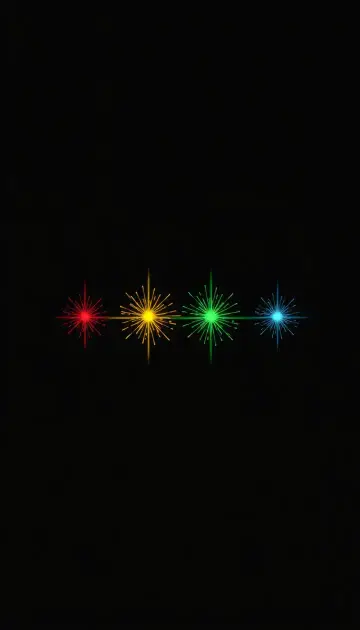
Red is strontium, yellow is sodium, green is barium, and blue-green is copper compounds. When metals burn, they give off light of a specific color. This is called the flame test reaction.

Blue in particular is said to be the hardest color to make, and producing a beautiful blue has long been a way for fireworks makers to show off their skill.

Inside an aerial firework shell, pellets of gunpowder called 'stars' are packed in concentric circles, and the way they're arranged decides the pattern that opens in the sky.
And one more thing. With fireworks, the light reaches you first and the sound comes a little later, right? That's because sound travels at about 340 meters per second, far slower than light. If the sound arrives 3 seconds late, the firework burst roughly 1 kilometer away.
Sources
- 暮らしの化学 夏の夜空を彩る化学「花火」の秘密(化学だいすきクラブ)Japanese“Chemistry in Daily Life: The Secrets of Fireworks, the Chemistry That Colors the Summer Night Sky (Kagaku Daisuki Club)”The Chemical Society of Japan
- 家庭でトライ!! キッチンで炎色反応(化学だいすきクラブ)Japanese“Try It at Home!! Flame Tests in the Kitchen (Kagaku Daisuki Club)”The Chemical Society of Japan
Spotted a mistake in the article or the translation? Let us know.
Report an error (contact form in Japanese, opens in a new tab)