On this page
A closer look
Freshly made ice cream is a collection of "tiny ice"
As the video explains, ice cream contains lots of ice crystals too small to see. According to the textbook by Professor Goff, who researches ice cream at the University of Guelph in Canada, a single gram of typical ice cream contains roughly 8 million ice crystals with an average size of about 0.05 mm (50 micrometers).
In fact, not all the water in ice cream is frozen. Even at serving temperature (around -16°C, or about 3°F), only about 70% of the water is frozen. The rest stays liquid as a very concentrated sugar solution, and that's what makes ice cream soft enough to scoop with a spoon.
For ice cream to feel smooth, it's important that the ice crystals are small and uniform in size. Once the crystals get bigger, your tongue can detect them.
Every temperature swing makes only the big crystals grow
In the video, we said that "the tiny ice crystals melt, then stick together and get bigger as they refreeze." Crystals sticking together and growing has actually been observed, but the main mechanism is a little different.
Professor Goff's textbook explains it like this:
- When the temperature rises slightly, the ice crystals begin to melt, starting with the smallest ones, and mix into the surrounding liquid.
- When the temperature drops again, that water refreezes, but instead of forming new small crystals, it freezes onto the surfaces of the larger crystals that remain.
- As this repeats, the number of crystals goes down while each one gets bigger.
In other words, "the small crystals disappear, and the big crystals get even bigger." A paper from the Japan Society of Refrigerating and Air Conditioning Engineers also notes that the growth of ice crystals in ice cream is often explained by this mechanism, in which small crystals are absorbed into larger ones. The paper points out that areas closer to the surface are more affected by temperature changes, and the ice there can even melt completely. When those melted areas were refrozen, the ice crystals changed from round shapes to irregular, intricate ones.
By the way, opening and closing the door isn't the only cause of temperature swings. Freezers cycle their cooling on and off, and they also run defrost cycles. The temperature rising on the way home from the store is another major cause.
"Frost" and "grittiness" happen in different places
The "frost" in the title and the "gritty texture" described in the video are actually slightly different phenomena.
- A gritty, crunchy texture: Ice crystals that have grown larger inside the ice cream (the mechanism explained above).
- White frost on the surface or under the lid: Moisture that has escaped from the ice cream and frozen onto the surface, the underside of the lid, and so on.
Hitachi, the refrigerator maker, also explains that when you store foods with a lot of moisture, that moisture can sublimate (ice turning directly into water vapor) and then freeze into frost when the surrounding air cools. Humid outside air getting in every time you open the door also adds to the frost. So frost on the surface is also a sign that the ice cream is gradually losing moisture.
One more thing: if you notice a sandy texture that doesn't melt in your mouth, it may not be ice at all but crystallized lactose, the sugar found in milk. According to Professor Goff's textbook, lactose crystals don't dissolve in your mouth, so you can tell them apart from icy grittiness. This, too, is less likely to happen if you prevent temperature changes.
Tips for keeping ice cream smooth longer
As the video says, opening the door less often is effective. Hitachi also recommends opening the door fewer times and for shorter periods to reduce frost.
Here are some other things that help:
- Store it at as low and steady a temperature as possible: Professor Goff's textbook says a "low and constant temperature" is key to preventing ice crystal growth.
- Head straight home and into the freezer after buying it: If it softens on the way home, that alone makes the ice crystals grow.
- Don't refreeze ice cream that has started to melt: Once softened ice cream is refrozen, its smoothness won't come back.
- Close the lid tightly: This helps keep moisture from escaping from the surface and stops other odors from transferring. However, since ice crystal growth inside is caused by temperature changes, sealing alone won't prevent it.
Related reading
What the video says

Have you ever noticed that ice cream you bought a while ago has gone gritty and crunchy on the surface?

It turns out the culprit is the water inside the ice cream. Ice cream contains ice crystals so tiny you can't see them, smoothly locked inside.
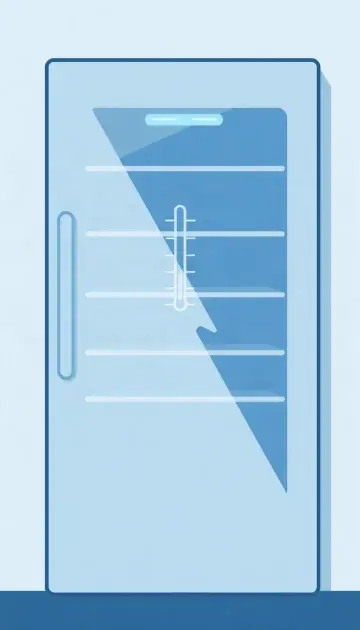
When opening and closing the freezer raises the temperature inside a little, the tiny ice crystals melt, then stick together and get bigger as they refreeze.

As this happens over and over, the ice crystals keep growing larger, creating that gritty, frost-like texture on the surface.

Just opening the freezer less often and sealing your ice cream tightly can help that smooth texture last longer.
Sources
- Ice Cream Shelf-Life(Ice Cream Technology e-Book)Goff H.D., University of Guelph
- Structure from the Ice crystals(Ice Cream Technology e-Book)Goff H.D., University of Guelph
- Body and Texture Defects(Ice Cream Technology e-Book)Goff H.D., University of Guelph
- アイスクリームの保存温度の変動による氷結晶形態の変化Japanese“Changes in ice crystal morphology due to fluctuations in ice cream storage temperature”Hiroko Noritake (Ando) et al., Transactions of the Japan Society of Refrigerating and Air Conditioning Engineers, 2012
- 冷凍室内や冷凍した食品に霜がつきます。Japanese“Frost forms inside the freezer and on frozen foods.”Hitachi Home Appliances (Support Information)
Spotted a mistake in the article or the translation? Let us know.
Report an error (contact form in Japanese, opens in a new tab)