On this page
A closer look
Sweetness starts with starch
As the video explains, bananas get sweeter because the starch in the fruit turns into sugar.
According to a 2019 review by researchers in Brazil, bananas at harvest time contain roughly 12–35% starch in the fruit, depending on the variety. As the fruit ripens, enzymes that cut up starch (such as amylase) go to work, so the starch decreases while sugars like sucrose, glucose and fructose increase. In a ripe banana, sugars can apparently make up close to 20% of the fruit's weight.
For the Cavendish variety, a 2022 review summarizes data from a study of bananas sold in U.S. stores. Per 100 g of fruit, starch dropped from about 13 g when green to about 2 g once ripe and yellow, while fructose and glucose each rose from about 1.5 g to about 7 g, and sucrose rose from about 1 g to about 3 g. It's not just the added sweetness: having less chalky starch also makes the banana nicer to eat.
How "breathing" and ethylene are connected
The video said bananas "keep breathing even after they're harvested." That's true, and on top of that, bananas have a special trait: once they start ripening, their respiration shoots up.
According to a research report from NARO (Japan's National Agriculture and Food Research Organization), fruits can be divided into "climacteric" types (whose respiration suddenly jumps when ripening begins) and "non-climacteric" types (whose respiration doesn't increase). In climacteric fruits, a large amount of a plant hormone called ethylene is produced as ripening starts, driving changes in peel color, flesh softness and flavor. Bananas are a classic example.
To give a sense of how much respiration increases, the 2022 review cites data showing that green Cavendish bananas kept at 20°C (68°F) went from about 20 mg of carbon dioxide per kilogram per hour to a peak of about 250 mg in roughly four days.
One note: the video said "as it breathes, its starch turns into sugar," but strictly speaking, it's enzymes that turn starch into sugar, not respiration itself. Respiration actually does the opposite, using up sugar to make energy. It's best to think of both as happening side by side during ripening, a process triggered by ethylene.
Black spots aren't sugar — they're a color change in the peel
The video said "black spots on the peel are a sign that sugar conversion is underway." The black spots (sometimes called "sugar spots") do tend to show up when a banana is well ripened and sweet, so they're a handy sign that it's ready to eat. But the spots themselves aren't sugar.
A 2005 study in Food Preservation Science (the journal of the Japanese Society for Food Preservation Science) found that the outer layer of banana peel contains a lot of dopamine, a type of polyphenol. As the bananas ripened, dopamine decreased in the outer layer where brown spots appear, while the activity of the enzyme that oxidizes it (polyphenol oxidase) increased. When oxygen was reduced using nitrogen gas, the brown spots appeared later. In other words, the black spots are thought to be the same kind of "color change from oxidation" that turns a cut apple brown, just happening on the peel.
A storage tip: bananas are prone to "chilling injury" when kept below 13°C (55°F), and if they're then moved somewhere warm, the peel can turn blackish (2022 review). A peel that turned black in the fridge is not a sign of sweetness, so be sure to tell the difference.
Imported bananas arrive in Japan while still green
Most bananas sold in Japan are imported, and they're shipped while still green and firm. One reason is that ripe fruit spoils quickly. The review also explains that bananas for market are harvested at the "green stage," once the fruit is fully developed.
Another big reason is plant quarantine (the system for keeping foreign pests and diseases out). Appended Table 2 of the Ordinance for Enforcement of Japan's Plant Protection Act bans importing fresh fruit of host plants from areas where fruit flies (pests that lay eggs in fruit) are present, and the banana family (plants of the genus Musa) is on that list. However, the rule states "excluding fresh fruit of unripe bananas," so green bananas can be imported. A draft international standard (ISPM 46) also lists "a specific maturity stage at harvest (hard green, mature green)" as one option for dealing with the oriental fruit fly.
Once imported, the green bananas are ripened in rooms called muro (ripening rooms) in Japan before going to stores. Materials from a 2011 Ministry of the Environment meeting describe the process: a temperature of 13–19°C (55–66°F), humidity of 90–95% at the start of ripening and 80–85% once the color changes, and an ethylene concentration of 300–1,000 ppm with the room sealed for 24 hours before ventilating. The ethylene concentration and timing vary from source to source, and an overseas review gives an example of 10–150 ppm for 2–3 days.
Related reads
What the video says
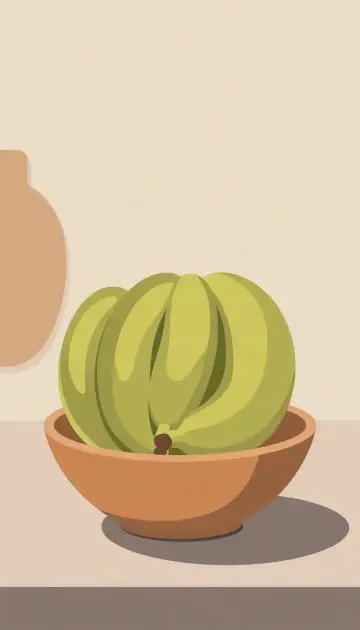
You know how a green banana you just bought is hard and not very sweet?

The truth is, even after it's harvested, a banana keeps slowly breathing on its own.

As it breathes, its starch gradually turns into sugar.

Those black spots that show up on the peel are a sign that this sugar conversion is underway.

That's why a banana that's had time to ripen ends up sweet, soft and easy to eat.
Sources
- Recent Postharvest Technologies in the Banana Supply ChainSugianti C. et al., Reviews in Agricultural Science, 2022
- The Starch Is (Not) Just Another Brick in the Wall: The Primary Metabolism of Sugars During Banana RipeningCordenunsi-Lysenko B.R. et al., Frontiers in Plant Science, 2019
- エチレンによる果実の成熟・老化制御機構Japanese“Mechanisms of ethylene-regulated fruit ripening and senescence”Miho Tatsuki, Bulletin of the National Institute of Fruit Tree Science (NARO), 2007
- Changes in concentrations of phenolic compounds and polyphenol oxidase activity in banana peel during storageRomphophak T. et al., Food Preservation Science, 2005
- 植物防疫法施行規則(別表第二)Japanese“Ordinance for Enforcement of the Plant Protection Act (Appended Table 2)”e-Gov Law Search (Ordinance of the Ministry of Agriculture, Forestry and Fisheries, Japan)
- ISPM46「品目基準」の附属書案「バナナ(Musa spp.)生果実の国際移動」Japanese“Draft annex to ISPM 46 "Commodity-specific standards": International movement of fresh banana (Musa spp.) fruit”Ministry of Agriculture, Forestry and Fisheries (Japan) (Document 2-1, FY2025 Domestic Liaison Meeting on the International Plant Protection Convention)
- 参考資料3 エチレンの使用状況についてJapanese“Reference Material 3: Current use of ethylene”Ministry of the Environment (Japan) (12th Joint Meeting on Specified Agricultural Chemicals, 2011)
Spotted a mistake in the article or the translation? Let us know.
Report an error (contact form in Japanese, opens in a new tab)