On this page
A closer look
The real culprit: "soluble tannin"
The source of a persimmon's astringency is tannin, a large molecule made of many catechin-type units linked together. Around harvest time, the flesh of astringent persimmons contains about 2% by weight of a water-soluble type of tannin (soluble tannin).
When this dissolves into your saliva, it latches onto proteins in your tongue and the lining of your mouth, creating that intensely unpleasant, tightening sensation. The video's explanation, that "tannin that dissolves easily in water leaches out in your mouth, which makes it taste astringent," matches this mechanism exactly.
So to get rid of the astringency, you don't need to eliminate the tannin. You just need to turn it into a form that won't dissolve in saliva.
Drying turns tannin into an "insoluble" form
To make dried persimmons, the surface of the peeled fruit is dried quickly, and then the fruit is left in the sun to slowly lose moisture. According to a research review, a dry film forms on the surface and the tissue of the flesh breaks down, which makes the fruit's respiration incomplete and produces a substance called acetaldehyde.
Acetaldehyde links soluble tannin molecules together into even larger clumps, turning them into a form that doesn't dissolve in water. In an experiment at Kagoshima University, adding acetaldehyde to persimmon tannin caused it to set into a gel (a jelly-like state) in a relatively short time. Methods that remove astringency with carbon dioxide or alcohol also rely on the same action of acetaldehyde.
One report found that with sun-drying, the soluble tannin and the astringency disappear in roughly 7 to 9 days. It's also thought that as the flesh softens, tannin sticks to fragments of broken-down cell walls and becomes insoluble that way as well.
Just as the video says, the astringent compound itself doesn't vanish. It stays in the flesh in an insoluble form.
Does it "become sweeter" or just "taste sweeter"?
The phrase "turn sweet" in the title actually mixes two different meanings.
The first is that you can now taste sweetness that was hidden by the astringency. Converting the tannin to an insoluble form doesn't increase the sugar. Astringent persimmons contain sugar to begin with; the strong astringency just made it impossible to enjoy the sweetness.
The second is that the sugar becomes more concentrated as water is lost, and this isn't just a matter of perception: the concentration really does go up. According to the food composition tables published by Japan's Ministry of Education, Culture, Sports, Science and Technology, fresh persimmons that have had their astringency removed contain 82.2 g of water per 100 g, while dried persimmons contain 24.0 g. Carbohydrates come to 16.9 g and 71.3 g respectively, so by equal weight, dried persimmons have roughly 4 times as much as fresh ones (these figures are a rough guide, since they vary by variety and production method).
On the other hand, the total amount of sugar in a single persimmon doesn't increase when it's dried. In a research review, sugar consistently made up about 60% of the dry weight (everything other than water) throughout drying. The type of sugar does change, however: one report found that sucrose (the same sugar as table sugar) breaks down into glucose and fructose and almost completely disappears within about 10 days of drying.
Black specks and white powder
The black, sesame-seed-like specks you see when you cut a sweet persimmon are, as the video says, clumped tannin. In some varieties that develop seeds, the seeds release acetaldehyde and ethanol, which make the surrounding tannin clump together; the clumps then oxidize and turn dark. Not every sweet persimmon gets these specks, though. In sweet varieties like Fuyu, which lose their astringency naturally while still growing on the tree, the astringency disappears without relying on this mechanism.
The white powder on the surface of dried persimmons is also, as the video says, not mold but sugar crystals. It forms when sugar crystallizes as water evaporates from the surface, and it consists of glucose and fructose. In every example studied, there was more glucose than fructose (about 1.7 to 6.5 times as much, depending on the variety and production method).
Related reading
What the video says
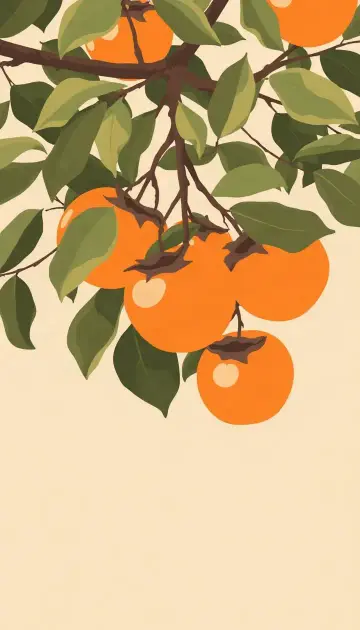
Astringent persimmons turn sweet just by being dried, but the compound that causes the astringency doesn't actually disappear.

The real cause of the astringency is a type of tannin that dissolves easily in water. When it dissolves in your mouth, your tongue picks up that puckery taste.
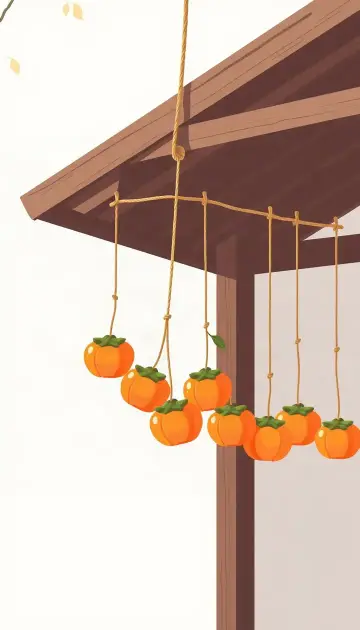
But when you dry a persimmon, a substance called acetaldehyde forms inside the flesh. When it binds with the tannin, the tannin changes into a type that doesn't dissolve in water.

Once the tannin can no longer dissolve, your tongue stops sensing it as astringency. Those black, sesame-seed-like specks you see when you cut a sweet persimmon? Those are actually clumped-up tannin too.
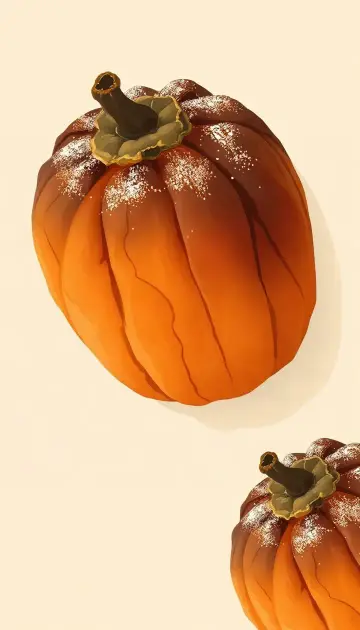
On top of that, drying removes water, so the sweetness gets packed in tight. And the white powder on the surface isn't mold. It's sugar from the flesh that has crystallized.
Sources
- Changes in the Physico-Chemical Properties of Persimmon (Diospyros kaki Thunb.) During Drying and Quality Deterioration During StorageJia, Katsuno & Nishizu, Reviews in Agricultural Science, 2019
- A Model Experiment for De-astringency of Persimmon Fruit with High Carbon Dioxide Treatment: in vitro Gelation of Kaki-tannin by Reacting with AcetaldehydeMatsuo & Itoo, Agricultural and Biological Chemistry, 1982
- Persimmon breeding in Japan for pollination-constant non-astringent (PCNA) type with marker-assisted selectionSato & Yamada, Breeding Science, 2016
- 渋いままの柿でもそのまま加工用材料として使えますJapanese“Persimmons that are still astringent can be used as-is as material for processing”Gifu Prefectural Agricultural Technology Center
- 日本食品標準成分表(八訂)増補2023年 かき 渋抜きがき 生Japanese“Standard Tables of Food Composition in Japan (8th Revised Edition), 2023 Supplement: Persimmons, astringency removed, raw”Ministry of Education, Culture, Sports, Science and Technology (Japan), Food Composition Database
- 日本食品標準成分表(八訂)増補2023年 かき 干しがきJapanese“Standard Tables of Food Composition in Japan (8th Revised Edition), 2023 Supplement: Persimmons, dried”Ministry of Education, Culture, Sports, Science and Technology (Japan), Food Composition Database
Spotted a mistake in the article or the translation? Let us know.
Report an error (contact form in Japanese, opens in a new tab)