On this page
A closer look
The "added time" written into the rules
Soccer's rules, the Laws of the Game, are set by an organization called IFAB (the International Football Association Board). Law 7, "The Duration of the Match," says the referee adds all playing time lost in each half at the end of that half. The reasons listed for adding time include:
- Substitutions
- Assessing injured players and/or removing them from the field
- Wasting time
- Disciplinary sanctions such as cautions and sending-offs
- Drinks breaks (no longer than one minute) and cooling breaks permitted by competition rules
- VAR (video review) checks and reviews
- Goal celebrations
- Any other cause, including any significant delay to a restart
The "treatment time," "goal celebrations" and "time taken for substitutions" mentioned in the video are all on this list.
"+3" means "at least 3 minutes"
So what does the "+3" on the scoreboard or the board actually mean? Law 7 says that at the end of the final minute of each half, the fourth official (the official standing between the benches) indicates the "minimum" additional time decided by the referee. The referee can increase this time but cannot reduce it.
In other words, "+3" doesn't mean "exactly 3 minutes" — it means "at least 3 minutes." If another player gets injured during added time, it can be extended further.
The display is in minutes, and the rules don't specify a counting method like "count down to the second." The video described it as "added up second by second," but it's probably more accurate to think of it this way: the referee is expected to add lost time as accurately as possible, and what's shown is a minimum time in whole minutes.
The referee decides; the fourth official "indicates"
Law 5 of the Laws of the Game says the referee acts as the timekeeper. Under Law 7, it's also the referee who adds the time. So the video's explanation that "the referee alone decides the length" matches the rules.
Meanwhile, the fourth official's role under Law 6 is to "indicate" the minimum additional time the referee intends to allow. The video said the referee "works with the fourth official" to calculate it, but under the rules, it's the referee who calculates and decides, while the fourth official's job is to display that time. The rules don't go into how officials actually communicate with each other during a real match.
More accurate since the 2022 World Cup
Added time got a lot of attention at the 2022 World Cup in Qatar. Pierluigi Collina, then chairman of the FIFA Referees Committee, explained that referees had been "asked to calculate stoppage time more accurately." According to a FIFA article, after referees were instructed to accurately count things like time spent on injury treatment, average added time rose from about 6.5 minutes at the 2018 tournament in Russia to about 10 minutes. In the England vs. Iran match, a total of 23 minutes was added across both halves.
Following this, IFAB agreed at its Annual General Meeting in March 2023 to adopt a stricter, more accurate way of calculating added time in competitions worldwide. Law 7 was also revised to list "goal celebrations" as a separate item. Celebrations tend to run long, and the change makes it clear that this time should be added.
So the reason added time differs between similar matches isn't that the referee is eyeballing it — it's that a different amount of time was lost in each match.
Related reading
What the video says
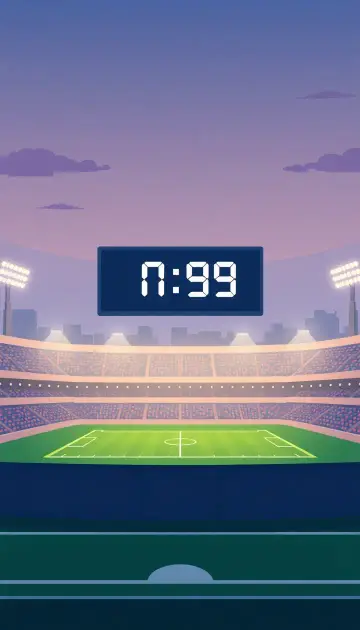
Near the end of a soccer match, a number like "+3" pops up on the scoreboard. Do you think that's just a rough guess?
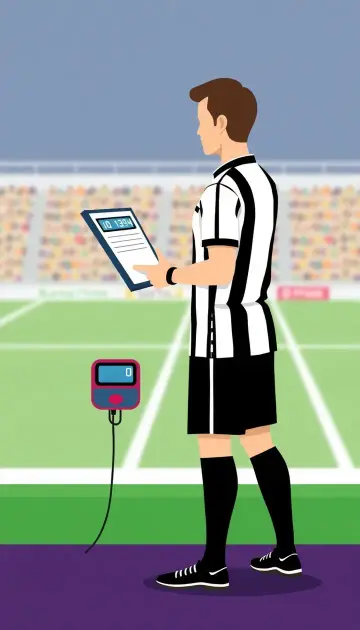
Actually, the referee works with the fourth official on the sideline to add up the "lost time" during the match, second by second.
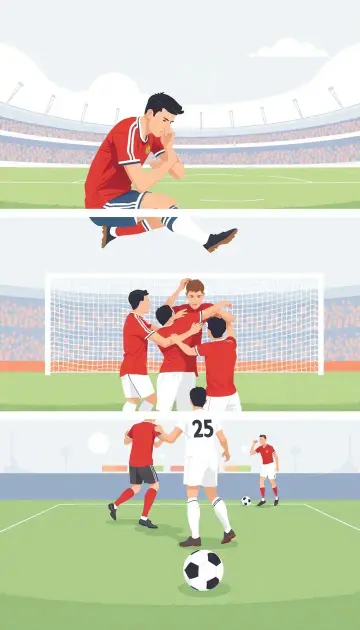
Time spent treating a player who went down, time stopped for goal celebrations, time taken for substitutions. The referee keeps a mental note of each and adds them up.
That's why the rules leave the decision on how long it lasts to the referee alone, and why the length varies even between similar matches.

It's not a guess — it's built up second by second. Next time you watch a match, try imagining the drama hidden behind that number.
Sources
- Law 7 - The Duration of the MatchThe International Football Association Board (IFAB)
- Law 5 - The RefereeThe International Football Association Board (IFAB)
- Law 6 - The Other Match OfficialsThe International Football Association Board (IFAB)
- Circular no. 27(第137回年次総会の決定、2023年3月23日)Japanese“Circular no. 27 (Decisions of the 137th Annual General Meeting, March 23, 2023)”The International Football Association Board (IFAB)
- Collina: We've asked referees to calculate stoppage time more accuratelyFIFA (November 30, 2022)
Spotted a mistake in the article or the translation? Let us know.
Report an error (contact form in Japanese, opens in a new tab)