On this page
A closer look
Today's rules say "45 minutes each"
Soccer's rules are set by an organization called the IFAB (International Football Association Board) in its "Laws of the Game," and matches all over the world are played according to them. Law 7, "The Duration of the Match," states that a match lasts two equal halves of 45 minutes each. So it's 45 minutes in the first half plus 45 in the second, for a total of 90.
The 45 minutes can be shortened only if the referee and both teams agree before the match starts, and only if the competition rules allow it. You can't decide partway through the game to make it shorter.
Halftime and "added time"
There's a break between the two halves (halftime), and the Laws say it must not exceed 15 minutes. The actual length is set by each competition's rules.
Also, the final whistle doesn't necessarily blow at exactly 90 minutes. Time lost to substitutions, dealing with injured players, time-wasting, VAR checks, goal celebrations and so on is added by the referee at the end of each half. The fourth official displays the "minimum" added time; the referee can extend it but can't reduce it.
Some matches are shorter than 90 minutes
For youth, senior (veterans), and disability soccer, as well as local grassroots games, national associations are allowed to change the length of the halves. Even then, though, the rule is that both halves must be the same length. Ninety minutes is simply the standard length for official adult matches.
About the story that it was "decided by chance in 1866"
Soccer's unified rules were created in England in 1863, the same year the Football Association (The FA) was founded. In 1886, the IFAB was established as the body that oversees the rules.
The video explained that at an 1866 match, the two teams happened to agree on the spot to play 45 minutes each way, and that this became an official rule in 1897. However, we couldn't confirm this account in the official historical materials of the IFAB or The FA. There are several theories about where the 90 minutes came from, and it's probably best to keep in mind that no clear record of it has been confirmed.
You might also like
What the video says

A soccer match is two halves of 45 minutes, 90 minutes in all. Everyone takes this rule for granted, but it actually wasn't set from the start.
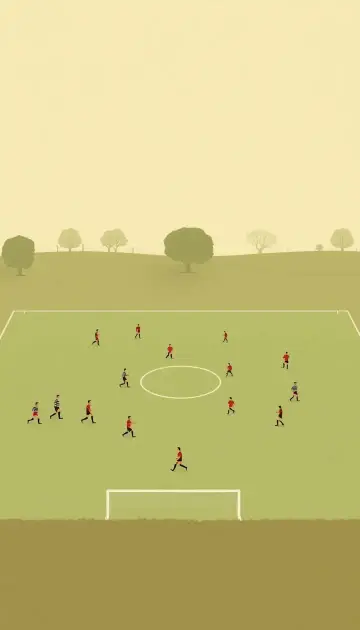
In 19th-century Britain, match length varied from team to team. Some games ran long, and others were short.
The turning point came at one match in 1866. The two teams happened to agree on the spot to play 45 minutes each way, and that's how it all started.
This "45 minutes each" format was adopted again and again in later matches, and in 1897 it became established as an official rule.
In other words, the number 90 didn't come from any scientific basis. It began with a chance agreement at one match.
Sources
- Law 7 - The Duration of the MatchThe IFAB (International Football Association Board), Laws of the Game
- General modificationsThe IFAB (International Football Association Board), Laws of the Game
- The IFAB BackgroundThe IFAB (International Football Association Board)
- A history of the FAThe Football Association
Spotted a mistake in the article or the translation? Let us know.
Report an error (contact form in Japanese, opens in a new tab)