On this page
A closer look
The flag isn't "decoration" — it's "equipment"
Here's the text of Law 1 of the Laws of the Game:
A flagpost, at least 1.5 m (5 ft) high, with a non-pointed top and a flag must be placed at each corner.
A pole at least 1.5 m tall, without a pointed top, and with a flag attached must be placed at each corner.
"Must be placed" is the language of obligation. Just like the goalposts and crossbar, it's defined as equipment necessary to play the match. It's not an optional decoration.
The requirements for height and a "non-pointed top" are there for safety. Since players may fall near the corner, the flagpost has to be shaped so it can't impale anyone.
It's the reference point for the corner arc
There's a practical reason not to remove it, found in another part of the rules:
The corner area is defined by a quarter circle with a radius of 1 m (1 yd) from each corner flagpost drawn inside the field of play.
The quarter circle where the ball is placed for a corner kick is drawn with a radius of 1 m from the corner flagpost.
In other words, the flag is the reference point for drawing the line. Pull it out, and there's no way to determine "1 m from where." Of course, the white line is already painted, so the actual harm is small — but in terms of how the rules are structured, the flag comes first and the line comes after.
The flag is also a three-dimensional marker showing exactly where the corner is. When the referee or assistant referee has to judge from a distance whether the ball crossed near the point where the goal line meets the touchline, a standing flag is easier to see than a line on the ground.
Flags can go at the halfway line, too
The same section mentions another kind of flagpost:
Flagposts may be placed at each end of the halfway line, at least 1 m (1 yd) outside the touchline.
Flags may also be placed at both ends of the halfway line, at least 1 m outside the touchline. The corner flags are a "must"; the halfway-line flags are a "may." Required and optional are clearly distinguished.
The halfway-line flags serve as a useful reference for assistant referees when watching the offside line.
Advertising is banned, too
There are surprisingly detailed rules about how flags are handled:
Advertising is not permitted on the goals, nets, flagposts or their flags and no extraneous equipment (cameras, microphones, etc.) may be attached to these items.
No advertising on the goals, nets, flagposts, or flags. And no extra gear like cameras or microphones may be attached to them, either.
Nothing unrelated to the game goes on the equipment needed to play it. That principle is applied thoroughly.
No form of commercial advertising, whether real or virtual, is permitted on the field of play, on the ground within the area enclosed by the goal nets, the technical area or the referee review area (RRA), or on the ground within 1 m (1 yd) of the boundary lines from the time the teams enter the field of play until they have left it at half-time and from the time the teams re-enter the field of play until the end of the match.
"Whether real or virtual" — neither physical ads nor virtual ads digitally inserted into the broadcast are allowed. The ground within 1 m of the lines is covered too. The rules even specify the exact time periods when this applies.
What "pulling it out is a foul" actually means
So what actually happens if a player pulls out a flag? The Laws of the Game contain no specific article titled "penalty for removing a corner flag."
It's handled under general provisions. Moving field equipment without permission can be grounds for a caution as unsporting behaviour. It's left to the referee's discretion.
Every so often, a player yanks out a corner flag while celebrating a goal. That will get you in trouble, but there's no dedicated "flag-pulling" offense — it's dealt with under the general framework of damaging equipment or disrupting the flow of the match.
Put the other way around, the very fact that the Laws say the flag "must be placed" is the basis for not removing it. If placing it is mandatory, the match can't continue with it removed.
Without the required equipment, there's no valid match
Law 1 lists the field dimensions, the goals, the lines, the flagposts, and optional items like goal-line technology (GLT). The items marked "must" are the minimum conditions for playing a match.
If a goalpost breaks, play stops. By the same logic, a field missing even one flagpost is, according to the rules, an incomplete field. Strictly speaking, saying "pulling out the flag is a foul" really means "without the flag, the field doesn't meet the rules."
It may be humble equipment, but in the rulebook, it's treated the same as the goals.
You might also like
What the video says
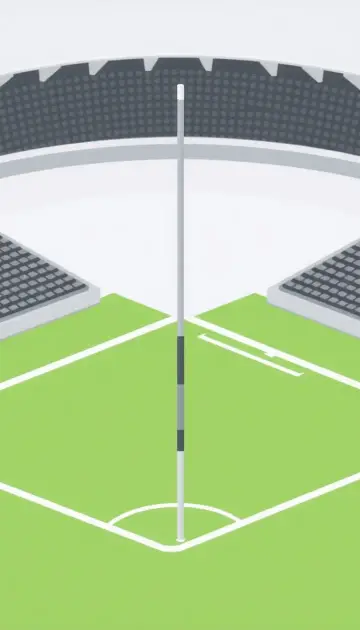
Have you ever noticed that even when players crash into each other near the corner of a soccer field, the corner flag never stays knocked down?
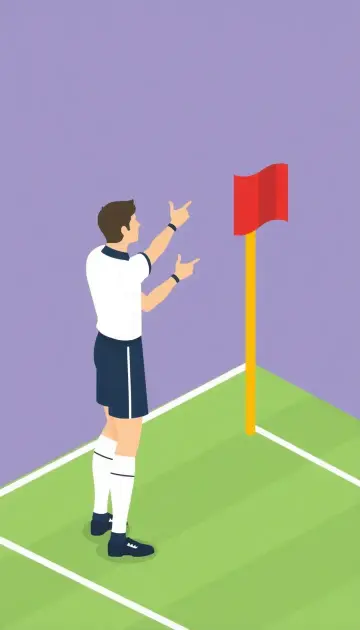
It turns out the rules prohibit removing the corner flag during a match. If a player or coach pulls it out on their own, it's treated as a foul.
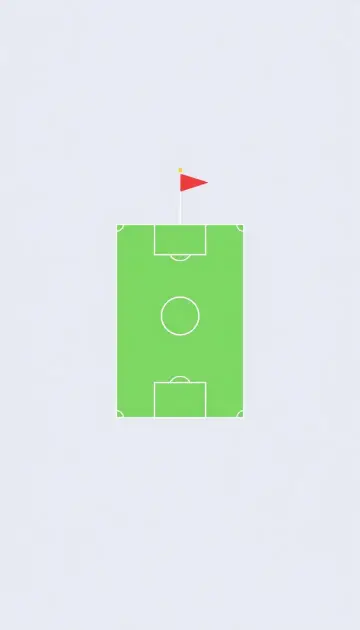
The reason is simple: the flag is the only marker showing where the lines are. If it were pulled out, it would be impossible to tell the exact corner kick spot or whether the ball had crossed the line.

That's why the rulebook from the International Football Association Board clearly states that the corner flag must be at least 1.5 meters tall and must not be moved during a match.

Even a single little flag has a real reason behind it: keeping the game fair.
Sources
- Laws of the Game – Law 1, The Field of PlayThe International Football Association Board (IFAB)
- サッカー競技規則 2026/27Japanese“Laws of the Game 2026/27 (Japanese edition)”Japan Football Association
Spotted a mistake in the article or the translation? Let us know.
Report an error (contact form in Japanese, opens in a new tab)