On this page
A closer look
There are two kinds of what we call "morning dew"
Here's the interesting part. The water droplets on leaves in the morning may look the same, but they come from two different sources. Answers from the Japanese Society of Plant Physiologists draw a clear line between them.
One is water vapor in the air that turns back into liquid on a cool leaf. That's true dew.
The other is water that comes out from inside the plant.
Guttation is the phenomenon in which xylem sap comes out through openings in the leaf called "water pores."
Asked about water droplets on the leaves of a plant called mube (Stauntonia hexaphylla, a climbing vine native to Japan), the expert looked at the photos and concluded:
Judging from these photos, the droplets along the edges of the mube leaves are clearly guttation caused by root pressure. On the other hand, I think the water on the leaf surface is probably dew.
Droplets lined up neatly along the edges or tips of leaves are guttation; droplets scattered randomly across the leaf surface are dew. That's the key to telling them apart.
It can't transpire, so it gets rid of the water as liquid
Another of the society's answers explains the conditions under which guttation happens.
This drainage is a phenomenon called exudation (guttation), seen in many plants, and it occurs under humid conditions such as at dawn or on rainy days. As for the mechanism, it's thought to be driven by a force called root pressure, which the roots use to send water to the parts of the plant above ground.
Normally, plants get rid of water in a different way.
Usually, plants absorb nutrients from their roots along with water, and release moisture as water vapor through small openings on the leaf surface called stomata. However, under humid conditions, they can't release enough water vapor through the stomata.
In other words:
So they release the excess water outside the body through a tissue called the hydathode (which, in the case of bamboo, happens to be right at the tip of the leaf).
The air is so humid that the plant can't release water as vapor, so it lets it out as liquid instead. It's a switch in how the plant disposes of water.
It happens at dawn and on rainy days because humidity is high at both times. For the same reason, you may sometimes see droplets lined up on the leaf tips of houseplants during Japan's rainy season.
The roots are "pushing" water up
The other key to how this works is root pressure. The mube answer goes into detail:
Root cells use energy from respiration to send solutes such as ions into the xylem vessels of the central cylinder (which carry water absorbed from the soil, along with nutrients like nitrogen and potassium, to the parts above ground). This raises the osmotic pressure inside the vessels, so water from the soil enters the plant and travels up to the above-ground parts along with the solutes. The osmotic pressure that drives this is called root pressure.
During the day, plants pull water up like a straw by letting water vapor escape from their leaves. But when it's too humid to transpire, that pulling force doesn't work. So the roots use energy to push the water up through osmotic pressure. The same answer adds:
Guttation is also often seen when transpiration is low (for example, early in the morning when humidity is high and leaf temperature is low).
The answer also notes that root pressure is what makes it possible to collect hechima-sui (loofah water, sap collected from loofah vines and traditionally used as a skin lotion in Japan).
"Water pores" are different from stomata
The openings where the water comes out have a distinct structure, too.
Water pores are openings in the epidermis that resemble stomata. Unlike stomata, water pores don't open and close. These water pores are arranged in a regular pattern along the leaf margins.
They don't open and close, and they're lined up regularly along the edges of the leaf. That's why guttation droplets are spaced so neatly and evenly. That almost decorative arrangement is simply the layout of the water pores made visible.
Water pores aren't the only drainage structures. Another answer lays it out:
Normally, water also exits through the stomata, but it is actively drained through the openings of hydathodes. Known hydathode structures include drainage hairs and drainage cells derived from epidermal cells.
And about water pores, it says:
Hydathodes also include a structure called the water pore, which is usually found near the ends of the veins at the tips or edges of leaves. You've probably seen it on taro or hydrangea leaves in the morning, looking like dew.
The water that comes out isn't just plain water
One last thing that might change the way you see it:
Since the guttated liquid is originally the plant's xylem sap, it contains various ions. However, the cells around the water pores seem to reabsorb the nutrients they need from the guttation fluid, so its composition differs from that of the xylem sap itself.
What drips from the leaf tips is a liquid containing minerals the roots drew up. On top of that, the plant recovers just the nutrients it needs right before the exit, then lets the rest go. It's more elaborate than you might think.
Plants where you'll often see this include bamboo, strawberries, taro, hydrangeas, and Japanese hop. Among everyday plants, strawberries and taro are especially easy to observe. Early on a humid morning, take a close look at the edges of their leaves.
Related reads
What the video says

Those water droplets on the tips of leaves in the morning are sometimes actually water released by the plant itself.
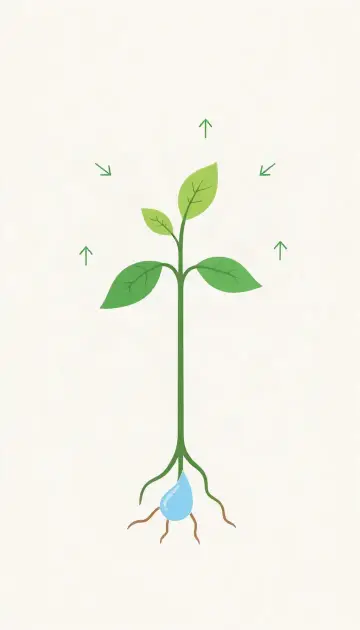
This is called guttation. The pressure of water drawn up from the roots pushes water out through tiny pores at the tips of the leaves.

At night, the stomata tend to close and humidity rises, so transpiration drops sharply, but the roots keep absorbing water. With nowhere else to go, that water spills out of the pores at the leaf tips.
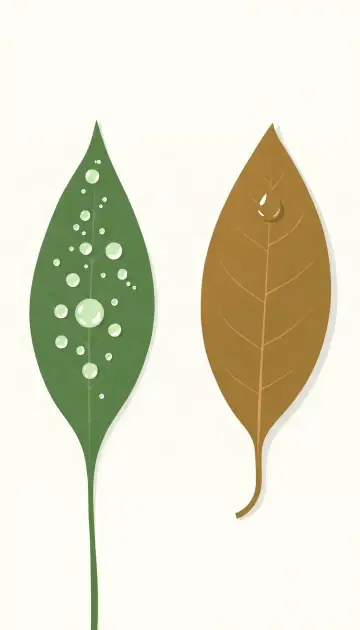
It's easy to mistake for morning dew, but dew forms when moisture in the air cools and settles on the leaves. Guttation is water that comes from inside the plant.

If you look closely, you can see this in many plants, like strawberries and rice. Try looking for it next morning!
Sources
- 植物Q&A「タケの葉の排水について」(みんなのひろば)Japanese“Plant Q&A: "About water drainage from bamboo leaves" (Minna no Hiroba)”The Japanese Society of Plant Physiologists
- 植物Q&A「ムベの若葉の水滴について」(みんなのひろば)Japanese“Plant Q&A: "About water droplets on young mube leaves" (Minna no Hiroba)”The Japanese Society of Plant Physiologists
- 植物Q&A「葉の表面への組織内水分の滲出状況の撮影」(みんなのひろば)Japanese“Plant Q&A: "Photographing the seepage of internal tissue water onto the leaf surface" (Minna no Hiroba)”The Japanese Society of Plant Physiologists
Spotted a mistake in the article or the translation? Let us know.
Report an error (contact form in Japanese, opens in a new tab)