On this page
A closer look
The sky appears to turn around the "north celestial pole"
Over time, the stars in the night sky appear to move from east to west. It isn't the stars themselves that are moving; it's because Earth rotates once a day.
If you extend Earth's rotation axis straight out to the north, it hits a single point in the night sky. This point is called the north celestial pole. Because Earth spins around this axis, from the ground the whole sky seems to wheel around the north celestial pole.
An explainer from Royal Museums Greenwich notes that long-exposure photos of the night sky capture the stars circling around the North Star.
The closer a star is to the center of rotation, the smaller the circle it traces. Think of a spinning top: its rim moves a lot, but the area near the middle barely moves at all.
The North Star sits right next to the north celestial pole. So even if you watch it all night, its position seems to hardly change. That's the mechanism the video introduced.
The North Star actually traces a small circle, too
The video said that "the North Star is the one that barely changes position," but the North Star doesn't line up perfectly with the north celestial pole.
NASA's Astronomy Picture of the Day (APOD) states that the North Star is offset from the north celestial pole by 0.7 degrees (as of 2011). An explainer from the British Astronomical Association (BAA) also says the North Star is roughly 1 degree away from the north celestial pole and traces a small circle around it.
So it's not that "only the North Star is specially standing still." More precisely, "there's a landmark star very close to the north celestial pole." Any star near the north celestial pole, even one that isn't the North Star, also doesn't move much.
By the way, according to NASA's APOD, the North Star is a second-magnitude star and isn't especially bright in the night sky. It's the North Star not because it stands out, but because it's in a good spot.
The North Star's height tells you your latitude
Royal Museums Greenwich explains that because the North Star sits almost directly above the North Pole, it helps you find direction, and by measuring its height above the horizon you can work out your latitude. That's why sailors in the past relied on the North Star.
The farther north you go, the higher the North Star appears; the farther south, the lower it looks. Stand at the North Pole and the North Star is nearly straight overhead.
"Just happens" has an expiration date
The video said the North Star "just happens" to sit near the extension of Earth's axis. This lucky coincidence won't last forever.
Earth's rotation axis gradually changes direction, much like the stem of a spinning top slowly traces a circle. This is called precession. According to the BAA, it takes about 25,700 years for the axis to make one full circuit. As the axis shifts, the north celestial pole also moves across the starry sky.
The BAA writes that around 3000 BC, Thuban in the constellation Draco was the pole star, and that around AD 14000, Vega in Lyra (known in Japan as the "Weaver Princess star" from the Tanabata legend) will become the pole star. Royal Museums Greenwich also says that in about 5,000 years, Alderamin in Cepheus will be the star closest to the north celestial pole, and that in about 28,000 years it will be the current North Star's turn again.
The Southern Hemisphere has no prominent "South Star"
If there's a north celestial pole, there's also a south celestial pole on the opposite side. But there's no landmark star there like today's North Star.
According to the BAA, the star closest to the south celestial pole is Sigma Octantis, a rather faint star of magnitude 5.4. Those of us in the Northern Hemisphere happen to live in an era when a fairly bright star sits beside the north celestial pole.
Related reading
What the video says
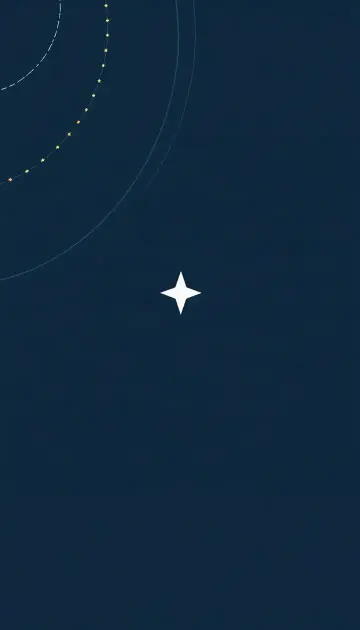
Here's a fact: of all the stars in the night sky, the North Star is the one that barely changes position.

Other stars appear to travel from east to west because Earth rotates.
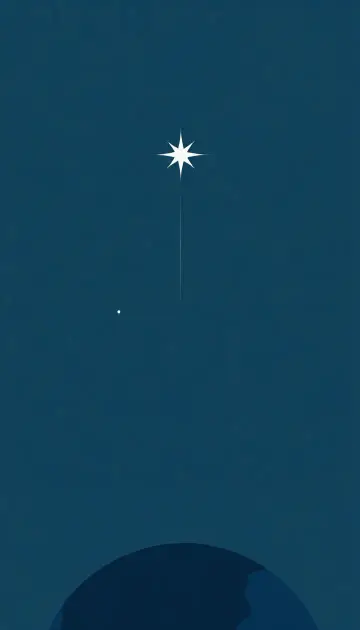
But the North Star lies almost exactly where Earth's rotation axis points if you extend it straight out.

In other words, the North Star just happens to sit right near the extension of the axis Earth spins on, like a spinning top.

That's why, seen from the ground, the North Star sits near the center of the rotation and seems to hardly move at all.
Sources
- APOD: 2011 May 14 - The Little DipperNASA (Astronomy Picture of the Day), 2011
- The Pole StarPaul G Abel, British Astronomical Association, 2018
- Ursa Minor (Little Bear) and PolarisRoyal Museums Greenwich
Spotted a mistake in the article or the translation? Let us know.
Report an error (contact form in Japanese, opens in a new tab)