On this page
A closer look
It's the same as iron changing color when heated
The National Museum of Nature and Science's explainer starts with a familiar comparison.
When you heat iron, it first begins to glow a dull, dark red, but gradually turns yellow, and eventually shines a dazzling white. This shows that color is related to temperature.
It goes on to explain why.
At low temperatures, long-wavelength red light is strongest, and as the temperature rises, short-wavelength blue light becomes stronger.
Then it applies this directly to stars.
The same is true for stars: the more a star's color shifts from red to yellow to bluish-white, the higher its surface temperature.
That's the exact opposite of our everyday sense that red is a "hot color" and blue is a "cool color."
Lining up the actual numbers
Here are the star surface temperatures given in the same explainer, arranged from lowest to highest.
| Star | Color | Surface temperature |
|---|---|---|
| Antares (Scorpius) | Red | About 3,500 degrees |
| Arcturus (Boötes) | Orange | 4,200 degrees |
| The Sun | Yellow | About 6,000 degrees |
| Vega (Lyra; the "Weaver Star" of Japan's Tanabata star festival) | White | About 9,500 degrees |
| Regulus (Leo) | Bluish-white | 13,000 degrees |
In Orion, Betelgeuse at the left shoulder is the classic red star, and Rigel at the lower right is the classic bluish-white one. So within a single constellation, you have stars whose temperatures differ by thousands of degrees.
The museum's explainer says this is exactly why such observations matter.
Because observing a star's color lets us determine its temperature in this way, it is one of the most important kinds of observation.
Differences in temperature mean differences in mass and age
So why does each star have a different temperature? The same page goes into more detail.
We know that most stars that look bluish-white are massive, young stars. Red stars, on the other hand, are either low-mass stars or old stars.
The interior of a low-mass star is denser.
When the density is this high, energy generated at the center has a hard time making its way to the surface. That's why low-mass stars have low surface temperatures.
Old stars are red for a different reason.
As stars age, they swell to hundreds of times their original radius, becoming what are called red giants. This is why old stars have lower surface temperatures.
In other words, there are two kinds of red stars: ones that were small and dim to begin with, and giants that have swollen up as they near the end of their lives. Antares and Betelgeuse are the latter.
The colors we see are only part of the true colors
The National Astronomical Observatory of Japan's "The Multi-Wavelength Universe" explains that hotter stars shine brightest at shorter wavelengths. Newborn, hot, massive stars are brightest in ultraviolet light, while cooler stars are easier to see in near-infrared light. That means the "red, yellow, and bluish-white" we distinguish with the naked eye are just a slice of the light stars emit, the range our eyes can detect.
On top of that, the colors we see from the ground are mixed with the effects of Earth's atmosphere. The Subaru Telescope's explainer puts it this way:
The twinkling of stars is caused by fluctuations in Earth's atmosphere.
When stars low in the sky seem to flicker between red and blue, it's not because the star's own color is changing. It's because the direction the light travels gets disturbed as it passes through the atmosphere. If you want to see a star's true color, your best bet is to look at stars as high in the sky as possible.
Related reading
What the video says

The stars in the night sky actually shine in all sorts of colors: red, white, and blue.

These color differences actually reveal each star's surface temperature.

The cooler a star is, the redder it glows; the hotter it is, the more bluish-white it shines.
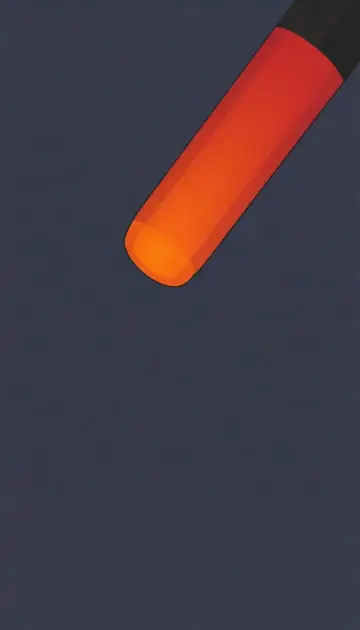
It works the same way as the color change when you heat iron. The hotter it gets, the more bluish-white it glows.

Even within Orion, visible in the winter night sky, red and bluish-white stars stand out clearly side by side.
Sources
- 宇宙の質問箱-恒星編(どうしていろいろな色の星があるのでしょう)Japanese“Space Q&A Box: Stars (Why are there stars of different colors?)”National Museum of Nature and Science
- 多波長で観る宇宙Japanese“The Multi-Wavelength Universe”National Astronomical Observatory of Japan
- 他では得られないシャープな天体像Japanese“Sharp Images of Celestial Objects Unavailable Anywhere Else”Subaru Telescope, National Astronomical Observatory of Japan
Spotted a mistake in the article or the translation? Let us know.
Report an error (contact form in Japanese, opens in a new tab)