On this page
A closer look
Sound has two ways in
An explainer from the University of Tokyo sums up the key point in a single paragraph:
Sound reaches us by two routes: "air-conducted sound," where vibrations in the air travel to the eardrum, and "bone-conducted sound," where vibrations travel through bone. The voice we normally hear as our own is a mix of sound arriving by both routes. A recorded voice, on the other hand, is air-conducted sound only, so it sounds different. The voice other people hear from us is also air-conducted sound, the same as a recording.
That last sentence is the clincher. Recorded voice = the voice other people hear. So it's not that "the recorded voice is strange"; it's the voice you hear every day that's the special one.
The explainer also describes the two routes in detail. First, air conduction:
Every external sound we hear, whether it's other people's voices, music, or noise, reaches our ears as vibrations in the air. Those air vibrations enter the ear hole, called the ear canal, and make the eardrum at the end of it vibrate. The vibrations then pass through three tiny bones called the ossicles, deeper inside, and enter a snail-shaped organ called the cochlea, where they are converted into electrical signals and sent to the auditory nerve. This is air-conducted sound.
And then bone conduction:
Bone-conducted sound is sound we hear when vibrations of the temporal bone (one of the bones of the skull) are transmitted directly to the cochlea. If you cover your ears and speak, you can still hear your own voice, right? That is mainly bone-conducted sound.
Cover your ears and say "ahh," and you can hear the bone-conducted sound on its own. It's an experiment you can try right now.
Sound traveling through bone loses its high frequencies
So what does that mixed-in bone-conducted sound actually sound like? A study from the Japan Advanced Institute of Science and Technology (JAIST) has published measurement results:
In this study, Professor Unoki's research group focused on two observable types of bone-conducted speech (temporal vibration and sound radiated inside the ear canal) and measured the transfer characteristics of temporal vibration (RT) and ear-canal radiated sound (EC), using air-conducted speech as the reference. The results showed that, in both transfer characteristics, high-frequency components are attenuated compared with air-conducted speech.
Passing through bone reduces the high frequencies. That has been confirmed by measurement.
When people say bone-conducted sound makes a voice seem "deeper and fuller," it's not because low frequencies are added. It's because high frequencies are reduced, raising the proportion of low frequencies. The voice you hear yourself has this low-leaning component mixed in, so when you hear the recording, without it, your voice feels "light" or "thin."
The same study also notes that the bone-conduction pathway isn't simple:
Bone-conducted speech travels along pathways in which vibrations of the head (skull and soft tissue) are transmitted directly to the middle and inner ear, as well as a pathway in which head vibrations leak into the ear canal as air vibrations (ear-canal radiation). Because of the influence of this complex transmission process, the spectral characteristics of bone-conducted sound differ greatly from those of air-conducted sound.
There's a route straight from the bone into the inner ear, and another where the bone's vibrations leak out into the ear canal as airborne sound. "Bone conduction" may sound like one thing, but it's really the sum of several pathways.
The same reason bone-conduction headphones struggle with sound quality
This loss of high frequencies is also a practical problem:
When listening to speech through bone-conduction headphones, a challenge is that sound quality and speech intelligibility decline compared with air-conducted listening.
That's why bone-conduction earphones can sound "muffled." The research team came up with a fix: apply the opposite processing.
The method compensates speech using the inverse of the bone-conduction transfer characteristics, and two approaches were developed: a simple method (low-order high-frequency emphasis) and a precise method (high-order high-frequency emphasis).
In other words, boost the high frequencies ahead of time to make up for what will be lost. The result:
By presenting bone-conducted speech using the developed technology, it became possible to hear speech clearly and accurately even in noisy environments, without covering the ears with headphones or similar devices (with the ears left open).
It's fascinating that the strange feeling about your own voice and better sound in bone-conduction earphones are connected by the same property: high frequencies get lost.
So which one is your "real" voice?
To sum it up:
- The voice you hear yourself: air-conducted + bone-conducted sound. The bone-conducted part, which lacks high frequencies, is mixed in, so it sounds deeper and fuller
- Your recorded voice: air-conducted sound only
- The voice other people hear: air-conducted sound only. In other words, the same as the recording
The voice you actually put out into the world is the one on the recording. The voice only you hear is a version filtered through your skull, one that never reaches anyone else.
The University of Tokyo article is part of a series by an acoustics researcher, and it introduces research on the relationship between sound and discomfort:
The frequencies humans can hear are said to be roughly 20 to 20,000 hertz (Hz). The number represents vibrations per second: smaller numbers mean lower sounds, larger numbers mean higher sounds.
By the way, feeling that your recorded voice is "cringey" is a matter of familiarity, not physics. The more you listen, the less strange it feels. The voice with bone conduction that you've heard for years has simply become your reference point; neither version is wrong.
You might also like
What the video says
Have you ever heard a recording of your own voice and thought it sounded like a completely different person?

The truth is, the voice you normally hear as your own isn't just sound coming in through your ears.
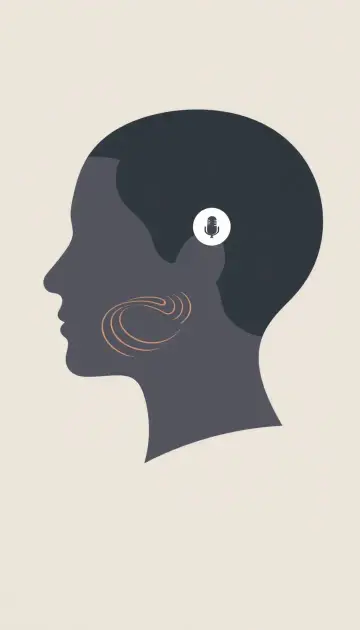
You're also hearing sound that travels from inside your body, through the bones of your throat and skull.

This bone-conducted sound makes the low tones feel stronger, so your own voice tends to sound deeper and fuller than it really is.

But a recorded voice is only the sound that travels through the air to your ears. That's why it seems higher and lighter than usual, like someone else's voice.
So it's not that your recorded voice is weird. It's the voice you always hear that was the special one all along.
Sources
- 録音した自分の声はどうして変に聞こえる?(素朴な疑問vs東大 Q.11)Japanese“Why does my recorded voice sound strange? (Simple Questions vs. UTokyo, Q.11)”The University of Tokyo
- 骨を伝って音を聴く:騒音環境でも耳を塞がずに明瞭に音声を聴きとる技術の開発に成功Japanese“Hearing sound through bone: Successful development of technology to hear speech clearly without covering the ears, even in noisy environments”Japan Advanced Institute of Science and Technology (JAIST)
Spotted a mistake in the article or the translation? Let us know.
Report an error (contact form in Japanese, opens in a new tab)