On this page
A closer look
The definition itself describes the structure
Let's look at the definition in JIS Z 0104 (Japanese Industrial Standard glossary of corrugated fiberboard terms).
Corrugated fiberboard: A board made by bonding liner to one or both sides of a medium formed into flutes. By type, there are single-faced, double-faced (single-wall), double-wall, and triple-wall corrugated fiberboard; by use, it is classified into fiberboard for outer packaging and fiberboard for inner packaging.
It's made of three parts.
- Liner: the flat paper on the outside and inside
- Medium: the wavy paper in the middle
- Bonding: gluing these three layers together
The names of the types are defined too.
Single-faced corrugated fiberboard: Corrugated fiberboard made by bonding a medium formed into flutes to one sheet of liner Double-faced corrugated fiberboard: Corrugated fiberboard made by bonding liner to the flute tips of single-faced corrugated fiberboard
The cardboard boxes you usually see are "double-faced corrugated fiberboard," with liner on both sides of the medium.
Triangles take the load
Between the points where it touches the liners, the wavy medium forms slanted walls. Seen in cross-section, it looks like a row of triangles.
The triangle is the only polygon whose shape is fixed once its side lengths are fixed. A square squashes out of shape when you push on it, but a triangle won't deform unless its sides stretch or shrink. That's why triangles are used in the frameworks of bridges and steel towers.
Cardboard's medium lines up countless of these triangles, made of paper. Force pushing down from above travels along the slanted walls and spreads out into the liners.
A single sheet of paper can't stand up, but turn it into waves and sandwich it between two sheets, and it can. That's the invention of cardboard.
Strength differs by direction
This structure gives cardboard an important property: its strength depends on direction.
- Standing up along the flute lines (the box's vertical direction): strong, because the triangles act as columns
- Perpendicular to the flute lines: weak, because the waves crush easily
- Perpendicular to the surface (pressing from above): in between, because the liner flexes
That's why cardboard boxes are made with the flutes running vertically. When boxes are stacked, the load from above is carried along the direction of the flutes.
Put the other way, if you stack boxes on their sides, they won't show their full strength. A "This side up" label has a structural reason behind it.
The fineness of the waves changes the character
JIS classifies how fine the waves are by the "number of flutes."
A-flute: One of the flute types making up the corrugated part of corrugated fiberboard, with 34±2 flutes per 30 cm. B-flute: One of the flute types making up the corrugated part of corrugated fiberboard, with 50±2 flutes per 30 cm. C-flute: One of the flute types making up the corrugated part of corrugated fiberboard, with 40±2 flutes per 30 cm. E-flute: One of the flute types making up the corrugated part of corrugated fiberboard, with 93±5 flutes per 30 cm.
Lined up by flutes per 30 cm, they look like this.
| Type | Flutes (per 30 cm) | Wave character |
|---|---|---|
| A-flute | 34±2 | Coarse = large waves |
| C-flute | 40±2 | Medium |
| B-flute | 50±2 | Fine |
| E-flute | 93±5 | Very fine |
A-flute has large waves and is thick. That means a thick layer of air, giving it cushioning and strength against loads from above. It's used for boxes for large items.
B-flute has fine waves and is thin. Without the thickness, its stacking strength is lower, but its surface is closer to flat, so printing comes out cleanly and boxes can be made smaller. It's well suited to retail packaging.
E-flute, at 93 flutes, is extremely fine and almost as thin as paper. It's used for decorative gift boxes and packaging for small items.
Stacking layers makes it stronger
The "double-wall" and "triple-wall" corrugated fiberboard in the JIS definition are made by layering these waves.
- Double-wall: two layers of medium (for example, A and B combined)
- Triple-wall: three layers of medium
These multi-layer boards are used for heavy goods and export packaging. More waves means more triangles, so they can take more force.
The air is working too
The spaces inside the waves are filled with air. Air's thermal conductivity is 0.0241 W/m·K, making it the substance around us that conducts heat the least.
So cardboard is both a structural material and an insulator. Part of the reason cardboard boxes are used for frozen foods and fresh produce is this insulation, not just their strength. It's not as effective as Styrofoam, but it works far better than a single sheet of paper.
The same layer of air also works as a cushion. When an impact hits from outside, the waves crush slightly and absorb it. Cardboard is a structure that "protects by crushing."
What makes paper so tough
To sum up, cardboard's strength comes from its shape, not its material.
Simply stacking three sheets of the same paper wouldn't give you this. Turn one sheet into waves and sandwich it between the other two. That one simple trick gives you thickness, a triangular framework, and a layer of air all at once.
JIS specifies flute counts like "34±2 flutes per 30 cm" because this shape determines performance. Cardboard is a material whose character is decided more by the shape of its waves than by the type of paper.
You might also like
What the video says

When you open up a piece of cardboard, there's wavy paper sandwiched inside, right? That wave shape isn't just for decoration.
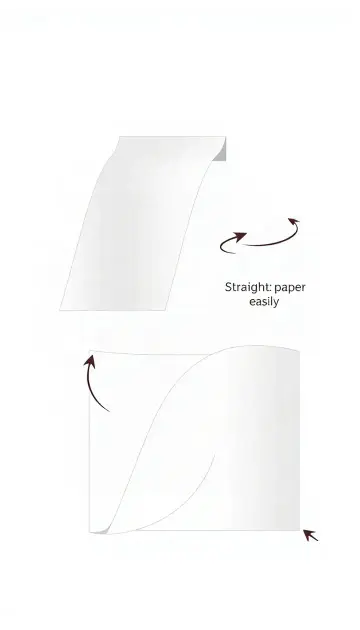
If you try to crush a flat sheet of paper with force from above and below, it collapses easily. But give it a wave shape, and it's a different story.
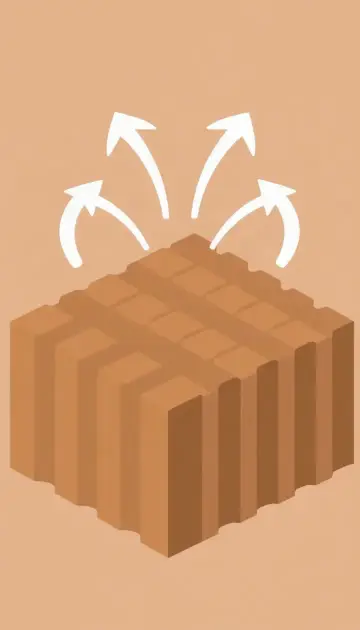
The curves of the waves spread force from above in every direction, like an arch. That's why cardboard is light yet strong.
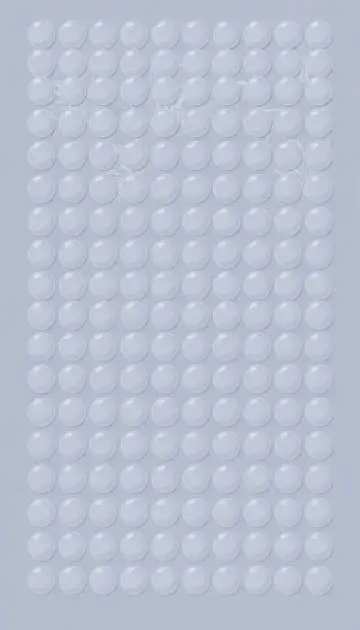
Cushioning like bubble wrap works on a similar principle: the little bubbles of air inside catch the impact and gently let the force escape.
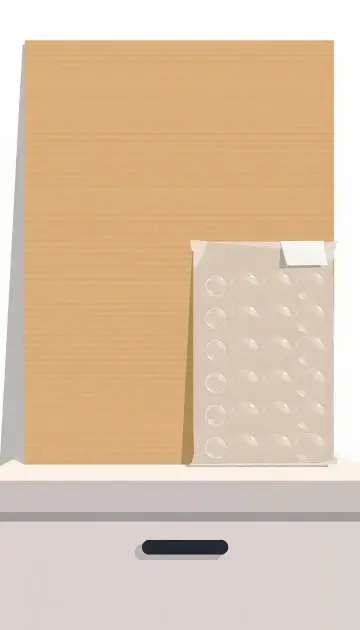
Waves and air bubbles: both are tricks for "not concentrating force on one spot, but letting it escape smoothly."
Sources
- JIS Z 0104:2013 段ボール用語Japanese“JIS Z 0104:2013 Glossary of terms used in corrugated fiberboard”Japanese Industrial Standards (JIS)
Spotted a mistake in the article or the translation? Let us know.
Report an error (contact form in Japanese, opens in a new tab)