On this page
A closer look
The rule: it has to be fine even if one rope breaks
As the video says, a typical traction (rope-type) elevator hangs its car from several ropes, not just one. This isn't merely a clever design choice; it's a legal requirement.
Japan's Order for Enforcement of the Building Standards Act (Article 129-4) states that any part supporting the car that could wear down or suffer metal fatigue must be made up of two or more parts, each able to support the car on its own. The main ropes fall squarely into this category, so if one breaks, the others can still hold the car.
There are standards for rope strength, too. A notice from the Ministry of Land, Infrastructure, Transport and Tourism (No. 1414) specifies that for ordinary elevators using wire ropes 10 mm or more in diameter (8 mm or more for small ones), the ropes must be 5 times as strong as the force they normally bear when installed, and still 4 times as strong after continued use (this is called the safety factor). How many ropes are used depends on the elevator's size and design.
If they all break, the elevator detects it by speed
The video said that "even if every rope breaks, a safety gear grips the rails firmly and brings the car to a stop." It's true that this device is one of the last lines of defense, but the system actually works in two stages.
- The governor monitors speed: If the car's speed rises abnormally, the governor automatically cuts the power before the car exceeds 1.3 times its normal speed (rated speed).
- The safety gear clamps the rails: If the car still keeps descending, the safety gear clamps onto the rails and stops the car before it exceeds 1.4 times its rated speed.
For elevators traveling at 45 m per minute or less, fixed values of 63 m and 68 m per minute are used instead of 1.3 and 1.4 times.
In other words, rather than sensing that the ropes have broken, the system uses "the car is going too fast" as its cue to stop. (For some elevators with small loads or short travel heights, a device that stops the car when the ropes break is also permitted.)
Also, the "grip firmly" style of stopping is limited to slow-moving elevators. According to the Japan Elevator Association, stopping a fast elevator (over 45 m per minute) instantly would put a heavy shock on the car and actually be dangerous. So these use a "progressive safety gear," which gradually increases braking force to slow the car down before stopping it.
In addition, in case the car overshoots the top or bottom floor for some reason, buffers that absorb impact using springs or oil are installed at the bottom of the shaft. And elevators whose construction began on or after September 28, 2009, are also required to have an "unintended car movement protection device," which prevents accidents where the car starts moving with its doors open.
If you get stuck
By law, elevators must have a device that lets people inside the car contact the outside during a power outage or similar situation. The Japan Elevator Association advises that if you're trapped, you should use the intercom to explain the situation and wait to be rescued. Forcing the doors open or trying to climb out is extremely dangerous. The car isn't airtight, so air flows in and there's no risk of suffocation. Emergency lighting also comes on during a power outage. If you feel shaking from an earthquake, the basic rule is to press all the floor buttons and get off at the first floor where the car stops.
The speed of escalator handrails
As the video says, the Order for Enforcement of the Building Standards Act (Article 129-12) requires an escalator's handrail to "move in conjunction with the steps in the same direction and at the same speed."
However, the handrail is a separate part from the steps, and it's usually driven indirectly through a chain from the drive wheels or other parts that move the steps. Materials from the Tokyo Metropolitan Government also describe the handrail as moving at "almost the same speed" as the steps. The video explained that the handrail pulls ahead because "they gradually drift apart with use," but we couldn't find any official source showing why, or by how much, they drift. You may notice a slight difference, but it's best to think of them as designed to move at the same speed.
Because a handrail that stops on its own could cause riders to fall, escalators whose construction began on or after April 1, 2024, are required to have a device that automatically stops operation if the handrail stops or becomes extremely slow.
Related reads
What the video says

The elevator you ride every day without thinking about it. Did you know it isn't hung from just one rope, but from several bundled together?

Because several thick ropes hold the car, even if one breaks, the rest keep supporting it.

And even in the unlikely event that every rope breaks, a safety gear grips the rails firmly and brings the car to a stop.
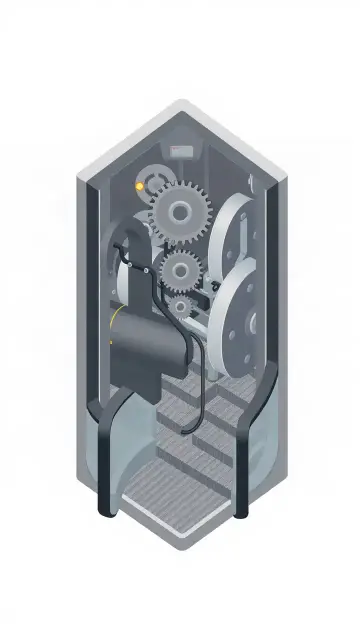
Escalators, meanwhile, are required by law to have the handrail and the steps move in the same direction at the same speed.

So why does the handrail sometimes pull ahead? It's hard to match the speeds perfectly, and they gradually drift apart with use. Even your daily commute depends on careful little adjustments.
Sources
- 建築基準法施行令(第129条の4、第129条の10、第129条の12)Japanese“Order for Enforcement of the Building Standards Act (Articles 129-4, 129-10, and 129-12)”e-Gov Law Search (Digital Agency, Japan)
- エレベーターの制動装置の構造方法を定める件(平成12年建設省告示第1423号)Japanese“Structural Methods for Elevator Braking Devices (Ministry of Construction Notice No. 1423 of 2000)”Ministry of Land, Infrastructure, Transport and Tourism (Japan)
- エレベーター強度検証法の対象となるエレベーター、エレベーター強度検証法及び屋外に設けるエレベーターに関する構造計算の基準を定める件(平成12年建設省告示第1414号)Japanese“Elevators Subject to the Elevator Strength Verification Method, the Elevator Strength Verification Method, and Structural Calculation Standards for Outdoor Elevators (Ministry of Construction Notice No. 1414 of 2000)”Ministry of Land, Infrastructure, Transport and Tourism (Japan)
- エレベーターの安全対策Japanese“Elevator Safety Measures”Japan Elevator Association
- 戸開走行保護装置の設置の促進及び設置済みマークの活用について(国住指第3008号-2)Japanese“On Promoting the Installation of Unintended Car Movement Protection Devices and the Use of Installation Marks (Kokujushi No. 3008-2)”Building Guidance Division, Housing Bureau, Ministry of Land, Infrastructure, Transport and Tourism (Japan)
- エスカレーターの種類と安全対策(令和7年度 第1回 資料2)Japanese“Types of Escalators and Safety Measures (FY2025 1st Meeting, Document 2)”Tokyo Metropolitan Government Product Safety Council
- 令和6年4月1日からエスカレーターの安全基準が変わります。Japanese“Escalator Safety Standards Are Changing from April 1, 2024”Japan Elevator Association
Spotted a mistake in the article or the translation? Let us know.
Report an error (contact form in Japanese, opens in a new tab)