On this page
A closer look
Paper is a network of "stuck-together" fibers
Paper is made of thin plant fibers (pulp) layered on top of one another. The video described paper as "made of tangled fibers," but tangling isn't the only thing holding the fibers together.
Wherever fibers touch, an attractive force between molecules called hydrogen bonding comes into play and makes the fibers stick tightly together. In one study, researchers formed paper using alcohol instead of water, producing sheets in which hydrogen bonds had a hard time forming, and compared them. The paper's resistance to pulling dropped sharply. The researchers concluded that at least about 60% of paper's tensile strength comes from hydrogen bonds, with the rest coming from friction between fibers.
In other words, paper's strength depends not just on how strong each individual fiber is, but very much on the "joints" between fibers.
Folding pulls on the outside and pushes on the inside
As the video shows, when you fold paper, the outside of the crease is stretched and the inside is compressed. Papermaking research likewise describes folding as "extreme bending" that creates tensile stress on the outside and compressive stress on the inside.
The changes the sources point to are the bonds between fibers coming apart and the layers within the thickness of the paper separating (delamination). With thick paper, "fold cracking," where stretching on the outside breaks up the surface structure, is a common problem.
The video called it "a trace of fibers being crushed and broken," but it's more accurate to think of it as "a trace where fibers were not only squashed on the inside but also stretched on the outside, so the connections between them came apart."
Why the crease looks whitish
Paper looks white because light changes direction again and again at the boundaries between fibers and air, scattering as it goes. Papermaking researchers have long thought that areas where fibers are bonded together don't scatter much light, while unbonded, "exposed" fiber surfaces do. In fact, when paper is pulled and stretched, it scatters more light, which is thought to be because the bonds between fibers are breaking.
The white line left by a fold is likely the same thing: bonds come apart, tiny gaps multiply inside the paper, and those gaps scatter light well. That said, we couldn't find any study that actually measured "the whiteness of creases" itself this time, so please take this explanation as a mechanism inferred from paper's optical properties.
Breaking from repeated folding is even used as a test method
If you keep folding paper back and forth along the same line, it will eventually break there. This property is actually used to measure paper strength.
Under the international standard ISO 5626, a narrow strip of paper is held under constant tension and folded back and forth at the same spot, and the number of double folds it survives before breaking is counted as a measure of its "folding endurance."
Paper also has a direction in which its fibers line up (the grain). According to material from FUJIFILM Business Innovation, paper tears easily along the direction of the fibers and resists tearing across them. So when you tear along a crease, how easily it tears also depends on the direction of the grain.
Making weak lines on purpose
When making things like paper boxes, manufacturers press a groove-like line (a crease or score line) into the board before folding it. A study on folding paperboard found that a good crease already has a little delamination in it, which makes the board easier to bend and less likely to crack when folded. Papermaking research also cites reports that when fibers separate and delaminate during folding, the stretching stress on the outside is relieved and fold cracking is reduced.
In other words, the fact that "a crease becomes weak" is cleverly put to good use.
Related reading
What the video says

When you fold a piece of paper and then flatten it out again, a faint white crease stays behind, right?

That white line is actually a trace of the paper's fibers getting crushed and broken in just that spot.
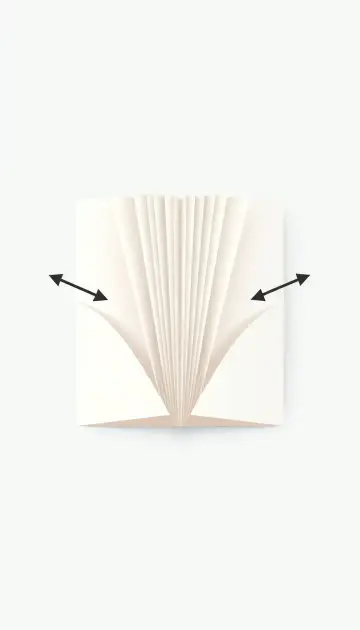
Paper is made of thin fibers tangled together. When you bend it, the fibers on the inside get squeezed tight, while the fibers on the outside get stretched.
As a result, the connections between fibers break, and that one line loses strength.

That's why if you fold paper in the same place over and over, it tears easily.
Sources
- Contribution of Hydrogen Bonds to Paper Strength PropertiesPrzybysz P. et al., PLoS One, 2016
- Changes in fold cracking properties and mechanical properties of high-grammage paper as affected by additive and fillersKim D.-S. & Sung Y.J., BioResources, 2023
- Bonding in paper sheetsNordman L.S., Fundamentals of Papermaking Fibres (1st FRC Fundamental Research Symposium), 1957
- An experimental and computational study of laminated paperboard creasing and foldingBeex L.A.A. & Peerlings R.H.J., International Journal of Solids and Structures, 2009
- ISO 5626:1993 Paper — Determination of folding enduranceInternational Organization for Standardization (ISO)
- かみの基礎講座:紙を知る ~紙の特性~Japanese“Paper Basics Course: Getting to Know Paper – Paper Properties”FUJIFILM Business Innovation Corp.
Spotted a mistake in the article or the translation? Let us know.
Report an error (contact form in Japanese, opens in a new tab)