On this page
A closer look
The blue of the sky is the color of "scattered light"
Sunlight looks whitish, but it contains all seven colors of the rainbow mixed together. When this light enters the atmosphere, it hits nitrogen and oxygen molecules and scatters in all directions. Because the molecules are much smaller than the wavelength of light, the scattering that happens here, called "Rayleigh scattering," means that the shorter the wavelength, the more strongly the light is scattered. The strength is inversely proportional to the fourth power of the wavelength, so by this calculation, blue light (about 450 nm) scatters roughly 5 to 6 times more readily than red light (about 700 nm).
The scattered blue light reaches our eyes from every direction in the sky, so the whole sky looks blue. The sky near the horizon looks whitish because light traveling such a long distance gets scattered many times over, and the colors mix back together.
Why isn't the sky violet?
Violet scatters even more strongly than blue. The reason the sky still doesn't look violet is mainly explained by two things: "sunlight contains little violet to begin with" and "the human eye is more sensitive to blue than to violet" (the UK Met Office's explanation also cites these two points).
In the video, we introduced a third reason: "violet light is absorbed in the upper atmosphere." However, what ozone high in the sky strongly absorbs is mainly invisible ultraviolet light; visible violet light isn't significantly reduced there. It's more accurate to think of the two main reasons as the amount of light and the eye's sensitivity.
Sunsets, clouds, and rainbows each involve other mechanisms too
In the evening, sunlight passes through a long stretch of atmosphere, so blue light is scattered and reduced along the way, leaving a larger share of red and orange light. Rather than "only red is left," think of it as "the proportion of red light increases." Dust and fine particles in the air can intensify the red of a sunset or, if there are too many, dull its colors, depending on their amount, size, and altitude (→ Why do sunrises and sunsets turn red?).
The water droplets in clouds are much larger than the wavelength of light, so "Mie scattering" occurs, scattering all colors about equally, which is why clouds look white. Rainbows, on the other hand, are produced not by scattering but by refraction and reflection inside raindrops, and they appear at roughly 42 degrees from the point directly opposite the sun. When light reflects twice inside the raindrops, a secondary rainbow with the reverse order of colors forms outside the primary one.
The video summed everything up as "just one principle," but rainbows involve refraction and reflection, and the blue of the sea comes from water absorbing red light, so those are somewhat separate stories from scattering.
The sky on Mars: reddish-brown by day, bluish at sunset
Mars's atmosphere is much thinner than Earth's, and its main component is carbon dioxide. Fine dust, reddened by rusted iron in the ground, gets kicked up and drifts in the atmosphere, so according to NASA, the daytime sky would look like a hazy reddish color to the human eye.
In the evening, the sky around the sun turns bluish. NASA's Curiosity rover captured this sunset in color at Gale Crater on April 15, 2015. According to NASA's explanation, the fine dust on Mars lets blue light through relatively easily, so blue light stays in the part of the sky near the sun, while yellow and red light are scattered more widely. This effect is most noticeable around sunset, when light travels a long way through the atmosphere.
Note that it's the sky around the sun that turns blue; the whole sky doesn't change to blue. NASA's explanation for kids describes it as "blue-gray."
Related reading
What the video says

When you glance up at the sky on your commute, it's always blue, as if that's just how things are. But question that "just how things are" a little, and you'll find a genuinely strange phenomenon hiding there. Today, let's trace the mystery of the sky's color from its roots, along a single thread.
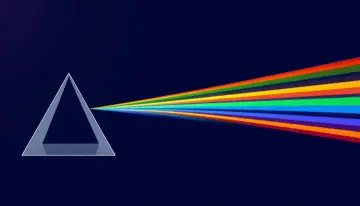
To our eyes, sunlight looks like nothing more than bright, colorless light. But in reality it's a mix of every color of light, from red to orange, yellow, green, blue, and all the way to violet. This fact is the key to solving every mystery we're about to talk about.

So why does blue alone stand out from that mixture of light? The answer lies in the tiny molecules that make up the air. Let's start unraveling the mystery of the sky's color from here.

Air molecules are much smaller than the wavelength of light. When light hits these tiny particles, a phenomenon called "Rayleigh scattering" occurs, and the light gets scattered in all directions.
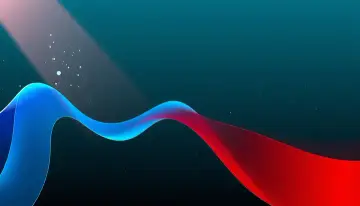
Rayleigh scattering has an interesting property. The strength of the scattering is inversely proportional to the fourth power of the light's wavelength, so the shorter the wavelength, like blue and violet light, the more overwhelmingly strongly it gets scattered.
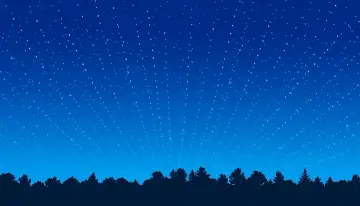
The scattered blue light reaches our eyes from every direction in the sky. It doesn't come from one specific point; blue pours down evenly from the entire sky. That's why, when you look up, the sky appears blue from edge to edge.

So far, we've answered "why is the sky blue?" But the truly puzzling part starts here. Violet should scatter even more strongly than blue, so why doesn't the sky look violet?
Three reasons overlap to explain this mystery. The first is that sunlight contains less violet to begin with than blue.
The second is that some of the violet light has already been absorbed in the upper atmosphere. By the time it reaches the ground, the amount of violet has dropped even further.

And the third lies in our own human eyes. The human eye is more sensitive to blue than to violet, so even when the same amount of light arrives, the brain perceives blue more strongly.
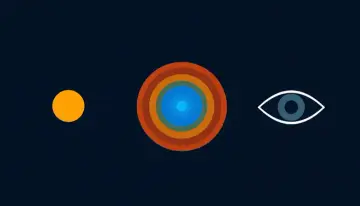
The amount of light, absorption in the atmosphere, and the eye's sensitivity. These three overlap so that the sky appears to us as blue rather than violet. No single reason can explain it; the blue of the sky rests on a delicate balance.

Now, so far we've been talking about the sky on a clear afternoon. But in the evening, the same sky shows a completely different face. Why do sunsets blaze such a vivid red? This is where the real subject of this video begins.

When the sun sinks close to the horizon, the distance its light travels through the atmosphere becomes much longer than at midday. Along that long journey, the blue light gets completely scattered away.
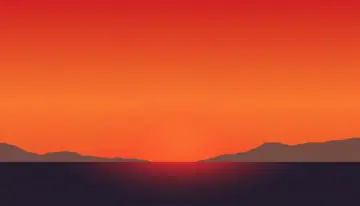
What's left is only the red and orange light, which has longer wavelengths and doesn't scatter easily. When this surviving light reaches our eyes, the sky looks deep red or orange.

Then why are the clouds floating in that sky white? It turns out that the whiteness of clouds comes from a completely different mechanism than the blue sky.

Clouds are made of water droplets that are much larger than air molecules. At this size, what happens isn't Rayleigh scattering but a different phenomenon called "Mie scattering."

In Mie scattering, wavelength makes almost no difference. Red, blue, and green all scatter in nearly the same way. With all those colors mixed together, the clouds look pure white to our eyes.
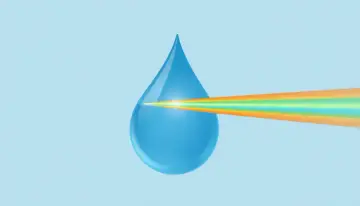
Rainbows that appear in the sky after rain actually follow a fixed rule, too. A rainbow forms when light refracts inside countless water droplets floating in the air, reflects once inside, and then refracts again on its way out.

When you stand with the sun at your back, the angle at which you see the rainbow is almost always the same. That's why a rainbow doesn't appear just anywhere in the sky; it only arcs at a set position on the side opposite the sun.
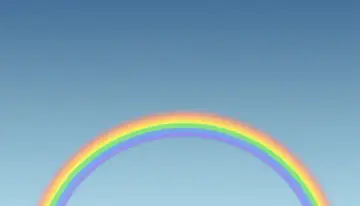
Look even more closely, and you may sometimes see another faint rainbow outside the primary one. This is called a secondary rainbow. It forms when light reflects twice inside the water droplets, so its order of colors is the reverse of the primary rainbow's.

I'd also like to touch on a common misconception here. People often say the sea is blue because it reflects the color of the sky, but that alone doesn't explain it.

In fact, water itself has the property of absorbing a small amount of red light. The thicker the layer of water, the more red gets absorbed and disappears, leaving only blue. That's why the deeper the sea, the darker the blue it appears.

Now, we've been talking about Earth's sky, but on Mars, even though it's bathed in the same sunlight, the exact opposite happens. Mars has a thin atmosphere, and fine dust containing iron is constantly drifting through it.

Because of this dust, the daytime sky on Mars looks not blue but a reddish ocher. It's the complete opposite of Earth's coloring.
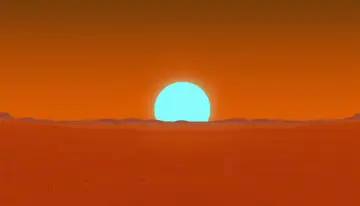
And yet, sunsets on Mars actually glow blue. The dust particles strongly forward-scatter blue light in the direction of the sun, so only the area around the setting sun is tinted a cool blue. This scene has actually been photographed by a NASA rover.
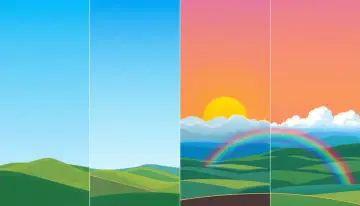
The blue daytime sky, red sunsets, white clouds, rainbows that appear in a set position. All of these branched out from just one principle: the wavelength of light and the size of particles.

And when we turn our eyes to Mars, we can see the same laws of physics creating a sky of a completely different color. The next time you look up at the sky, take a moment to remember the work of the tiny particles behind its blue.
Sources
- Why Is the Sky Blue?NASA Space Place
- Why the sky is blue and sunsets redMet Office (UK)
- Rainbows: optical wondersMet Office (UK)
- Sunset in Mars' Gale Crater (PIA19400)NASA/JPL-Caltech/MSSS/Texas A&M Univ. (NASA Photojournal)
- Mars: FactsNASA Science
Spotted a mistake in the article or the translation? Let us know.
Report an error (contact form in Japanese, opens in a new tab)