On this page
A closer look
"One orbit" and "one cycle of phases" are two different things
As the video explains, the Moon actually has two kinds of "month."
- Sidereal month: The time it takes the Moon to go once around Earth, measured against the distant stars. It's about 27.3 days (27.3217 days, according to NASA).
- Synodic month: The time for the phases to complete one full cycle, from new moon to the next new moon, or from full moon to the next full moon. According to the National Astronomical Observatory of Japan (NAOJ), it averages about 29.5 days, or more precisely 29.530589 days.
The Moon doesn't make its own light; it shines by reflecting sunlight. We see a full moon when the Moon is directly opposite the Sun as seen from Earth. In other words, the phases are determined not by "where the Moon is relative to the stars" but by "how the Moon and Sun are lined up." That's why one trip around Earth isn't enough to bring the next full moon.
Earth is moving too, so there's about 2 days of "catch-up"
Here's how NAOJ explains it. While the Moon is orbiting Earth, Earth is also moving along its orbit around the Sun. So the Moon has to orbit a little extra, covering the distance Earth has moved, before its alignment with the Sun is restored. That takes about 2 days.
Let's check it with numbers.
- Relative to the stars, the Moon moves about 13.2 degrees per day (360 degrees ÷ 27.32 days).
- Earth moves about 1 degree per day around the Sun (360 degrees ÷ 365.26 days). From Earth, this looks like the Sun drifting eastward through the constellations by about 1 degree a day.
- The difference, about 12.2 degrees, is how far the Moon pulls away from the Sun each day. For it to get 360 degrees away and return to the same alignment with the Sun takes 360 ÷ 12.2 ≈ 29.5 days.
It's like the minute and hour hands on a clock. The minute hand goes around in 60 minutes, but the hour hand moves forward a bit in that time, so it takes the minute hand about 65 minutes to catch up with the hour hand again. Think of the Moon as the minute hand and the Sun's apparent position as the hour hand.
This motion of "pulling about 12 degrees away from the Sun each day" is also why moonrise happens later each day, as covered in our article on the daytime Moon.
29.5 days is an "average"—the length changes a little each time
As the video said, "29.5 days on average," this is an average value. According to NAOJ, the actual cycle of phases varies within a range of about 29.3 to 29.8 days, and rather than jumping around suddenly, it slowly gets longer and shorter over the course of about a year.
The reason is that neither Earth nor the Moon travels in a perfect circle; both follow slightly squashed circular (elliptical) orbits.
- Earth moves faster when it's closer to the Sun and slower when it's farther away. When Earth is moving faster, it takes the Moon longer to catch up, so the cycle gets longer.
- The Moon also moves faster when it's closest to Earth (perigee) and slower when it's farthest (apogee). When a new moon happens near perigee, the cycle is shorter; near apogee, it's longer.
On top of that, the orientation of the Moon's elliptical orbit rotates over an 8.85-year cycle, so the way these two effects combine also changes from year to year. NAOJ explains that, on average, the cycle is longer around the winter solstice to the spring equinox, when Earth is closer to the Sun, than around the summer solstice to the autumn equinox—but depending on the orientation of the Moon's orbit, this can be reversed.
Why doesn't it match a calendar month?
At the end of the video, we said "it's also why it doesn't match up with a calendar month," but let's add a bit more detail.
According to NAOJ, the "month" as a unit originally came from the repeating cycle of the Moon's phases. In old calendars that set months by the phases (lunar calendars), a month was either 30 days (a long month) or 29 days (a short month). But 12 such months add up to about 354 days, roughly 11 days shorter than a solar year. So the calendar Japan used until the early Meiji era (the early 1870s), a lunisolar calendar, added a leap month whenever the gap built up, creating years with one extra month.
The Gregorian calendar we use today is designed to match the solar year (about 365 days). Months are 28 to 31 days long, and NAOJ explains that the length of each month was strongly influenced by ancient Rome and isn't necessarily logical. So rather than saying calendar months drift from the Moon's phases because 29.5 days is an awkward number, it's more accurate to say it's because today's calendar was built around the solar year in the first place, not the Moon.
Related reading
What the video says
From one full moon to the next actually takes 29.5 days on average. It's an awkward number that doesn't line up with a month or with any multiple of a week.
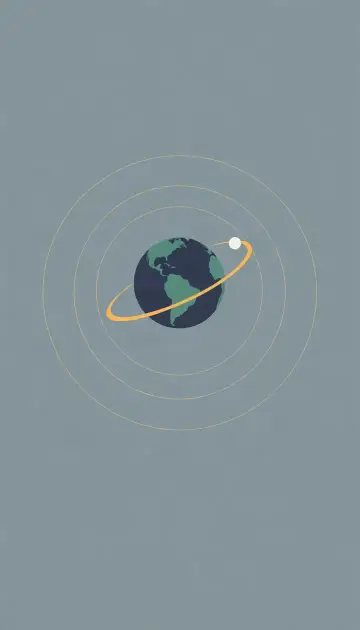
The reason is that two motions overlap while slipping out of step: the Moon orbiting Earth, and Earth orbiting the Sun.
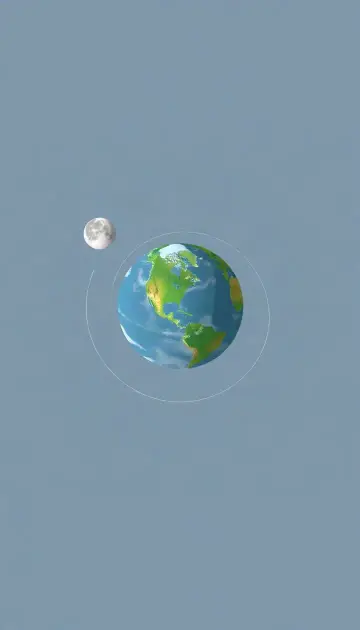
The Moon goes around Earth in about 27.3 days. But in that time, Earth also moves a bit farther along its path around the Sun, so it takes a little longer for the Sun and Moon to return to the same alignment.
That's why the time from full moon to full moon settles at 29.5 days, a number that looks so random. It's also why it doesn't match up with a calendar month.
Sources
- 暦Wiki/月の満ち欠けJapanese“Koyomi Wiki / Phases of the Moon”Ephemeris Computation Office, National Astronomical Observatory of Japan
- 暦Wiki/月の満ち欠け/周期Japanese“Koyomi Wiki / Phases of the Moon / Period”Ephemeris Computation Office, National Astronomical Observatory of Japan
- 暦Wiki/月の満ち欠け/周期の変動Japanese“Koyomi Wiki / Phases of the Moon / Variations in the Period”Ephemeris Computation Office, National Astronomical Observatory of Japan
- 暦Wiki/太陰太陽暦Japanese“Koyomi Wiki / Lunisolar Calendar”Ephemeris Computation Office, National Astronomical Observatory of Japan
- 暦Wiki/要素/1か月とは?Japanese“Koyomi Wiki / Elements / What Is a Month?”Ephemeris Computation Office, National Astronomical Observatory of Japan
- Moon PhasesNASA Science
- Moon Fact SheetNASA Goddard Space Flight Center (NSSDCA)
Spotted a mistake in the article or the translation? Let us know.
Report an error (contact form in Japanese, opens in a new tab)