On this page
A closer look
Ice is weaker when pulled than when pushed
We tend to think of ice as hard and tough. And it's true that ice can hold up fairly well against force pressing down on it.
But according to a 2023 explainer in the physics magazine Physics Today by Schulson, who leads the ice research laboratory at Dartmouth College (USA), pure ice starts to break at about 10 megapascals under a pushing force (compression), but at only about 1 megapascal under a pulling force (tension). In other words, its strength against pulling is only about a tenth of its strength against pushing.
Schulson also writes that, compared with other natural materials, ice is very poor at stopping cracks from spreading. Once a tiny crack forms somewhere, it tends to race through the whole piece. That's why puddle ice breaks apart with a sharp crack.
The video mentioned ice's crystal structure, but not everything made of crystals is brittle (metals are crystalline too). What directly makes ice break so easily is that it's weak under tension and doesn't stop cracks well.
Slow force makes it bend, fast force makes it break
Ice behaves differently depending on how force is applied.
Apply force slowly, and ice gradually changes shape instead of breaking. This is called ductility (the ability to deform without breaking). Apply force quickly, and it breaks before it has barely changed shape at all. This is called brittleness (the tendency to shatter).
According to Schulson, for pure, crack-free ice under compression, the switch from ductile to brittle happens at deformation rates of roughly 0.01–0.1% per second. Push faster than that, and ice breaks in a brittle way.
Under tension, though, that switch happens at a much slower rate: roughly one millionth to one hundred-thousandth of a percent per second. That's about as slow as stretching something by 1% over an entire day. The video said ice "doesn't bend and just snaps when force hits it quickly," but when it comes to pulling forces, it's more accurate to say ice breaks in a brittle way at almost any speed you'd encounter in everyday life.
The weight it can hold goes with thickness squared
The idea from the video that "the weight ice can hold is proportional to the square of its thickness" comes from actual research.
According to a 2015 report by Barrette of the National Research Council Canada (NRC), in the 1950s NRC scientist Lorne Gold studied how much weight ice of a given thickness could bear, for the sake of people traveling over ice. Gold gathered records from the paper industry of accidents where vehicles and horses broke through the ice (including the ice thickness and the weights involved), and from them used the formula "allowable load = coefficient × thickness squared." Barrette notes that this Gold formula (or a modified version of it) appears in most Canadian ice road guidelines.
By this formula, if ice is half as thick, it can hold a quarter of the weight. If it's a tenth as thick, it can hold a hundredth. So it's no surprise that thin puddle ice breaks under a single child's foot.
That said, this formula is a rule of thumb built from real accident records for ice floating on lakes and rivers. Barrette points out that if a heavy load sits on the ice for a long time, tiny invisible cracks can grow, and the load can break through even if it's lighter than the formula allows. For that reason, he notes, the formula applies only for short periods, often given as about two hours.
White ice is weaker than clear ice
How strong ice is depends not only on its thickness but also on what kind of ice it is.
According to Barrette, clear ice contains almost no air, while white ice is full of tiny bubbles. White ice is mechanically weaker than clear ice, and some guidelines treat white ice as only half as strong as clear ice.
So even if two sheets of ice look equally thick, one with lots of cloudy white areas may break more easily.
If you're thinking of stepping onto ice
Cracking puddle ice is one of winter's little joys, but ice on ponds and rivers is a different story.
The guidelines described in Barrette's report also say that ice strength can't be determined by a formula alone, and urge caution about things like cracks and sudden temperature changes. Because thickness matters as a square, even one slightly thin spot can sharply reduce how much weight the ice can hold. Even if it looks safe, stay off ice on ponds and rivers.
Related reading
What the video says
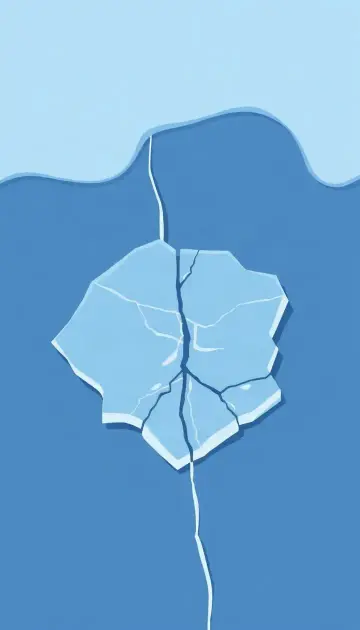
The ice that forms on winter puddles actually breaks far more easily than thick ice.

When water freezes, it builds an orderly structure called a crystal.

Ice is weak against pulling forces, and when force hits it quickly, it doesn't bend. It just snaps.
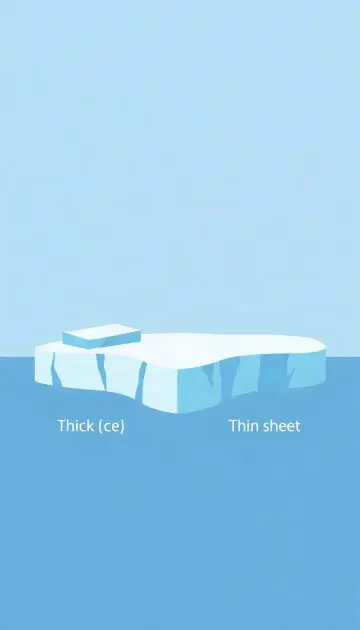
The weight ice can hold is said to be proportional to the square of its thickness, so if the ice is half as thick, it can only hold a quarter of the weight.
That's why thin puddle ice cracks all at once with just a light step.
Sources
- Ice fracturingErland M. Schulson (Dartmouth College), Physics Today 76(7), 2023
- A review of guidelines on ice roads in Canada: Determination of bearing capacityPaul D. Barrette (National Research Council Canada), Transportation Association of Canada, 2015
Spotted a mistake in the article or the translation? Let us know.
Report an error (contact form in Japanese, opens in a new tab)