On this page
- A closer look
- The only difference between a mirror and a "rough surface" is flatness
- Wind creates countless tilts in the surface
- Surface tension flattens the water
- The smallest waves disappear first
- "No wind" is a tough condition to meet
- What it takes for an "upside-down Mount Fuji"
- An oil film makes it even flatter
- Related reading
- What the video says
- Sources
A closer look
The only difference between a mirror and a "rough surface" is flatness
A mirror and a sheet of white paper both reflect light. The difference is whether the reflected light all heads in the same direction.
- Mirror: The surface is flat, so light comes back aligned in one direction (specular reflection)
- White paper: The surface is rough, so light scatters in every direction (diffuse reflection)
You only see an image with specular reflection. With diffuse reflection, the information about the light's direction is lost, so only brightness remains and no image forms.
Water works the same way. When it's flat, it acts like a mirror; when it's rippled, it acts like white paper.
Wind creates countless tilts in the surface
Once waves form, the water's surface is no longer a single flat plane. It becomes a crumpled surface made of countless tiny slopes.
Each slope sends light back in its own direction. Because those directions are all over the place, the light reaching your eyes comes from every which way, and the image falls apart.
Rippled water sparkles because, out of all those countless slopes, only the ones angled just right to bounce sunlight toward your eyes look bright. As the slopes move, the bright spots move too. That glitter is the waves themselves made visible.
Surface tension flattens the water
So why does the surface go flat once the wind stops?
Here's an explanation from Toyo University:
Water droplets hanging, water bulging above the rim of a cup, water striders floating on water — these phenomena are all due to "surface tension." Water has strong attractive forces between its molecules, so its surface tension is large, and it tends to ball up more easily.
Surface tension is the force by which a liquid tries to minimize its surface area.
For a small droplet, the shape with the smallest surface area is a sphere. That's why morning dew forms round beads.
But on a large surface like a pond, gravity has the stronger effect. Gravity tries to make the surface level, and surface tension tries to smooth out extra bumps. Both work in the same direction, so the water settles into a flat, level surface.
Waves are what happens when that balance is disturbed. Once the disturbing force (the wind) is gone, gravity and surface tension smooth the waves out and return the surface to flat.
The smallest waves disappear first
There's a pattern to the order in which waves fade.
Fine ripples (short-wavelength waves) are strongly affected by surface tension. Since they're bumps that add surface area, surface tension works hard to suppress them. That's why small ripples vanish quickly.
Large swells (long-wavelength waves) are driven mainly by gravity. They carry a lot of inertia, so they take longer to die out.
After the wind dies down, the ripples disappear first, then gentle swells linger, and eventually those fade too. That's the sequence that produces a mirror-like surface.
"No wind" is a tough condition to meet
The Japan Meteorological Agency's forecast terminology includes definitions for "wind," but a completely windless state is surprisingly rare.
So you can only see a mirror-like surface at times when conditions line up:
- Early morning: The wind has dropped overnight, and convection from sunlight hasn't started yet
- Just after sunset: The winds stirred up by the day's heat die down
- Lakes in the mountains: The surrounding peaks block the wind
- Clear winter mornings: Radiative cooling stabilizes the air and stops vertical mixing
When a temperature inversion forms and the air stops mixing up and down, wind has a hard time picking up. The same weather conditions that let sound carry far on autumn nights also create mirror-like water.
What it takes for an "upside-down Mount Fuji"
For a photo of a mountain reflected in a lake (in Japan, the classic shot is sakasa Fuji, an "upside-down Mount Fuji"), a flat surface alone isn't enough.
The water is clear. If it's murky, light scatters inside the water and mixes with the reflected light.
The bottom is dark. If the bottom is bright, light coming up from it overlaps the reflection and washes out the image. Deep lakes and ponds with dark bottoms reflect better.
The water is in shade, or the sky is bright. You get more contrast when the thing being reflected (the sky or mountains) is bright and the water below is dark.
That's why those morning lake photos are taken on clear, deep lakes during windless hours.
An oil film makes it even flatter
One bonus fact: when a film of oil spreads across water, waves have a harder time forming.
An oil film changes the surface tension and works to suppress fine ripples. There are records of sailors long ago pouring oil onto rough seas to try to calm the waves.
The same thing happens in parking lots after rain. A puddle with an oil film is oddly flat, and it also shimmers in rainbow colors. It's a tiny city water surface where you can see both flatness and thin-film interference at once.
Related reading
What the video says
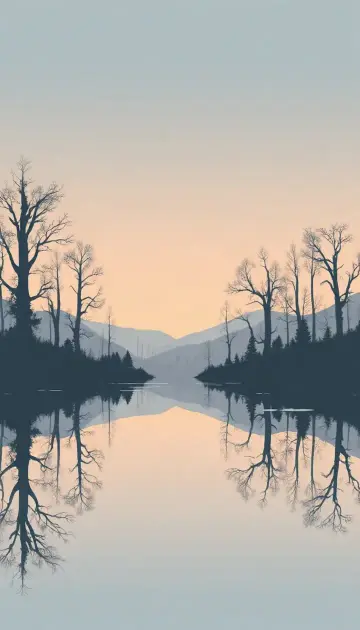
A pond on a windless morning. When there's hardly any breeze, the water reflects the scenery just like a mirror.

Water gets choppy because wind gently pushes the surface water, creating small bumps and dips.
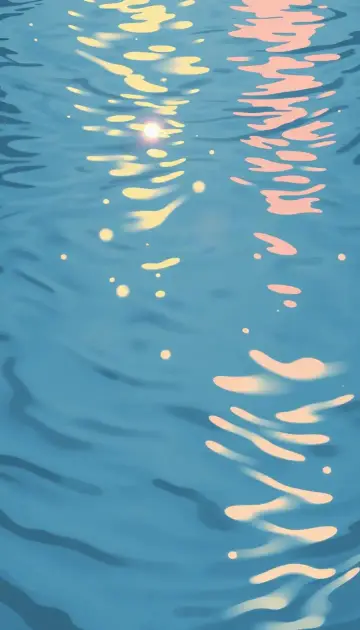
Those bumps scatter light all over the place, so the reflection looks blurry.

But when there's almost no wind, there isn't enough force to build waves, and the water's stickiness damps out even small wobbles, so the surface stays smooth.
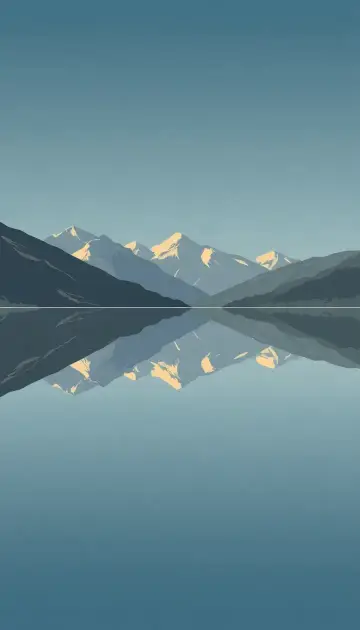
So with the bumps gone, light reflects straight back in one direction, and the water becomes a mirror that shows the sky and mountains crisply.
Sources
- 表面張力と濡れ性Japanese“Surface Tension and Wettability”Toyo University
- 風に関する用語(予報用語)Japanese“Terms Related to Wind (Forecast Terminology)”Japan Meteorological Agency
Spotted a mistake in the article or the translation? Let us know.
Report an error (contact form in Japanese, opens in a new tab)