On this page
- A closer look
- The "second yellow" is on the list of sending-off offenses
- That's why the referee has no room for discretion
- There's special handling for when to give the second yellow
- Two offenses close together still mean two yellows
- Historically, it's said to date from 1976, or from 1968
- What happens after a sending-off
- Further reading
- What the video says
- Sources
A closer look
The "second yellow" is on the list of sending-off offenses
Law 12 of the Laws of the Game lists the offenses that result in a sending-off.
A player, substitute or substituted player who commits any of the following offences is sent off:
And included in that list is this:
receiving a second caution in the same match
Receiving a second caution in the same match. That, in itself, is listed as a reason for a sending-off.
The other items on the list are serious offenses: violent conduct, serious foul play, spitting, denying an obvious goal-scoring opportunity with a deliberate handball, and so on. And right there among them, on equal footing, is "a second caution."
So it's not simple addition, where "two minor fouls add up to something serious." The very fact of receiving two cautions is defined as a sending-off offense in its own right.
That's why the referee has no room for discretion
This structure is what "automatic" means.
Whether to give the first caution is the referee's call. They look at how serious the foul was, the flow of the game, and whether it deserves a caution. The same goes for the second one: whether to give it is a judgment call.
But the moment the referee decides to give a second caution, the sending-off is settled. Under the Laws, there's no option like "It's a second yellow, but there's not much time left, so I'll skip the sending-off."
Law 5 sets out the referee's powers like this:
has the power to show yellow or red cards and, where competition rules permit, temporarily dismiss a player
The power to show cards belongs to the referee. But there's no power to show a second yellow and then not show the red.
There's special handling for when to give the second yellow
There's a practical detail here involving advantage (letting play continue after a foul so the fouled team can benefit).
Advantage should not be applied in situations involving serious foul play, violent conduct or a second cautionable offence unless there is a clear opportunity to score a goal.
For serious foul play, violent conduct, or an offense that would be a second caution, advantage should not be applied unless there is a clear opportunity to score a goal.
A foul that would be a second yellow is treated as too serious to let go. That said, it isn't an absolute exception either:
The referee must send off the player when the ball is next out of play, but if the player plays the ball or challenges/interferes with an opponent, the referee will stop play, send off the player and restart with an indirect free kick, unless the player committed a more serious offence.
Even if play was allowed to continue because of a clear goal-scoring opportunity, the player must be sent off the next time the ball goes out of play. And if that player touches the ball or gets involved with an opponent, the referee stops play right then and sends them off.
It's worded to leave no way out.
Two offenses close together still mean two yellows
There's one more provision that can change how you watch a match.
Where two separate cautionable offences are committed (even in close proximity), they should result in two cautions, for example if a player enters the field of play without the required permission and commits a reckless tackle or stops a promising attack with a foul/handball, etc.
If they're two separate cautionable offenses, it's two yellows, even if they happen close together in time.
The example given is a player who enters the field without permission and then makes a reckless tackle. It doesn't become "one yellow is enough since it was all one sequence"; two are shown, and the player is sent off.
Knocking someone down with a foul and then immediately protesting and getting a second yellow works the same way. The foul and the dissent are separate cautionable offenses, so it's two yellows.
Historically, it's said to date from 1976, or from 1968
When it comes to when cards themselves were introduced, sources differ.
Here's what the Britannica International Encyclopedia (as included on Kotobank, a Japanese online reference site) says:
It was devised in 1976 so that spectators could also understand cautions, and was later adopted by other sports as well.
Meanwhile, the Nipponica encyclopedia (Nihon Dai Hyakka Zensho) says it began at the 1970 World Cup in Mexico, and the Japan Football Association's Q&A says it was the 1968 Mexico City Olympics. We covered this discrepancy in our article on the origin of the cards.
That said, the "two cautions and you're off" system is reported consistently across all of these accounts. The Britannica entry also says:
A player who receives two cautions in the same match is sent off from that (match).
So the two-cards-and-out design was built in from the time the cards were introduced.
What happens after a sending-off
The Laws even cover what happens after a player is sent off.
A player, substitute or substituted player who has been sent off must leave the vicinity of the field of play and the technical area.
The player has to leave the area around the field and the technical area. They're not even allowed to sit on the bench.
And the team doesn't get its numbers back for that match. A substitute can't be brought on to replace a player who's been sent off. We cover this in another article.
Stacking up two yellows leads directly to the big disadvantage of playing a player short. That structure is why a yellow card is never something to take lightly.
Further reading
What the video says
In soccer, if a player gets two cautions, meaning two yellow cards, they're automatically sent off.
Under the rules, a red card itself isn't actually what's being given. Two yellows are treated as an "accumulation of cautions."
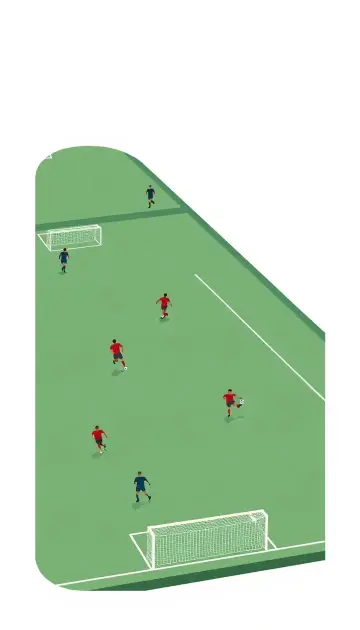
The system came about as a way to stop the same player from repeatedly committing rough play.
A single foul just gets play stopped and a warning, but repeat it and you're considered "not fit to continue."
That's why, even though it's the same yellow card, the second one means something completely different: it's the signal for a sending-off.
Sources
- Laws of the Game – Law 12, Fouls and MisconductThe IFAB
- Laws of the Game – Law 5, The RefereeThe IFAB
- イエローカード(デジタル大辞泉・ブリタニカ国際大百科事典)Japanese“Yellow card (Digital Daijisen / Britannica International Encyclopedia)”Kotobank
Spotted a mistake in the article or the translation? Let us know.
Report an error (contact form in Japanese, opens in a new tab)