On this page
A closer look
9.15 m is just "10 yards" in other words
Here's what the original text of the Laws of the Game says:
The defending team's players must remain at least 9.15 m (10 yds) from the ball
Take a look at what's in the parentheses: 10 yds, meaning 10 yards, is listed right alongside.
One yard is 0.9144 m, so 10 yards is 9.144 m. Round that to two decimal places and you get 9.15 m. The number 9.15 itself has no special meaning. It started out as 10 yards, a nice round number, just what you'd expect from a sport that originated in Britain.
Most of soccer's numbers work this way. The goal's 7.32 m width is 8 yards, its 2.44 m height is 8 feet, the 11 m penalty mark is 12 yards, and a 105 m pitch length is 115 yards. All of them are imperial measurements converted to meters.
The rules are still set by the International Football Association Board (IFAB), made up of the four British associations and FIFA. Here's how the Japan Football Association explains it:
IFAB was organized in 1886 by the four British associations—the Football Association (England), the Scottish Football Association, the Football Association of Wales, and the Irish Football Association—and was founded as an international body responsible for drafting and maintaining the Laws of the Game.
It also describes how decisions are made:
Currently, the four British associations each have one vote and the Fédération Internationale de Football Association (FIFA) has four votes, and a change to the Laws of the Game is approved when at least six votes—three-quarters or more of the eight total—are in favor.
The four British associations together hold as many votes as FIFA. You could say the fact that yard-based numbers are still around directly reflects how this organization came to be.
There's an exception: you can get closer on the goal line
The Law goes on:
at least 9.15 m (10 yds) from the ball, unless they are on their own goal line between the goalposts
Players standing on their own goal line, between the goalposts, are the exception. A goalkeeper or defender on the goal line can be within 9.15 m of the ball.
This is a practical consideration. If an indirect free kick is awarded right in front of the goal and everyone had to back up 9.15 m, they'd end up standing inside the goal.
Since 2019, there's a rule for attackers too
This Law has a relatively recent addition:
Where three or more defending team players form a 'wall', all attacking team players must remain at least 1 m (1 yd) from the 'wall' until the ball is in play.
When the defending team forms a wall of three or more players, attacking players must stay at least 1 m away from it.
There's a penalty for breaking this, too:
If, when a free kick is taken, an attacking team player is less than 1 m (1 yd) from a 'wall' formed by three or more defending team players, an indirect free kick is awarded.
An indirect free kick goes to the other side. In other words, the attacking team loses the kick.
Before this rule existed, attackers would slip into the wall to block the keeper's view, or move just before the kick to break the wall apart. Shoving matches broke out easily, and referees had a hard time managing it. The 1 m rule draws a line that physically cuts off that chaos.
Here again, you can see the yards listed alongside: "1 m (1 yd)."
What happens when defenders get too close
What happens all the time in real matches is defenders not respecting the 9.15 m. Here's how the Law handles it:
If, when a free kick is taken, an opponent is closer to the ball than the required distance, the kick is retaken unless the advantage can be applied; but if a player takes a free kick quickly and an opponent who is less than 9.15 m (10 yds) from the ball intercepts it, the referee allows play to continue.
As a rule, the kick is retaken. But if the kicking side still has an advantage, play goes on.
And deliberately stalling is punished:
However, an opponent who deliberately prevents a free kick being taken quickly must be cautioned for delaying the restart of play.
A player who intentionally prevents a quick restart must be cautioned. "Must be cautioned" is strong wording. This is the Law that makes standing in front of the ball to stop the kick a yellow card offense.
The wall isn't a "right" of the defending team
Here's a common misconception. Forming a wall isn't a right granted to defenders in the rules. The only thing the Law sets out is an obligation: stay 9.15 m away.
As long as they meet that obligation, how many players line up and where is up to them. So the wall is a tactic that grew up in the space the rules leave open. The player lying on the ground "under the wall" came about simply because it isn't prohibited.
By the way, referees sometimes mark the wall's position with a line of foam spray (vanishing spray). The Japan Football Association mentions it as part of a referee's equipment:
Depending on the competition, the referee may also use a spray (vanishing spray) to indicate positions at free kicks.
It's a tool for making the invisible 9.15 m distance visible. Considering the number goes back to 10 yards, that means more than a century of effort has gone into getting players to respect this distance.
Related reads
What the video says
When a free kick is awarded in soccer, the opposing players line up a short distance from the ball to form a wall, right?
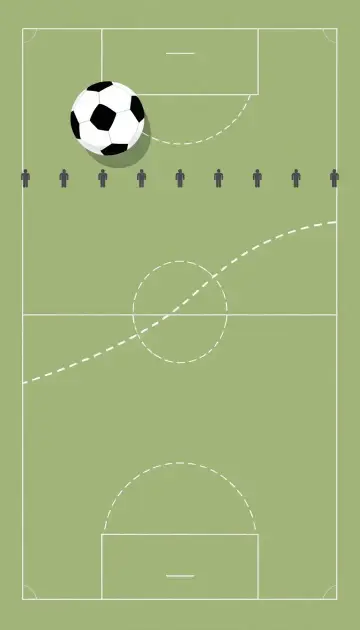
The distance the referee measures out is 9.15 meters. It looks like an oddly specific number, but there's actually a good reason for it.
This distance actually comes from a unit called the yard: 10 yards, to be exact. Convert that to meters and you get just about 9.15 meters.
The yards used when soccer's rules were born in Britain have simply stuck around as the international standard to this day.
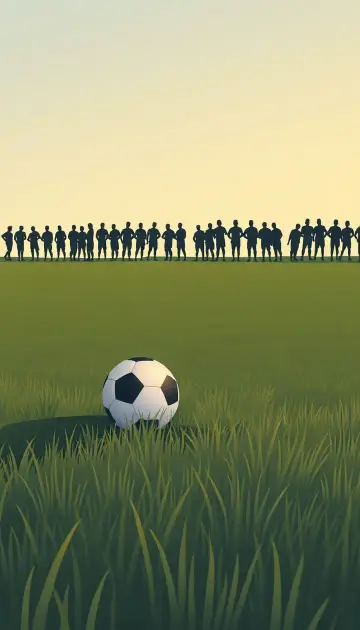
Once you know what the number means, the distance of a free kick wall starts to look a little different.
Sources
- Laws of the Game – Law 13, Free KicksThe IFAB
- サッカー競技規則 2026/27Japanese“Laws of the Game 2026/27”Japan Football Association
- サッカーのルールはどこで決めているの?(ドキュメント・FAQ)Japanese“Where are the rules of soccer decided? (Documents & FAQ)”Japan Football Association
Spotted a mistake in the article or the translation? Let us know.
Report an error (contact form in Japanese, opens in a new tab)