On this page
A closer look
What's actually wearing out inside the battery?
A smartphone battery (a lithium-ion battery) stores and releases energy by moving lithium ions from the positive electrode to the negative electrode when charging, and back to the positive electrode when in use. The video described it as "the path the particles travel gets a little more deformed," but research points to a somewhat different main cause.
The surface of the negative electrode is covered by a very thin film formed when the electrolyte (the liquid inside the battery) breaks down. It's called the SEI layer (solid electrolyte interphase), and it's essential: it keeps the electrolyte from breaking down any further. The catch is that as the battery goes through charge and discharge cycles, this film slowly gets thicker.
A 2025 study (Nature Communications) lists one of the degradation mechanisms as usable lithium being consumed as this film grows. The lithium that carries the charge gets locked into the film and can no longer move back and forth, so even when you charge to full, the battery holds less. The same study also lists other causes of degradation: when electrode particles crack and expose fresh surfaces, new film grows there and consumes more lithium, and the electrode material itself can become unusable.
Where the "pathway" analogy fits
The Osaka Research Institute of Industrial Science and Technology took apart commercial batteries that had been charged and discharged about 1,000 times, until their capacity had dropped to less than half of new, and found that the surface of the negative electrode looked very different from a new one. The institute explains that when the film gets too thick, it gets in the way of lithium ions moving around, and the battery's power (output) drops.
In other words, the "harder to get through" analogy does work as an explanation for lower output (for example, a phone being more likely to shut off during heavy tasks). But the main reason the battery holds less charge is better thought of as "less lithium available to move back and forth" rather than "harder to get through."
Heat, and leaving it fully charged
As the video says, heat and full charges speed up degradation. But the key point is less about "how many times you charge to 100%" and more about leaving the battery sitting near 100% for a long time.
In a German study (2016), three types of cylindrical batteries were stored at 16 different charge levels from 0% to 100%, at 25°C, 40°C, and 50°C (77°F, 104°F, and 122°F), for 9 to 10 months. At 50°C they lost far more capacity than at 25°C, and at high charge levels the film on the negative electrode grew more easily, so usable lithium was lost faster. Interestingly, degradation didn't rise smoothly in proportion to charge level. Instead it followed a "stair-step" pattern, where charge levels 20–30% apart could show about the same amount of wear. Batteries slowly degrade even when just sitting unused, which is another reason they wear out year after year.
Manufacturers' guidance points in the same direction as this research.
- Apple: Says the comfortable operating range is 16–22°C (62–72°F), and that leaving a device somewhere above 35°C (95°F) can permanently damage battery capacity. It also explains that "Optimized Battery Charging" is a feature that reduces the time spent fully charged to help prevent wear.
- Google (Pixel): Recommends charging in a cool place around 25°C (77°F) and not leaving the phone somewhere above 35°C (95°F) for long periods (6 hours or more).
As a rough guide to how long batteries last, Apple states that models up through iPhone 14 are designed to retain 80% of their original capacity after 500 full charge cycles, and iPhone 15 and later after 1,000. For Pixel, Google says 80% after about 800 or about 1,000 cycles, depending on the model.
If it swells, stop using it
Japan's Consumer Affairs Agency and other agencies warn that if a battery is hot, swollen, leaking, or giving off an unusual smell or sound, continuing to use it can lead to smoke, fire, or bursting. You should also watch for changes like slower charging, running hotter than before, or suddenly shutting off. If you notice anything out of the ordinary, stop using and charging the device right away and contact the manufacturer's repair service or a similar support channel. Trying to push a deformed device back into shape by hand is also dangerous. Keeping your phone out of cars parked in the blazing sun and away from heaters matters both for slowing battery wear and for preventing accidents.
Related reads
What the video says

Inside smartphones and rechargeable batteries is a system where tiny particles called lithium ions move back and forth.
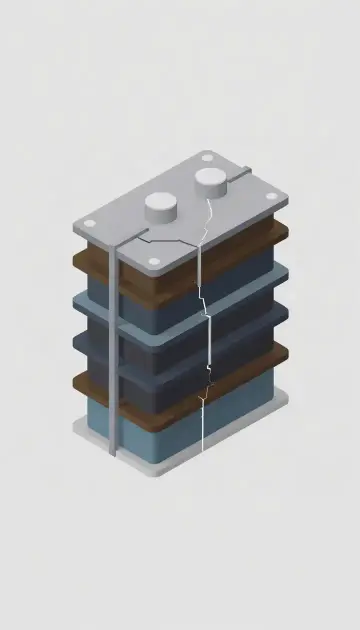
Each time you charge and discharge, the path those particles travel gets a little more deformed.
Then the particles can't pass through as smoothly, so even when it says "full," the battery holds less and less.
On top of that, high temperatures and repeatedly charging all the way to 100% are said to speed up this wear.
That's why, even with the same phone, battery life depends on how you use it.
Sources
- iPhoneのバッテリーとパフォーマンスJapanese“iPhone Battery and Performance”Apple Support
- バッテリー - パフォーマンスを最大化するJapanese“Batteries - Maximizing Performance”Apple
- iPhoneの充電上限とバッテリー充電の最適化についてJapanese“About iPhone charge limit and Optimized Battery Charging”Apple Support
- Google Pixel のバッテリーについてJapanese“About your Google Pixel battery”Google Pixel Help
- The importance of degradation mode analysis in parameterising lifetime prediction models of lithium-ion battery degradationLi R. et al., Nature Communications, 2025
- Calendar Aging of Lithium-Ion Batteries: I. Impact of the Graphite Anode on Capacity FadeKeil P. et al., Journal of The Electrochemical Society, 2016
- 大気非曝露表面分析について 〜リチウムイオン二次電池負極の測定事例〜(Technical Sheet No.24-01)Japanese“Air-Free Surface Analysis: A Measurement Example of a Lithium-Ion Secondary Battery Negative Electrode (Technical Sheet No.24-01)”Osaka Research Institute of Industrial Science and Technology
- リチウムイオン電池使用製品による発火事故に注意しましょうJapanese“Beware of Fires Caused by Products Using Lithium-Ion Batteries”Consumer Affairs Agency, Fire and Disaster Management Agency, Ministry of Economy, Trade and Industry, and Ministry of the Environment (Japan) (October 2, 2025)
Spotted a mistake in the article or the translation? Let us know.
Report an error (contact form in Japanese, opens in a new tab)