On this page
A closer look
Your breath is "air with a high dew point"
The reason your breath looks white can be explained by the dew point, as defined by the Japan Meteorological Agency.
Dew point: The temperature at which relative humidity reaches 100% when air is cooled while its water vapor pressure is held constant. The temperature at which water vapor in the air condenses to form dew.
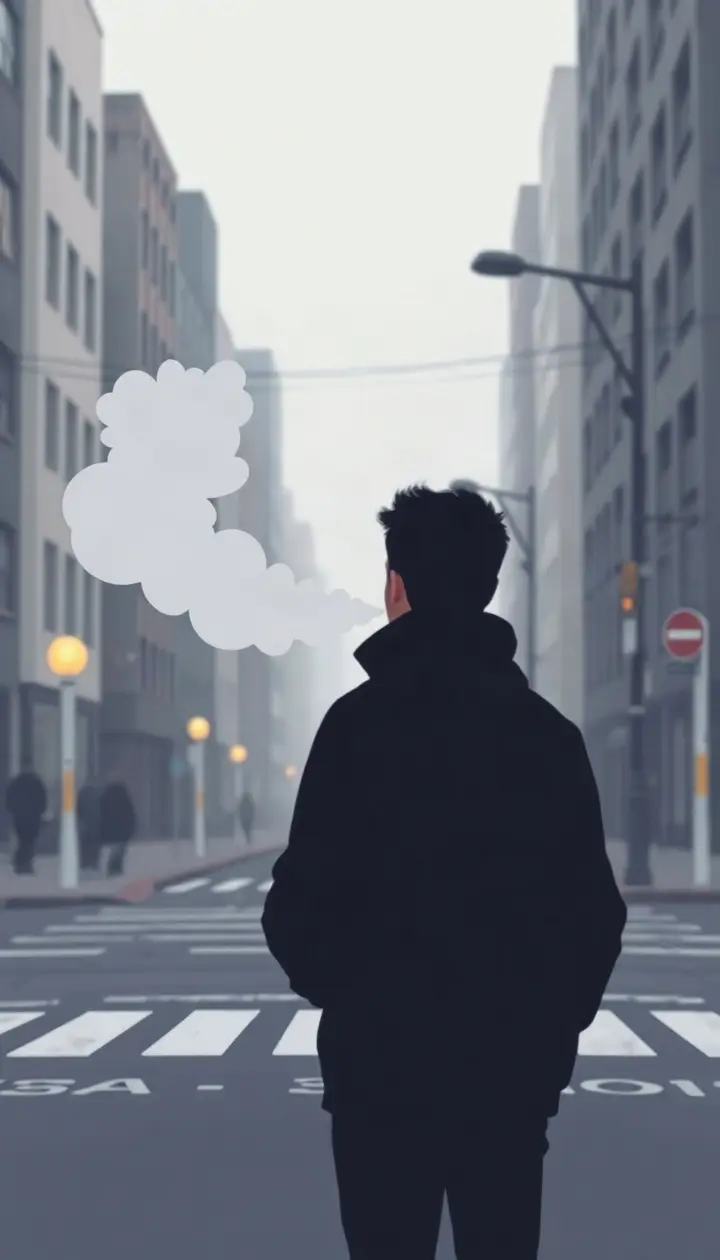
The air coming out of your lungs has been warmed to nearly body temperature and is almost saturated with water vapor. In other words, it has a very high dew point. When it mixes with the outside air and cools rapidly, the moment it drops below its dew point, the water vapor turns into water droplets. Those droplets scatter light, which is why you see white.
The "white stuff" is not water vapor. Water vapor is an invisible gas; what you're actually seeing is tiny particles of water that have turned back into liquid.
It's not just about temperature
The temperature at which your breath starts turning white isn't determined by air temperature alone. The dew point, meaning how much water vapor the outside air already holds, also plays a role.
- When the outside air is humid: Your breath only needs to cool a little to drop below its dew point → it can look white even when it's relatively warm
- When the outside air is dry: As your breath gets diluted, its dew point drops too → it's hard to see even when it's quite cold
That's why, even at the same temperature, there are days you can see your breath and days you can't. Your breath is especially likely to look white on winter mornings because low temperatures combine with radiative cooling, which tends to make the air near the ground more humid.
Yes, it really is the same as clouds
The video's closing line, that this is "exactly how the clouds floating in the sky are formed," checks out when compared with the Japan Meteorological Agency's explanation of cumulonimbus clouds.
According to the agency, cumulonimbus clouds develop when strong updrafts lift air upward, and "when the air near the ground is humid, the atmosphere becomes even more unstable." As air rises, the pressure drops and the air cools, and once it falls below its dew point, water droplets or ice particles form. That's a cloud.
Your breath is cooled by cold outside air; a cloud is cooled by rising. The cooling method is different, but what happens is the same: the air drops below its dew point and water droplets form.
Foggy windows and cold glasses are part of the same family
A single number, the dew point, explains a whole range of seasonal phenomena.
| Phenomenon | What dropped below its dew point |
|---|---|
| White breath | High-dew-point breath, cooled by outside air |
| Fogged-up windows | Indoor air, cooled by the cold glass surface |
| A wet glass | The surrounding air, cooled by the cold surface of the glass |
| Cloud formation | Rising air, cooled by falling air pressure |
Once you realize that the "white mist" around you and the clouds in the sky are the same phenomenon, winter mornings start to look a little different.
Related reading
What the video says

When you breathe out on a cold day, you see a white, misty cloud, right? What do you think that actually is?

It turns out that white stuff is made of tiny water droplets that form when water vapor gets cooled.

The inside of our bodies is full of warm, humid air. When we breathe it out, it hits the cold outside air and suddenly cools down.

The water vapor then turns into tiny water droplets all at once, and they reflect light, so they look white. In summer the air is warm, so this is much less likely to happen.

In fact, this is exactly how the clouds floating in the sky are formed. Next time you see your breath turn white, imagine you're making a tiny cloud.
Sources
- 予報用語(気温、湿度)Japanese“Forecast Terminology (Temperature, Humidity)”Japan Meteorological Agency
- 積乱雲ってどんな雲?Japanese“What Kind of Cloud Is a Cumulonimbus?”Japan Meteorological Agency
Spotted a mistake in the article or the translation? Let us know.
Report an error (contact form in Japanese, opens in a new tab)