On this page
A closer look
The Japan Meteorological Agency's definition: "from cooler to warmer"
Sea breezes and land breezes have official definitions in the Japan Meteorological Agency's glossary of forecast terms.
- Sea breeze: "A wind that blows during the daytime from the cooler sea surface toward the warmer land."
- Land breeze: "A wind that blows at night from the cooler land toward the warmer sea surface."
- Land and sea breezes: "Winds caused by the temperature difference between land and sea, blowing from sea to land during the day and from land to sea at night."
Lined up together, you can see the same principle repeating. The wind always blows from the cooler side to the warmer side. During the day, the sea is cooler and the land is warmer; at night, the land is cooler and the sea is warmer. The only thing that flips is which one is warmer. The mechanism is the same.
"Calm days" are part of the condition
The "calm, sunny day" in the video's title isn't just a scene-setter. The Japan Meteorological Agency's entry on land and sea breezes includes this note:
It becomes more distinct when the pressure gradient is small.
When the pressure gradient is large, broad-scale winds driven by low- and high-pressure systems sweep across the area. Land and sea breezes are local winds that occur over a range of a few dozen kilometers at most, so they get drowned out by those bigger winds.
Put the other way around, if the wind neatly reverses between day and night, that's evidence that "today's pressure pattern is calm." The wind direction can stand in for a weather map.
Why is the nighttime breeze weaker?
If you actually spend time at the beach, you'll notice the daytime sea breeze more clearly than the nighttime land breeze. This comes down to the size of the temperature difference.
During the day, sunlight heats the land quickly, so the gap with the sea grows large. At night, the land simply cools off by radiating heat, so the gap widens only gradually. A smaller difference means a weaker wind. That's why the sea breeze blows refreshingly while the land breeze tends to go unnoticed.
Related reads
What the video says
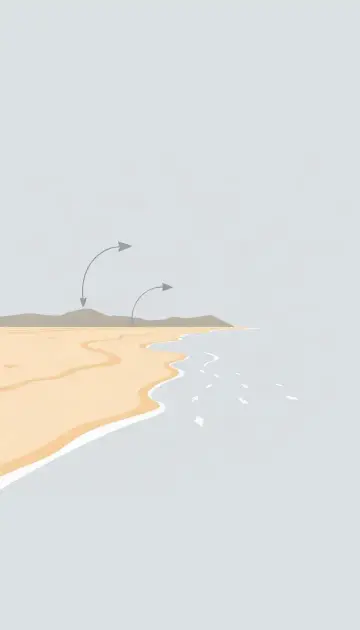
On a calm, sunny day at the beach, the wind blows in nearly opposite directions during the day and at night.

This happens because land and sea heat up at different rates.

During the day, the land heats up faster, so the air above it gets lighter and rises.

Cool air from the sea flows in to replace it, creating a sea breeze.

At night it's the opposite: the sea stays warmer, so the wind switches to blow from the land toward the sea.
Sources
- 予報用語(風)Japanese“Forecast Terms (Wind)”Japan Meteorological Agency
Spotted a mistake in the article or the translation? Let us know.
Report an error (contact form in Japanese, opens in a new tab)