On this page
A closer look
Pencil writing is just "sitting on top"
Pencil lead is made by mixing graphite with clay and firing it.
When you write on paper, the rough texture of the paper's fibers scrapes off bits of graphite, which get caught in the bumps and ridges and stay there. That's your writing.
There's no chemical bond. The graphite particles are only physically caught. So if there's a way to pull them off, the writing disappears.
Ballpoint pens and felt-tip markers are different. Their ink soaks into the paper fibers, then dries and sets. Once something has gotten inside the fibers, rubbing the surface won't remove it. That's why an eraser can't erase it.
An eraser "sticks and carries"
An eraser can pick up graphite because its material has a higher affinity for graphite than paper does.
Most erasers today are made of PVC (polyvinyl chloride) resin with added plasticizers (oils that make it soft). The plasticizer is what does the work. The soft, slightly tacky surface catches the graphite particles.
Graphite tends to blend well with oils. An eraser surface containing plasticizer attracts graphite more strongly than the paper fibers do.
This works much like how detergent removes dirt. Here's how the Japan Soap and Detergent Association explains it:
When the force of the washing machine is applied, these micelles surround the dirt on the fibers more effectively and pull it away.
In detergent, surfactants surround dirt and pull it away; in an eraser, the plasticizer-containing resin grabs the graphite and pulls it away. Both use the same strategy: "apply something that has a stronger affinity for the dirt than the place it's stuck to."
The discussion of wettability in Toyo University's explanation is based on the same idea:
Also, even with the same water, the shape of a droplet changes depending on what it's placed on, and it may either be repelled or spread out and wet the surface.
How things stick depends on what they're touching. Erasers take advantage of this property.
And then the eraser wears itself away
This is the heart of how an eraser works. Just sticking to the graphite isn't enough.
If the eraser didn't wear down, its surface would get coated with graphite and couldn't pick up any more. You'd be rubbing the paper with a dirty, graphite-covered surface, and you'd actually make the paper dirtier.
That's why erasers are deliberately designed to wear away.
As you rub, the surface layer that has absorbed graphite separates from the body of the eraser and rolls up into crumbs. A fresh, clean surface appears and picks up more graphite.
Eraser crumbs aren't a sign of failure; they're the mechanism itself. An eraser that doesn't produce crumbs can't carry the graphite away.
This role corresponds to detergent's "anti-redeposition" function:
They also surround the dirt that has come off in the water, preventing "redeposition," where dirt reattaches to the fibers.
Detergent suspends dirt in water and washes it away. An eraser traps graphite in its crumbs and drops it off. Both have a way of making sure "what's been removed doesn't go back."
Hardness and how well it erases
How soft an eraser is depends on the amount of plasticizer.
- Soft erasers: Pick up graphite well, but wear down easily and get used up fast. They erase dark writing well
- Hard erasers: Wear down slowly and last long, but have less erasing power. Good for erasing small, detailed areas
Drafting erasers are on the harder side so you can erase just the exact spot you're aiming for. Erasers for elementary school kids are soft so they can reliably erase dark pencil writing.
Sand erasers use a completely different method
"Sand erasers," used to erase ballpoint pen, work on a different principle.
Sand erasers contain abrasives and scrape away the surface of the paper itself. They physically grind off and remove the layer of fibers the ink has soaked into.
That's why the paper gets thinner and fuzzy. It's less erasing and more scraping away the paper.
Meanwhile, the ink in the "erasable ballpoint pens" commonly used today uses special dyes (leuco dyes) whose color disappears with heat. Friction heat just makes the color vanish; the ink itself is still on the paper. That's why the color can sometimes come back at low temperatures.
Plastic erasers are relatively new
By the way, even though they're called "rubber erasers," the mainstream ones today contain no rubber.
Originally, erasers were made of natural rubber mixed with abrasives. PVC resin erasers became widespread in the latter half of the 20th century.
They erase better than rubber, and their crumbs clump together more easily. Only the name stayed; what's inside was replaced.
Related reading
What the video says

When we use an eraser, we watch the black lines on the paper disappear. But what's really happening is that the eraser is just removing graphite from the paper.
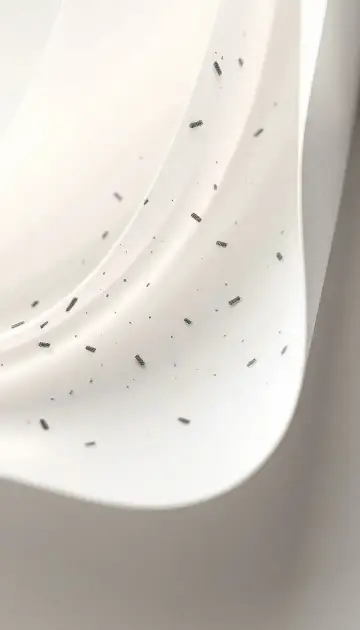
Pencil lead is made of a soft mineral called graphite, and it's only lightly caught on the fibers of the paper.

The eraser's material is stickier to those graphite grains than the paper is. So when you rub, the graphite comes off the paper and sticks to the eraser instead.
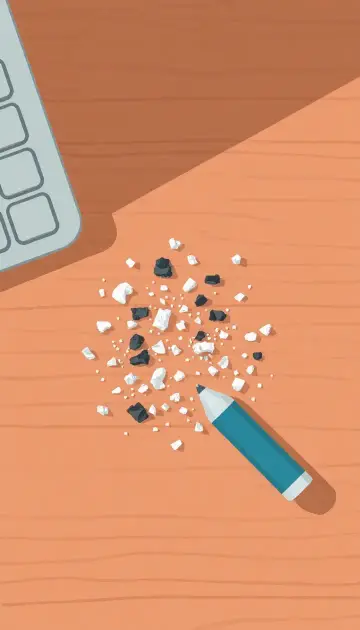
And when the worn-off rubber comes away as crumbs, the graphite it picked up comes out along with it. That's why eraser crumbs look dark.
An eraser isn't erasing your writing. It's peeling the graphite off the paper and trapping it in its own crumbs. Even the tools on your desk hide little bits of science like this.
Sources
- 表面張力と濡れ性(親和性と接触について)Japanese“Surface Tension and Wettability (on Affinity and Contact)”Toyo University
- 小ワザ裏ワザ(汚れを引きはがす仕組みについて)Japanese“Handy Tips and Tricks (on How Dirt Is Pulled Away)”Japan Soap and Detergent Association
Spotted a mistake in the article or the translation? Let us know.
Report an error (contact form in Japanese, opens in a new tab)