On this page
A closer look
Bubbles aren't just "films of water"
Pure water doesn't foam. Even if you stir it, any bubbles that form vanish in an instant.
The reason is surface tension. Water molecules pull strongly on one another and try to keep the surface area as small as possible. A thin film has a large surface area, so water alone can't sustain one.
For bubbles to form, you need a substance that lowers surface tension. That's what a surfactant is.
Molecules line both sides of the film
The film of a soap bubble or soapy lather is structured like this:
Air | surfactant layer | water layer | surfactant layer | air
Surfactant molecules line up with their hydrophilic (water-loving) end facing the water and their lipophilic (oil-loving) end facing the air. This creates walls of neatly aligned molecules on both sides of the water film.
These walls do two jobs:
- Lower surface tension: they weaken the force that makes the film want to shrink
- Slow evaporation: the molecular layer acts as a lid
That's why bubbles last longer than they would with water alone.
When the concentration drops, the walls can't form
This is why lather vanishes "the instant you rinse."
Recall the explanation from the Japan Soap and Detergent Association:
Detergents achieve their high cleaning power when the molecules of their main ingredient, surfactants, disperse in water and form clusters called "micelles."
For surfactants to form micelles, a certain concentration is needed. This threshold is called the "critical micelle concentration."
The same applies to bubbles. If there aren't enough molecules to fully cover both sides of the film, the walls can't form.
When you pour shower water over the lather, the surfactant concentration in the foam drops all at once. Films short on molecules can no longer withstand surface tension, so they shrink and pop.
On top of that, lather is a structure of countless connected films, so when one breaks, its neighbors collapse too. That's why it looks like it all "vanishes at once."
When there's dirt, lather won't form
Here's a phenomenon that matches everyday experience: when you first start washing your hair it doesn't lather much, but the second time it lathers up nicely.
The first time, the surfactant molecules are being used up latching onto sebum and dirt. They're consumed forming micelles around the dirt, so there are none left over for bubble films.
The second time there's less dirt, so the extra molecules turn into lather.
In other words, lather is also a "sign that the dirt has come off." If it won't lather, it's not that there's too little detergent; it means there's a lot of dirt.
A caution from the same explanation can be read in this light:
However, when the machine is overloaded, the amount of dirt also increases, so there aren't enough surfactant molecules.
The lather itself isn't doing the work
This point is easy to misunderstand: lather is not the cleaning power itself.
What removes dirt is the micelles surrounding it plus mechanical action. Lather is a byproduct of there being enough surfactant.
So a low-sudsing detergent doesn't necessarily clean poorly. Detergents for front-loading (drum) washing machines are deliberately formulated to suppress suds, because too much foam keeps the mechanical action from being transmitted through the water.
That said, lather does have secondary roles. It helps detergent spread more easily, and it also helps wrap up dirt and carry it away.
Bubbles change color right before they pop
One last bonus: a bubble film changes color just before it bursts.
The rainbow colors of soap bubbles come from interference between light reflected off the front and back of the film. Here's Toho University's explanation:
These A2 and B1 light waves interfere with each other, producing effects where they reinforce or cancel each other out.
As the film gets thinner, the colors reinforced by interference change. That's why a bubble shifts color as it thins out.
And when it gets as thin as it can, the reflections from the front and back nearly cancel each other out, so that part loses its color and looks blackish. Right after that, it pops.
If you look closely at shampoo lather, the same thing is happening in the brief moment before you rinse. Shifting colors are a sign the film is getting thinner.
Further reading
What the video says
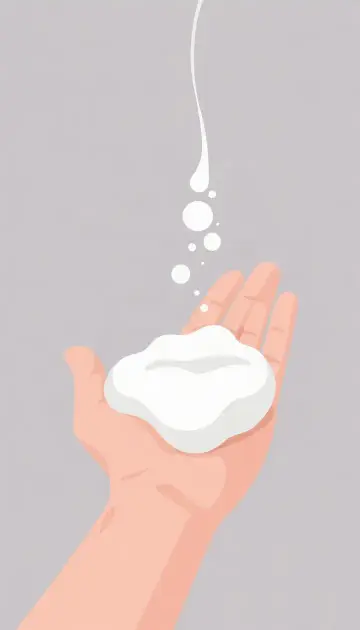
When you wash your hair with shampoo, you get a big, fluffy lather, right?

But once you hit it with water from the shower, all that lather disappears in an instant.

The reason is that the concentration of the "surfactant" holding up the bubble films gets diluted by the water.

Bubbles form when molecules that act as go-betweens for water and oil make thin films. When they're diluted with water, those films can't hold together, and they break.

So when you rinse, don't worry: even though the lather disappears, the dirt is actually being washed away right along with it.
Sources
- 小ワザ裏ワザ(洗たくの基本)Japanese“Tips and Tricks (Laundry Basics)”Japan Soap and Detergent Association
- 魚の体色変化の不思議を探る(3.薄膜干渉)Japanese“Exploring the Mysteries of Color Change in Fish (3. Thin-Film Interference)”Toho University Virtual Laboratory
Spotted a mistake in the article or the translation? Let us know.
Report an error (contact form in Japanese, opens in a new tab)