On this page
A closer look
The white and the yolk set at different temperatures
Eggs set when heat changes the shape of their proteins (a process called denaturation). The white and the yolk contain different kinds of protein, so they set at different temperatures.
According to a research summary from Kagoshima University, yolk sets at 65–70°C (149–158°F), while the white needs to be heated to 75–80°C (167–176°F) to set. The figures in the video—"the white starts to set at around 60°C and fully sets near 80°C" and "the yolk starts to set at around 65°C and is firmly set by 70°C"—fall roughly within this range.
Egg white is a mix of several proteins. One of them, ovotransferrin, is sensitive to heat and forms a soft, whitish gel at around 65°C (149°F). Meanwhile, ovalbumin, which makes up more than half of the protein in egg white, is heat-resistant and won't set until it gets much hotter. That's why egg white "turns a little cloudy but never quite sets."
What "the yolk sets first" really means
If you look closely at the numbers in the video, it's actually the white (at about 60°C) that starts to set first. The reason the yolk sets "first" in an onsen egg is that the yolk fully sets at a lower temperature.
If you leave an egg in water at about 65–68°C (149–154°F), the whole egg eventually reaches that temperature. That's hot enough for the yolk to set, but not hot enough for the heat-resistant proteins in the white. So the yolk turns thick and set, while the white stays soft and half-cooked.
"30 minutes" is how long it takes to heat the center
In a study published in the Journal of Cookery Science of Japan, researchers placed eggs in water at 65°C, 68°C, and 70°C and examined the internal temperature and how the eggs set.
- It took 30 minutes at 65°C, 28 minutes at 68°C, and 27 minutes at 70°C for the center of the egg to get close to the water temperature.
- At 65°C, the white was still runny even after 210 minutes (3.5 hours).
- At 70°C, the white stopped being runny after 30 minutes.
The video's "about 30 minutes in water at 65 to 70°C" makes sense as the time needed to heat the egg all the way to the center. But at 70°C, the white also stops being runny after about 30 minutes, so if you want to keep the white silky and runny, aim for about 65–68°C (149–154°F). The result also depends on the size of the egg, its starting temperature, and the amount of water.
Regular boiled eggs set "from the outside in"
As the end of the video explains, when you cook an egg in boiling water, heat travels in from the outside, so the white on the outside gets hot first and sets. Take the egg out before the heat reaches the yolk and you get a soft-boiled egg; boil it longer and you get a hard-boiled egg.
You could say the difference between an onsen egg and a boiled egg comes down to "the water temperature" and "whether you wait until the temperature inside the egg evens out."
What to know about food safety
On rare occasions, an egg's shell or contents may carry Salmonella, a bacterium that causes food poisoning. According to materials from the Food Safety Commission of Japan, most Salmonella bacteria are killed by heating at 60°C (140°F) for 15 minutes, but heat resistance varies depending on the strain and the food.
When restaurants and other businesses cook with eggs, they are required to heat them at 70°C (158°F) for at least 1 minute (or use a method with an equivalent effect), except when using eggs meant for raw consumption that are within their best-before date. Onsen eggs are cooked at a lower temperature than this guideline.
When making onsen eggs at home, keep the following in mind:
- Use uncracked eggs within their best-before date: In Japan, the best-before date on eggs sold for raw consumption is the date until which they can be eaten raw. Eggs past this date are labeled to be eaten only after thorough cooking.
- Refrigerate eggs as soon as you buy them: The recommended storage temperature is 10°C (50°F) or below.
- Eat them soon after making them: A notice from Japan's Ministry of Health, Labour and Welfare advises that egg dishes that aren't fully cooked should be eaten within 2 hours of starting to cook.
- Take care with vulnerable people: The Ministry of Health, Labour and Welfare notice asks that raw eggs be avoided for older adults, infants aged 2 and under, pregnant people, and people with weakened immune systems, and that they be served thoroughly cooked egg dishes whenever possible. The guideline for thorough cooking is "until both the yolk and white are firm," and onsen eggs don't meet this.
Related reads
What the video says

With an onsen egg, the yolk sets first, which is the opposite of a soft-boiled egg.

It turns out the white and the yolk start to set at different temperatures.

The white starts to set at around 60 degrees Celsius, but it needs nearly 80 degrees to set completely. The yolk, on the other hand, starts to set at around 65 degrees and is firmly set by 70.

So if you leave an egg in water at about 65 to 70 degrees for around 30 minutes, only the yolk becomes thick and set, while the white never fully firms up and stays runny.
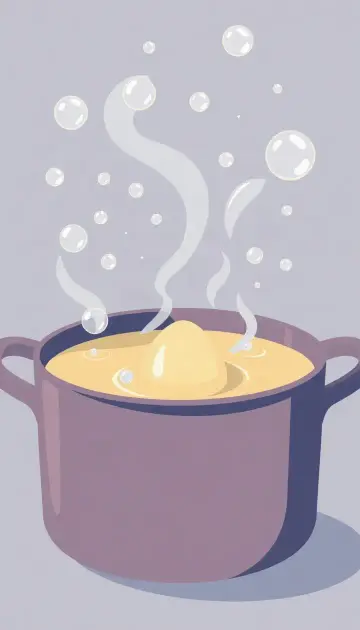
When you cook an egg in boiling water, the heat reaches the outer white first, so in both soft-boiled and hard-boiled eggs, the white sets before the yolk.
Sources
- 温泉卵の凝固状態への加熱温度と保持時間の影響 ―好みの温泉卵を作るには―Japanese“Effects of Heating Temperature and Holding Time on the Coagulation State of Onsen Eggs: How to Make Your Preferred Onsen Egg”Naoko Tatsuguchi and Masayo Dai, Journal of Cookery Science of Japan, 2019
- 70℃長時間加熱により形成された卵白ゲルの特性についてJapanese“Properties of Egg White Gel Formed by Prolonged Heating at 70°C”Mariko Tajima et al., Bulletin of the Faculty of Education, Kagoshima University: Natural Science, 2022
- 食品健康影響評価のためのリスクプロファイル ~鶏卵中のサルモネラ・エンテリティディス~(改訂版)Japanese“Risk Profile for Food Health Impact Assessment: Salmonella Enteritidis in Chicken Eggs (Revised Edition)”Food Safety Commission of Japan, 2010
- 卵の衛生的な取扱いについて(厚生労働省通知「家庭における卵の衛生的な取扱いについて」を紹介)Japanese“On the Hygienic Handling of Eggs (Introducing the Ministry of Health, Labour and Welfare Notice "On the Hygienic Handling of Eggs at Home")”Pharmaceutical Affairs and Sanitation Division, Shimane Prefecture
Spotted a mistake in the article or the translation? Let us know.
Report an error (contact form in Japanese, opens in a new tab)