On this page
A closer look
It starts at just 40°C
A Q&A from the Japan Dairy Industry Association sums up the mechanism in one sentence:
It's because when milk is heated, water at the surface evaporates, and the fat and protein in the milk concentrate and coagulate.
The key is evaporation. As milk heats up, water escapes from the surface. That raises the concentration of fat and protein in the surface layer only. The concentrated layer then sets with the heat and becomes a skin.
It starts sooner than you might think.
When milk is warmed to 40°C or higher, a thin skin forms on the surface. At first this skin is too thin to see with the naked eye, but it gradually thickens in proportion to the heating time and temperature.
40°C (104°F). You don't even need to bring it to a boil. Even just "warming it up a little" in the microwave already creates an invisible skin.
It even has a name.
This is called the Ramsden phenomenon. Yuba, made from soy milk, is the same phenomenon.
Once you hear it's the same as yuba, it makes sense. Yuba is the skin that forms on the surface of soy milk, gently lifted off. What forms on milk in a pot is, in a sense, "milk yuba."
Surprisingly, the skin is mostly fat
People tend to assume the skin is just set protein, but the actual composition is different.
The first skin to form contains more than 70% fat, while protein makes up 20–25%, mainly lactalbumin. Later skins contain less fat and more protein.
The first skin is more than 70% fat. Protein is only about 20%, mostly lactalbumin.
And the composition changes over time. Skins that form later have less fat and a higher share of protein. The fact that the first and second skins have different contents is a fun little detail.
J-milk's explanation describes the order of events like this:
It forms because protein sets when heated. When you heat milk, water evaporates and the protein at the surface condenses, and at that point the surrounding fat sticks along with it to form a skin.
Protein is the main thing that sets, and fat gets caught up in it to form the skin. That's why the first skin contains so much fat.
Remove it and it comes back, but only a few times
This is the part that makes you want to experiment.
So if you remove the skin, a new one forms, but if you repeat this several times, it stops forming.
Take off a skin, and another one forms. But not forever. The fat and protein that make up the skin are limited, so after a few rounds, no more can form.
Milk with all its skins removed has lost that much fat and protein. So throwing away the skin means throwing away nutrients.
It's part of milk's nutrients, so it's fine to eat it, but
How to heat milk without a skin
Both explanations say the same thing about prevention. The Japan Dairy Industry Association:
If it bothers you, stirring well while heating makes a skin less likely to form.
J-milk:
Stir well while heating, or warm it in the microwave without letting it boil.
Stirring keeps just the surface from getting concentrated. No concentration, no skin.
Microwaves are prone to making skins because you can't stir while heating. On top of that, microwaves heat liquid from the inside, so the area near the surface can easily get locally hot. To prevent it, taking the cup out partway through and giving it a stir works well.
The skin has its uses
J-milk's explanation doesn't treat the skin as a villain.
When you simmer potatoes or pumpkin in milk, the skin also acts as a drop lid. It's packed with nutrients, so there are even dairy products made from this set skin.
The skin acting as a drop lid (otoshibuta, a small lid placed directly on simmering food in Japanese cooking) is a practical point. With a lid on the surface, evaporation underneath is reduced.
Then there's the part about "dairy products made from this set skin." Malai, used in Indian and Pakistani cooking, is exactly that: the skin that gathers on the surface of heated milk, collected. The skin many people dislike is a standalone ingredient in another culture.
Related reads
What the video says

When you leave hot milk in a mug for a bit, a thin skin forms on the surface, right?
That skin is actually made of the protein and fat in the milk.

When milk is heated, water evaporates from the surface, and only the protein and fat get concentrated into a thin layer.
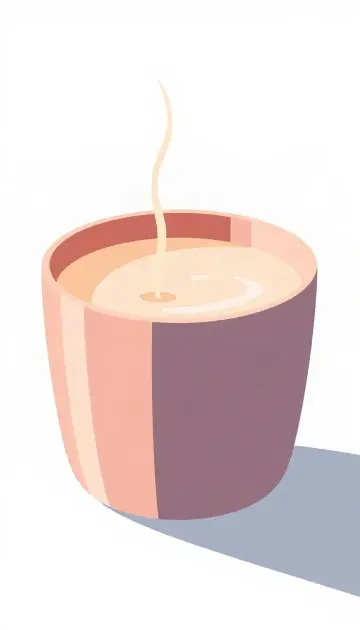
As it cools further, that layer sets into that jiggly skin.

The higher the heating temperature, the thicker the skin, so heating gently and slowly keeps it thin.
Sources
- 牛乳を温めると表面に薄い膜ができるのはなぜですか?(乳と乳製品のQ&A)Japanese“Why does a thin skin form on the surface when milk is heated? (Milk and Dairy Products Q&A)”Japan Dairy Industry Association
- ホットミルクの不思議Japanese“The Mysteries of Hot Milk”J-milk
Spotted a mistake in the article or the translation? Let us know.
Report an error (contact form in Japanese, opens in a new tab)