On this page
A closer look
What the Laws actually say
The rules of soccer are set out in the "Laws of the Game," which are decided by the IFAB (International Football Association Board). For captains, Law 3 (The Players) has a section called "Team captain," which says the following:
- Each team must have a captain on the field of play, wearing an armband so they can be identified.
- The captain has no special status or privileges but has a degree of responsibility for the behavior of the team.
This text was added to Law 3 in the 2025/26 revision. In addition, Law 4 (The Players' Equipment) says the captain must wear an armband provided or approved by the competition organizer, or a single-colored armband (which may include the word "captain" or the letter "C"). In other words, the armband's color and design are governed both by the Laws and by each competition's own rules.
It's "only one" because there's only one captain
As for the title's question, "Why can only one player wear it?", the Laws don't actually contain a sentence directly saying "other players must not wear an armband." What the Laws establish is that "each team must have a captain on the field, and that person wears the armband."
The Q&A on the Laws explains the reason as "so the referee can quickly identify the captain." That's why, when the captain is substituted off, another player remaining on the field must put on the armband. The video's line that "the armband gets passed on to the next player" is accurate.
The Q&A also says the captain can be changed at any time during the match, without needing to inform the referee. All that's required is that the new captain wears the armband.
"The only point of contact with the referee" is an overstatement
The video described the player with the armband as "the only point of contact who can talk to the referee," but strictly speaking, that's not quite right.
As we saw above, the Laws state that the captain has no special privileges. The Q&A on the Laws also says that if a captain complains about a decision, they can be shown a yellow card just like any other player.
The system where "only the captain may approach the referee" comes from the IFAB's "Only the captain" guidelines. The main points are:
- Normal interaction between players and referees is still allowed, as before.
- After a major decision, for example, only one player per team may approach the referee, and that's normally the captain.
- If the captain is the goalkeeper, the team must designate another player to go to the referee in their place by the pre-match coin toss.
- If other players surround the referee, they may be shown a yellow card.
Currently, each competition can choose whether to adopt these guidelines, and they're scheduled to become mandatory in all competitions starting on or after July 1, 2027. The IFAB also writes in its Notes on the Laws that captains should play an important role in making sure the Laws and the referee's decisions are respected.
The armband's origins are unclear
The video said the armband originated "in early-20th-century amateur leagues in Britain, after confusion arose when referees didn't know who to talk to." However, we couldn't find any records to back up this story. Please treat it as a commonly told theory.
As one reference point, FC Barcelona says the captain's armband was first used in the Spanish league in the 1974/75 season, when the captain at the time wore a white armband that stood out easily against the team's jersey colors. It's possible that the armband became standard at different times in different countries and leagues.
Also, in youth and grassroots soccer, national associations are allowed to modify the rules on wearing the armband.
Related reading
What the video says

In a soccer match, only one player on each team wears a band around their arm. And it's not just for decoration.
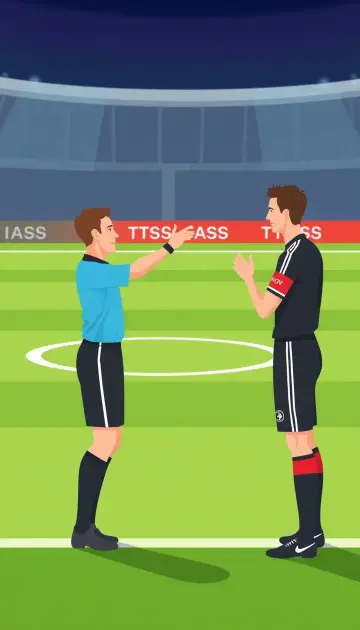
This armband is actually written into the rulebook as the marker for the player whose role is to communicate with the referee.

It's said to have started in the early 20th century in amateur leagues in Britain, after confusion broke out when referees didn't know who to talk to when players were unhappy with a call.

So the player with the armband is the only point of contact who can talk to the referee. If they're substituted during the match, the armband gets passed on to the next player.

That single armband carries the weighty meaning of representing the whole team's voice.
Sources
- Law 3 - The PlayersThe International Football Association Board (IFAB)
- Law 4 - The Players' EquipmentThe International Football Association Board (IFAB)
- 'Only the captain' guidelinesThe International Football Association Board (IFAB)
- Law changes 2025/26The International Football Association Board (IFAB)
- General ModificationsThe International Football Association Board (IFAB)
- Notes on the LawsThe International Football Association Board (IFAB)
- Law 12 - Fouls and MisconductThe International Football Association Board (IFAB)
- 50 years since Cruyff wore the 'senyera' armbandFC Barcelona
Spotted a mistake in the article or the translation? Let us know.
Report an error (contact form in Japanese, opens in a new tab)