On this page
A closer look
Light bends and bounces inside raindrops
For a rainbow to form, the sun has to be behind you and rain has to be falling in front of you. The UK Met Office and the U.S. National Weather Service both list this as the first condition.
When sunlight enters a raindrop, it bends as it goes in (refraction), bounces once off the back of the drop (reflection), and bends again on the way out before reaching your eyes. According to an explanation from the Fukuoka Regional Headquarters of the Japan Meteorological Agency, the outgoing light is concentrated at a specific angle measured from the direction it came from. Because each color of light bends by a slightly different amount, the angle where each color concentrates also shifts a little, so the light splits into bands of seven colors.
"42 degrees" is measured from your own head's shadow
The video said "exactly 42 degrees," so let's add a small clarification. According to Arizona State University course material, red light arrives from about 42 degrees and blue light from about 40 degrees. That's why a rainbow isn't a single line but a wide band, bluish-violet on the inside and red on the outside.
This angle is measured from the direction of your own head's shadow. If you extend the line from the sun through yourself, the point it reaches is called the "antisolar point," and on a sunny day the shadow of your head on the ground marks it. An explanation from Georgia State University also says that if you can see your head's shadow in the rain, you're in a position to see a rainbow. The same principle is why you see a rainbow in the spray when you water with a hose with the sun at your back.
Raindrops at the same angle from the antisolar point send you the same color, whether they're to the right or the left. So light of the same color lines up on a circle centered on the antisolar point. A rainbow is really a circle; the part below the ground is just missing from view. The Met Office also explains that from high places, such as an airplane, you can sometimes see a full circular rainbow.
The rainbow next to you comes from different raindrops
Raindrops are also at varying distances from you, so the drops sending light to your rainbow are arranged on the surface of a cone with your eye at its tip. The Arizona State University material explains that if you move left or right, you're looking at different raindrops, which makes it a new rainbow. It also notes that even when you're watching a rainbow with a friend, the two of you are seeing different rainbows.
What's more, raindrops keep falling, so even if you stand in the same spot, the drops sending light to your rainbow are constantly being replaced. The same material describes a rainbow as a cone of color that countless raindrops create "only for an instant." You can't get closer to a rainbow by walking toward it because when you move, the cone with your eye at its tip moves with you. The video's phrase "a view that belongs only to you, standing right there at that moment" fits this mechanism perfectly.
The artificial rainbow exhibit at the Nagoya City Science Museum shows that if you look with one eye at a time, the rainbow's position appears to shift between your left and right eye. Even a slight difference in eye position changes the light that reaches you.
That said, the video's opening line, "the person next to you can't see it," goes too far. The person next to you sees a rainbow in nearly the same direction and the same shape. What differs is the raindrops creating it. The accurate way to put it is: "It looks like the same view, but the light reaching each of you is different."
No rainbow when the sun is high, and a double rainbow's outer bow is reversed
According to the U.S. National Weather Service, when the sun is more than 42 degrees above the horizon, the rainbow sinks below the horizon and can't be seen. That's why you're more likely to spot rainbows in the morning or evening than at midday in summer. The lower the sun, the closer the rainbow gets to a large semicircle.
The outer bow of the double rainbows you sometimes see is called the "secondary rainbow." According to the Fukuoka Regional Headquarters of the Japan Meteorological Agency, it comes from light that bounces twice inside the raindrop before exiting; it appears outside the regular (primary) rainbow, at about 50 degrees, is wider, and has its colors in reverse order. Because the extra bounce weakens the light, it looks dimmer than the primary rainbow.
Related reads
What the video says
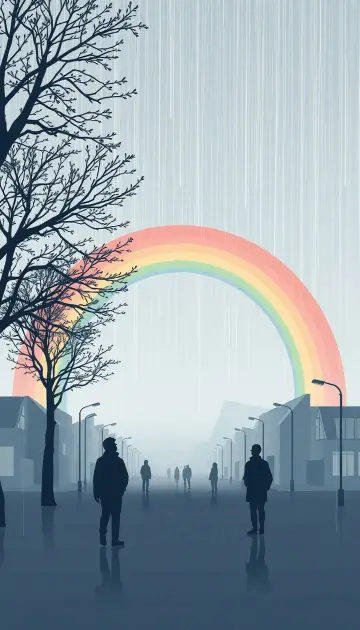
When you spot a rainbow after the rain, it feels like you and the person next to you are seeing the same view, right?

But actually, the rainbow you're seeing and the one the person next to you is seeing are made of completely different light.

A rainbow is a ring of light made only by the raindrops whose sunlight reaches your eyes at exactly 42 degrees.
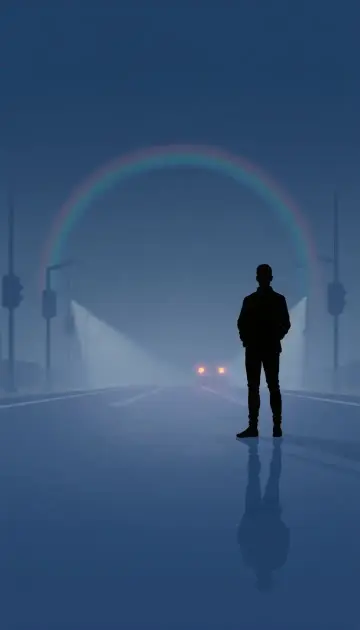
So if your position shifts, the raindrops you see change too, which means the rainbow the person next to you sees is made of slightly different light.
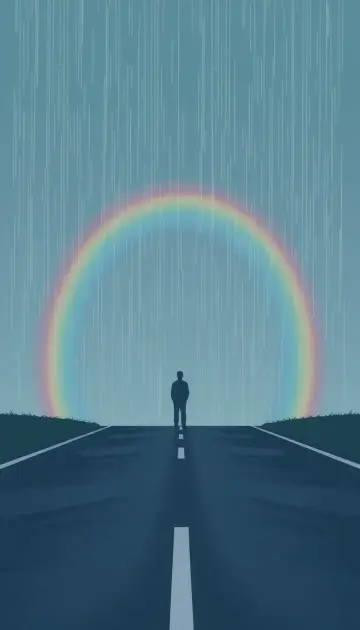
That's why a rainbow is a one-of-a-kind view that belongs only to you, standing right there at that moment.
Sources
- 虹(にじ)が弧を描いて見えるのはどうして?(はれるんマガジン 第32号)Japanese“Why do rainbows appear as arcs? (Harerun Magazine, Issue 32)”Fukuoka Regional Headquarters, Japan Meteorological Agency
- L215 虹をつくろう(展示解説)Japanese“L215 Let's Make a Rainbow (Exhibit Guide)”Nagoya City Science Museum
- How Do Rainbows Form?U.S. National Weather Service (NWS), Flagstaff Forecast Office
- Rainbows: optical wondersMet Office (UK)
- Submodule 4: Rainbows(Why is it a bow?)Steve Beeson, Arizona State University (PHS 208 course material)
- Primary and Secondary Rainbows(HyperPhysics)Department of Physics and Astronomy, Georgia State University
Spotted a mistake in the article or the translation? Let us know.
Report an error (contact form in Japanese, opens in a new tab)