On this page
A closer look
The aroma is born during roasting
First, let's look at where that aroma comes from. Most of the compounds that give coffee its characteristic smell weren't in the bean to begin with. They're created during roasting. Sugars, amino acids, and other substances in green beans (beans before roasting) undergo reactions in the heat of the roaster, such as the Maillard reaction (a reaction in which sugars and amino acids react under heat to produce brown color and toasty aromas).
The volatile compounds produced this way (compounds that escape easily into the air) are extremely numerous: more than 800 have been found in ground coffee and brewed coffee. The video described it as "oils and volatile compounds trapped inside," but it's easiest to think of these roasting-created volatile compounds as the stars of the aroma.
The inside of a bean is "full of holes"
Roasting also produces a large amount of gas along with the aroma compounds, most of it carbon dioxide. According to a paper by a Swiss research team, roasting can expand a bean's volume by up to about 80%, leaving the inside riddled with tiny gaps (pores). In dark-roasted beans, these pores can make up about half of the bean. Some of the gas produced stays trapped in these pores.
Whole beans release this gas only little by little. In the same study, light-roasted beans kept at 35°C (95°F) were still releasing gas after a month. Whole beans smell relatively mild because it takes time for what's inside to get out.
You may have noticed a small valve on some coffee bags. It's a one-way valve that lets the gas continuously released by the beans escape so the bag doesn't puff up. The paper also notes that how much gas remains in the beans can serve as an indicator of how fresh they are since roasting.
What happens when you grind
The video explained it as "the surface area suddenly increases." That's one correct explanation, but another important factor is that grinding destroys the porous structure inside the bean itself.
In the paper mentioned above, when freshly roasted beans were finely ground for espresso, up to about 75% of the gas trapped in the beans escaped during grinding and in the roughly 90 seconds right afterward. The paper attributes this to the large pores breaking apart during grinding, releasing the trapped gas all at once.
On top of that, another study confirmed that with dry grounds, the smaller the particles, the faster the aroma compounds are released. Both "the structure breaking apart" and "particles getting smaller with more surface area" contribute to that burst of aroma the moment you grind.
Incidentally, most of the gas released during grinding is carbon dioxide, and the odorous compounds have been reported to make up less than 1% of it. Even in that tiny amount, it's more than enough for us to smell.
The real reason "freshly ground" is better
When researchers at a Japanese food company collected and analyzed the aroma released during grinding, they found it contained more nutty, toasty notes and smoky roasted notes than the air above ground coffee stored in a container. The paper explains that these fresh, pleasant aromas are volatile and unstable, so they're easily lost during grinding and while the coffee is stored as grounds.
In other words, that aroma that fills the room the moment you grind is, flip it around, also "aroma escaping before it ever reaches your cup." The video's point that "freshly ground smells the best" is spot on. If you're enjoying coffee at home, it's best to store it as whole beans and grind just before brewing.
Related reads
What the video says
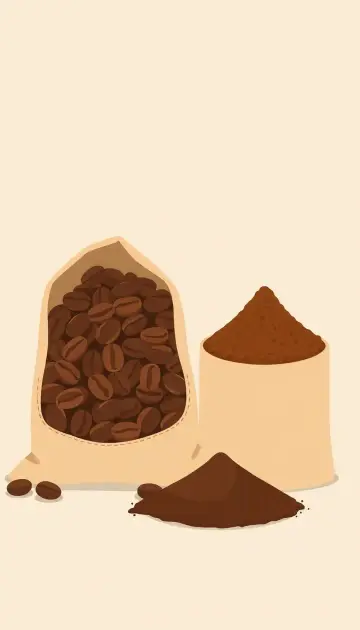
Coffee beans don't smell like much when they're sitting in the bag, but the moment you grind them, a strong aroma fills the air, right?

The truth is, coffee beans are packed with oils and volatile compounds that create that aroma.

When a bean is whole, it has a small surface area, so the aroma compounds escape only slowly.

But when you grind it, the bean breaks into tiny pieces and the surface area shoots up, so all those trapped aroma compounds burst out into the air at once.

That's why freshly ground coffee smells the most fragrant.
Sources
- Analysis of volatile compounds released during the grinding of roasted coffee beans using solid-phase microextractionAkiyama et al., Journal of Agricultural and Food Chemistry, 2003
- Time-Resolved Gravimetric Method To Assess Degassing of Roasted Coffee(著者公開版)Japanese“Time-Resolved Gravimetric Method To Assess Degassing of Roasted Coffee (author's accepted version)”Smrke et al., Journal of Agricultural and Food Chemistry, 2018
- Release kinetics of volatile organic compounds from roasted and ground coffee: online measurements by PTR-MS and mathematical modelingMateus et al., Journal of Agricultural and Food Chemistry, 2007
- Impact of agro-forestry systems on the aroma generation of coffee beansXu et al., Frontiers in Nutrition, 2022
Spotted a mistake in the article or the translation? Let us know.
Report an error (contact form in Japanese, opens in a new tab)