On this page
A closer look
The more pressure, the more dissolves
The amount of a gas that dissolves in a liquid is proportional to the pressure of that gas above the liquid. This is called "Henry's law." Carbonated drinks take advantage of this: under pressure, they're loaded with far more carbon dioxide than could ever dissolve in ordinary air. A study of three commercially sold carbonated waters found roughly 3 to 7 grams of dissolved carbon dioxide per liter.
While the cap is closed, high-pressure carbon dioxide also builds up in the gap above the liquid (the headspace), balancing the amount in the liquid. But once you open the cap, the balance is broken, because the surrounding air contains only a tiny amount of carbon dioxide, and most of the dissolved carbon dioxide tries to escape.
Bubbles need "seeds"
In the video, we said that "the trapped gas looks for a way out and turns into bubbles." But in fact, at the concentrations found in carbonated drinks, bubbles almost never form on their own in the liquid. To form a bubble, you need a tiny pocket of gas above a certain size (a nucleation site, or "bubble seed").
According to research using beer, the bubble seeds are very small pockets of gas trapped in tiny crevices on the glass surface or inside small hollow fibers (cellulose fibers). In cold beer (6°C / 43°F), it's estimated that only pockets with a radius of about 0.7 micrometers (smaller than a thousandth of a millimeter) or larger can produce bubbles.
Right after opening, the gas pockets in the liquid and on the container's surface all swell at once, which is thought to be why the fizzing is so vigorous. After that, because bubble seeds are limited, it settles into a calmer fizz, with thin trains of bubbles rising from specific spots. And even though it looks like it only happens "the moment you open it," carbon dioxide keeps slowly escaping through bubbles and the liquid's surface afterward, which is why soda goes flat over time.
Shaking makes it stronger because it adds more "bubble seeds"
In the video, we said that "if you shake it or warm it up, the gas escapes from the liquid more easily." That's true for warming, but the reason is a bit different for shaking.
Shaking doesn't change the amount of carbon dioxide dissolved in the liquid. According to an explainer from McGill University, shaking pulls the gas from the headspace down into the liquid, where it spreads throughout as tiny bubbles. The explainer also notes that the pressure inside doesn't go up.
These tiny bubbles act as bubble seeds when you open the drink. The instant the pressure drops, the dissolved carbon dioxide around each bubble flows into it and makes it swell rapidly, so foam erupts from the whole liquid. A study of the phenomenon where tapping the top of a beer bottle makes it foam over within seconds also showed that the impact breaks bubbles into a huge number of tiny ones, and the increased contact area between gas and liquid lets carbon dioxide move into the bubbles quickly.
Warming makes it stronger because less gas can stay dissolved
The higher the temperature, the less carbon dioxide dissolves in liquid. The beer study mentioned earlier calculated that, at the same pressure, beer at 6°C can hold about 1.5 times as much carbon dioxide as beer at 20°C. Put the other way around, when the drink warms up, the excess that can no longer stay dissolved comes out, and the pressure inside the container rises. Research on carbonated water also estimates that the carbon dioxide pressure inside a bottle varies greatly with temperature, and that at the same concentration, higher temperatures make bubble seeds more active and increase the number of bubbles.
In a test by the Tokyo Metropolitan Government in which unopened plastic-bottle drinks were left in a 60°C (140°F) environment, every carbonated drink container became deformed. The government warns that carbonated drinks left in places like a hot car in summer may even send the cap flying when opened.
How to open it well
As we showed in the video, loosening the cap little by little is the safe way to go, since you can close it again if foam starts rising. Keeping the drink chilled also helps keep the fizzing down.
By the way, an experiment (in a paper not yet peer-reviewed) that tested the folk wisdom that "tapping a shaken can with your finger keeps it from spraying" used more than 1,000 cans of beer and found no difference in the amount spilled between tapped and untapped cans. The researchers concluded that if you've shaken a can, waiting for the bubbles to settle before opening it is probably the only way to avoid spilling.
Related reads
What the video says
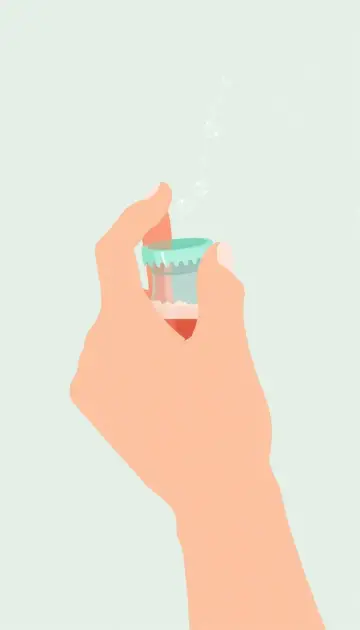
You know how soda sometimes fizzes and sprays out the instant you open the cap?
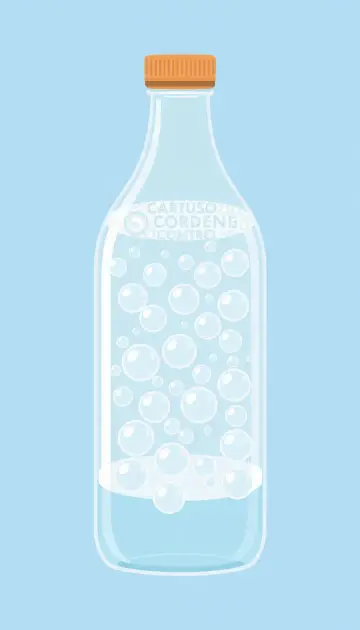
Here's the thing: the carbon dioxide in soda water has been forced to dissolve under high pressure.
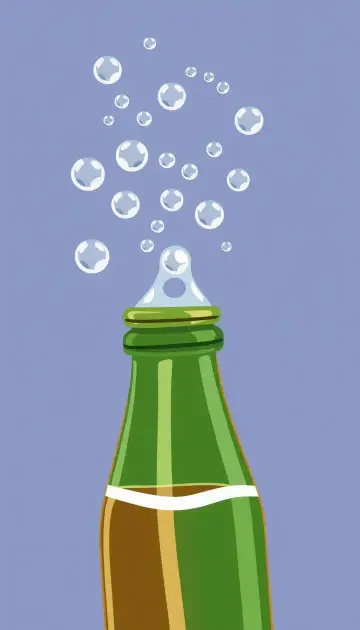
When you open the cap, the pressure drops all at once, and the trapped gas looks for a way out and turns into bubbles.
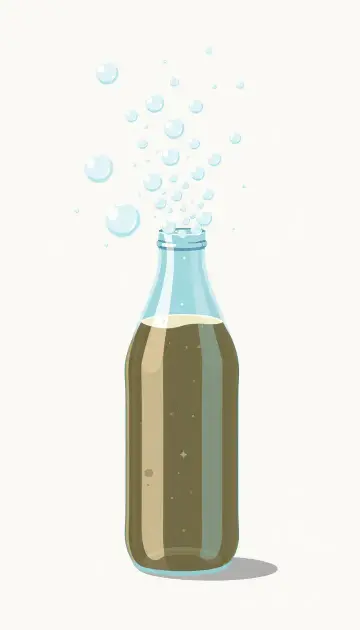
And if you shake it or warm it up, the gas escapes from the liquid more easily, so the fizz gets even stronger.
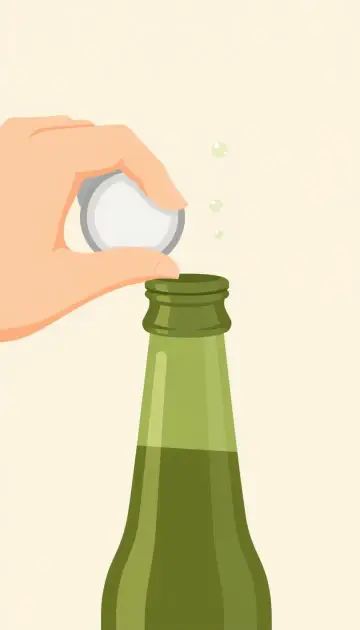
That's why the trick to opening soda is to do it slowly, a little at a time.
Sources
- How Many CO2 Bubbles in a Glass of Beer?Liger-Belair G. & Cilindre C., ACS Omega, 2021
- Carbon Dioxide in Bottled Carbonated Waters and Subsequent Bubble Nucleation under Standard Tasting ConditionLiger-Belair G., Journal of Agricultural and Food Chemistry, 2019
- Physics of beer tappingRodríguez-Rodríguez J. et al., Physical Review Letters, 2014
- Shaking a Champagne BottleMcGill University Office for Science and Society, 2019
- 暖かくなる季節、ペットボトルの飲み残しに注意!Japanese“As the weather warms up, watch out for leftover drinks in plastic bottles!”Tokyo Metropolitan Government Bureau of Citizens and Cultural Affairs (Tokyo Kurashi WEB), 2022
- 暑くなる季節、ペットボトルの飲み残しに注意!Japanese“As the weather gets hot, watch out for leftover drinks in plastic bottles!”Tokyo Metropolitan Government Bureau of Citizens, Culture and Sports, 2022
- To beer or not to beer: does tapping beer cans prevent beer loss? A randomised controlled trialSopina E. et al., arXiv (preprint, not peer-reviewed), 2019
Spotted a mistake in the article or the translation? Let us know.
Report an error (contact form in Japanese, opens in a new tab)