On this page
A closer look
The "steam" isn't actually water vapor
First, let's get our terms straight. Water vapor is a gas, and it's colorless and transparent. You can't see it. What looks white is tiny water droplets: water that never fully became a gas, or that turned back from a gas into liquid.
The Japan Meteorological Agency's forecasting terminology defines that state like this:
Fog: A condition in which visibility is less than 1 km due to tiny suspended water droplets.
A thinner version of the same thing has a different name:
Mist: A condition in which visibility is at least 1 km but less than 10 km due to tiny suspended water droplets or moist fine particles.
What rises off the road covers such a small area that it would never officially be called "fog," but the reason it looks white is exactly the same. Water droplets floating in the air scatter light, so they look white.
How hot does asphalt get in summer?
For water to evaporate all at once, the road has to be pretty hot. Japan's Ministry of Land, Infrastructure, Transport and Tourism has published figures it measured with a thermal imaging camera in 2004:
Surface temperature of asphalt pavement: 40–45°C (104–113°F) (48.6°C, or about 119.5°F, at the hottest spot)
The same survey listed the surface temperature of roadside zelkova trees at about 35°C (95°F) and greened areas at about 30°C (86°F). In other words, the pavement alone was more than 10°C (18°F) hotter.
Even when the air temperature is in the 30s °C (86–95°F or so), dark pavement in direct sunlight gets much hotter than that. The moment the rain from a summer downpour lands, all that stored heat goes into evaporating the water.
It turns white because it hits cooled air
Here's the key point. If water simply evaporated off the hot road, you'd just get more transparent water vapor, and you wouldn't see anything. It turns white because that vapor meets cooled air and turns back into droplets.
The Japan Meteorological Agency defines the temperature at which water vapor turns back into droplets as follows:
Dew point temperature: The temperature at which relative humidity reaches 100% when the temperature is lowered while keeping the water vapor pressure constant. The temperature at which water vapor in the air condenses to form dew.
A summer downpour brings both the rain itself and the cold air that gusts out of the rain clouds. Only the layer right above the road is hot, while the air a little higher up has been chilled by the rain. At the boundary of that temperature difference, the evaporated vapor quickly drops below its dew point and turns back into droplets. That's why the steam fades away a few dozen centimeters (a foot or two) above the road.
Flip it around, and even if the road is just as wet, no steam forms if the air is warm and dry enough. The vapor just blends into the air as vapor. That white band is a conditional phenomenon you only see right after a downpour, when you have both a hot road and cooled air.
The same thing happens on winter roads
The same principle works in any season. On winter mornings, white bands also rise from gutters carrying warm water pumped up from underground, and from roads sprayed with water to melt snow (some snowy regions of Japan use groundwater sprinklers built into the road for this). In those cases, it's not a hot road but the ice-cold air that sets up the conditions.
If either the surface is very hot or the air is very cold, steam will rise. The outside of a cold glass getting wet and windows fogging up are really just different faces of the same single phenomenon: water vapor being cooled and turning back into droplets.
Related reads
What the video says
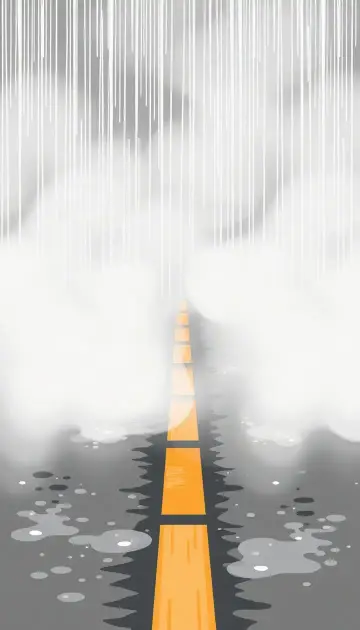
After a summer downpour, you sometimes see white steam rising from hot asphalt.
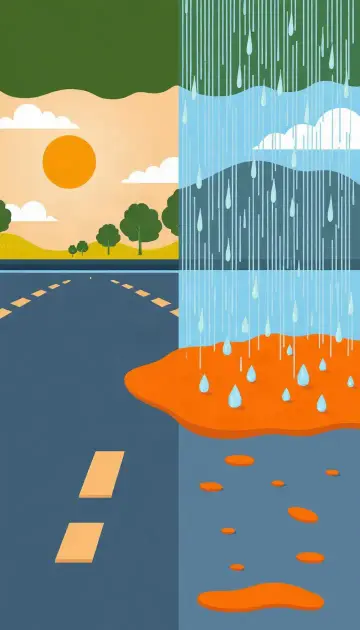
It happens when pavement that the sun can heat to over 60°C (140°F) gets wet with rain, while the air above it has cooled down.
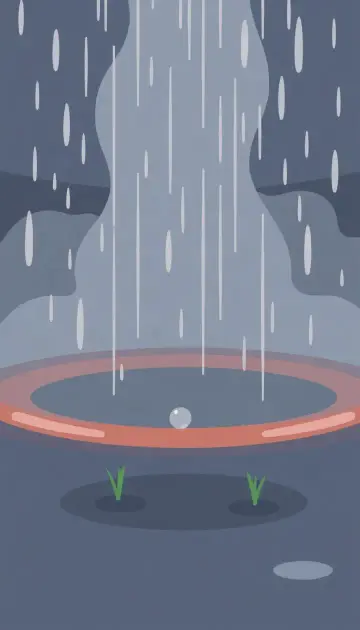
Rainwater sitting on the hot pavement warms up and rapidly evaporates into water vapor.

That vapor is cooled when it meets the cool surrounding air, turning into tiny water droplets that look white.
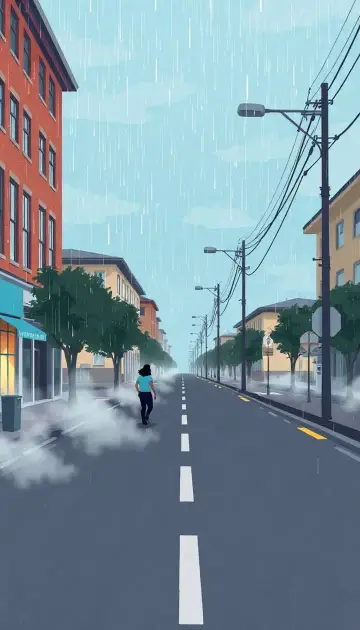
When the air is much colder than the wet road, the vapor cools quickly and steam forms easily.
Sources
- 氷、霜、霧、雷、日照時間(予報用語)Japanese“Ice, Frost, Fog, Thunder, Sunshine Duration (Forecasting Terms)”Japan Meteorological Agency
- 気温、湿度に関する用語(予報用語)Japanese“Terms Related to Temperature and Humidity (Forecasting Terms)”Japan Meteorological Agency
- 〜ヒートアイランド現象の緩和をめざして〜緑による熱環境改善効果に関する調査についてJapanese“Toward Mitigating the Heat Island Effect: A Survey on the Thermal Environment Improvement Effects of Greenery”Ministry of Land, Infrastructure, Transport and Tourism (Japan)
Spotted a mistake in the article or the translation? Let us know.
Report an error (contact form in Japanese, opens in a new tab)