On this page
A closer look
The smell is "a mix of hundreds of compounds"
As the video explains, the smell of old books comes from chemical reactions that happen as paper ages. A 2009 study by Matija Strlič and colleagues at University College London (UCL) described the scent of old books as "a combination of grassy notes with a tang of acids and a hint of vanilla over an underlying mustiness."
According to the paper, this smell is a mixture of hundreds of volatile organic compounds (VOCs: organic substances that escape into the air) given off by paper and books. Which compounds are released, and how much, depends not only on what the paper is made of but also on what's been written or printed on it, such as ink, the binding materials, and the environment where the book has been kept. The research team examined 72 types of paper from the 19th and 20th centuries and singled out 15 compounds that were especially abundant, including acetic acid (the sour component of vinegar) and furfural.
The video's "vanilla comes from cellulose" isn't quite right
The video said that "compounds that smell like vanilla are released when cellulose breaks down," but the pairing described in the research is a little different.
A 2017 paper by the same UCL team sorts it out like this:
- An example of a compound linked to the breakdown of cellulose (the main component of paper) is furfural. The paper's table describes its scent as "bread, almond, sweet."
- Examples of compounds linked to the breakdown of lignin (a substance in wood that binds the wood fibers together) are benzaldehyde and vanillin. Benzaldehyde has an "almond, burnt sugar" scent, and vanillin is the compound behind the smell of vanilla.
In other words, the vanilla scent is associated with lignin rather than cellulose. The video's second point, "almond scent from lignin," broadly matches the research. The same table also lists a compound called hexanal as smelling "grassy, fatty," which is thought to contribute to the "grassiness" of old books.
That said, a single compound doesn't necessarily come from just one source material. In the 2009 study, too, the compounds most closely related to the amount of lignin in the paper were acetic acid, hexanal, and furfural. It's not so simple that you can say "this scent comes from this compound alone"—many compounds overlap to create that familiar smell.
What did people think it smelled like?
In the 2017 study, visitors to Birmingham Museum & Art Gallery in the UK were asked to smell an old book published in 1928 without being told what it was. Among the 79 people who responded, the most common word was "chocolate," followed by "coffee." The research team pointed out that one reason may be that coffee and cacao contain many of the same compounds as old paper, such as furfural, acetic acid, and vanillin. However, the paper itself cautions that visitors were also asked to smell chocolate and coffee at the same venue, which may have influenced the results.
In an evaluation conducted at the library of St Paul's Cathedral in London, descriptions like "woody," "smoky," and "earthy" were frequently chosen, and some people also picked "vanilla," "almond," and "sweet."
A strong smell can also be a sign of fragile paper
The video concluded that the smell is "the very process of paper slowly decaying." That fits with how researchers see it. The 2009 study proposed that analyzing the compounds a book gives off might make it possible to assess how much it has deteriorated without damaging the paper.
Especially prone to damage is "acidic paper," which was mass-produced starting in the mid-19th century. According to the National Diet Library (Japan's national library), as paper came to be mass-produced and various chemicals were added during manufacturing, a great deal of acidic paper was made. Over time, this kind of paper can crumble just from being touched. The Library of Congress explains that the "rosin" and "alum (aluminum sulfate)" added as sizing to keep ink from bleeding produce sulfuric acid in the presence of moisture, and that paper made from wood pulp without the lignin removed is more prone to acid-driven breakdown. In the 2009 study as well, older papers made from rags (linen or cotton) fell into a relatively stable group.
So rather than thinking "the older it is, the more it smells," it's better to think that both how a book smells and how it deteriorates depend on "what materials the paper was made from and how." If you want your books to last, the basics are to avoid high heat, high humidity, and strong light. The National Diet Library keeps its general stacks dark, at a target of around 22°C (about 72°F) and 55% humidity.
Related reads
What the video says
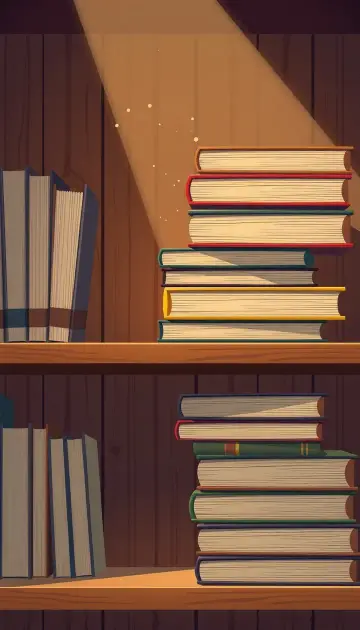
That sweet, slightly toasty smell you notice in used bookstores and libraries? It's actually the smell of chemical reactions that happen as paper ages.

Cellulose, the main component of paper, slowly breaks down over time. And as it does, it releases compounds that smell like vanilla.
On top of that, a component in paper called lignin oxidizes, adding not just vanilla but also notes of almond and hay. That's what creates the complex scent of old books.
In other words, the smell of old books is the very process of paper slowly decaying. That nostalgic scent is proof of chemical reactions etched by time.
Sources
- Material degradomics: on the smell of old booksStrlič M. et al., Analytical Chemistry, 2009
- Smell of heritage: a framework for the identification, analysis and archival of historic odoursBembibre C. & Strlič M., Heritage Science, 2017
- The Deterioration and Preservation of Paper: Some Essential FactsLibrary of Congress
- 国立国会図書館と資料保存Japanese“The National Diet Library and Preservation”National Diet Library (Japan)
Spotted a mistake in the article or the translation? Let us know.
Report an error (contact form in Japanese, opens in a new tab)