On this page
A closer look
A smell people knew long before it had a name
The distinctive smell that rises when you breathe on dry clay or soil, or wet it with water, was reportedly described even in old mineralogy textbooks. In dry regions especially, it was known as the smell that came with the first rain after a drought.
In India, people even made a perfume called mitti attar ("earth perfume") by capturing this smell in sandalwood oil. But science still didn't know what actually caused the smell.
"Petrichor" was originally the name of an oil
The people who tackled this mystery were Isabel Joy Bear and Richard Thomas of CSIRO, Australia's national science agency. When they steam-distilled rocks that had been exposed outdoors in warm, dry conditions, they got a yellowish oil, and found that this was the source of the smell.
The two published their results in the scientific journal Nature in 1964 and named the oil "petrichor." It's a coined word combining the Greek petra (stone) and ichor, the fluid said to flow through the veins of the gods in Greek mythology, meaning something like "the essence of stone."
In the video, we said that "that smell has been given the name petrichor." That's how the word is widely understood today, but to be precise, the name was originally given to the oil that produces the smell.
Another name: "geosmin"
A name that often comes up alongside petrichor is "geosmin." In 1965, researchers at Rutgers University in the US isolated it as an earthy-smelling substance from actinomycetes, a group of bacteria that live in soil, and gave it that name.
Geosmin is known as a substance that people and animals can detect at extremely low concentrations. When the video said the smell can be detected "even in tiny traces," that mainly refers to a property that has been confirmed for geosmin. The smell of rain is a mix that also includes plant-derived oils and more, not just a single substance.
How the smell gets into the air
For a long time, no one had explained how these scent compounds make it into the air. In 2015, a research team at the Massachusetts Institute of Technology (MIT) used high-speed cameras to film raindrops hitting soil. They found that tiny air bubbles form beneath a raindrop, and when those bubbles rise and burst, they release spray so fine it's invisible (aerosols). More of this spray was released during light to moderate rain than during heavy rain.
However, this study didn't measure the scent compounds themselves, and the researchers described the idea that the smell of rain is carried this way as a hypothesis. So the video's explanation that "scent compounds get flung into the air and reach our noses" is best taken as one of the leading explanations right now.
Related reading
What the video says

Have you ever noticed a soft, earthy smell the moment rain starts to fall?
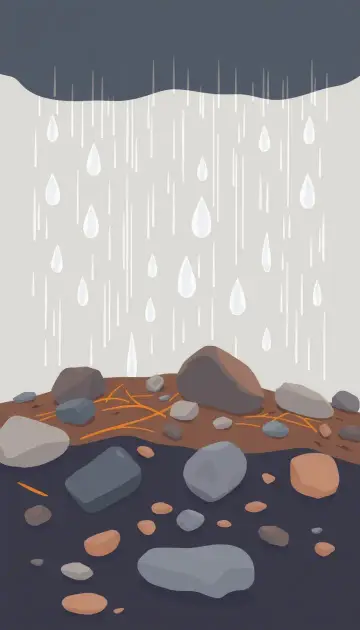
That smell actually has a name: "petrichor."

Dry soil and rocks build up oils released by plants and compounds made by bacteria.

When raindrops hit them, these scent compounds get flung into the air and reach our noses.

The human nose is said to be extremely sensitive to this smell, able to pick up even tiny traces of it.
Sources
- The smell of rain: how our scientists invented a new wordCSIRO
- Geosmin, an earthly-smelling substance isolated from actinomycetesGerber N.N. & Lechevalier H.A., Applied Microbiology, 1965
- Developmentally regulated volatiles geosmin and 2-methylisoborneol attract a soil arthropod to Streptomyces bacteria promoting spore dispersalBecher P.G. et al., Nature Microbiology, 2020
- Aerosol generation by raindrop impact on soilJoung Y.S. & Buie C.R., Nature Communications, 2015
- Rainfall can release aerosols, study findsMIT News
Spotted a mistake in the article or the translation? Let us know.
Report an error (contact form in Japanese, opens in a new tab)