On this page
A closer look
"It's not the soil" is only half right
In the video, we said it "actually isn't the soil," but the thing producing the smell is microbes that live in the soil. That's true in the sense that sand and clay themselves don't smell, but it's probably closer to reality to think of the "smell of soil" as including the living things that make their home in it.
The best-known of these are actinomycetes. They're a type of bacteria that grow in thin, branching, thread-like strands, and the bacterium that produces the antibiotic streptomycin belongs to this group. Actinomycetes use enzymes inside their cells to make a substance called geosmin.
That said, actinomycetes aren't the only producers of geosmin. Blue-green algae (cyanobacteria) that multiply in water and some molds are also known to make it, and geosmin is involved in the earthy flavor of red beets and the "muddy" taste of some fish.
Just how sensitive is the human nose?
The concentration at which people can detect geosmin dissolved in water has been reported at around 4 to 10 nanograms per liter. A nanogram is one billionth of a gram. As researchers put it, that's about as dilute as a teaspoon in the water of 200 Olympic-size swimming pools.
In 2024, a German research team tested several hundred types of human olfactory receptors (the sensors that pick up smells) and found one that responds to geosmin (OR11A1) in cell experiments. However, in those experiments, the receptor didn't respond to concentrations as low as the real nose can detect, so "why we're this sensitive" still hasn't been fully explained.
Why so sensitive? A few theories
Other creatures offer some clues. Fruit flies have a dedicated scent circuit just for geosmin, and they avoid eating or laying eggs where they smell it. It's thought to work as an "alarm" to help them avoid places with harmful microbes. On the other hand, there's also a theory that animals like camels and elephants may use it as a clue to find water in dry land.
For humans, some people find the smell pleasant and others find it unpleasant, and the reason for our sensitivity isn't clear. The "message from microbes" in the video may originally have been meant not for humans, but for other creatures like insects.
The "musty" smell in tap water is the same substance
Tap water sometimes smells like soil, mold, or ink. The cause is geosmin, made by phytoplankton that multiply in rivers, lakes, and reservoirs, along with a similar-smelling compound called 2-methylisoborneol.
Japan's national drinking water quality standards set both at no more than 10 nanograms per liter. That's roughly the same level at which people start to notice them, so these are standards meant to keep the smell down. Water utilities also say there's no effect on health. Some water treatment plants remove these compounds using activated carbon or ozone, but people vary in how they perceive smells, and sensitive people may notice them even within the standard. If it bothers you, chilling the water makes the smell milder. Boiling also reduces it, but it removes the disinfecting chlorine too, so use the water up soon.
Related reads
What the video says
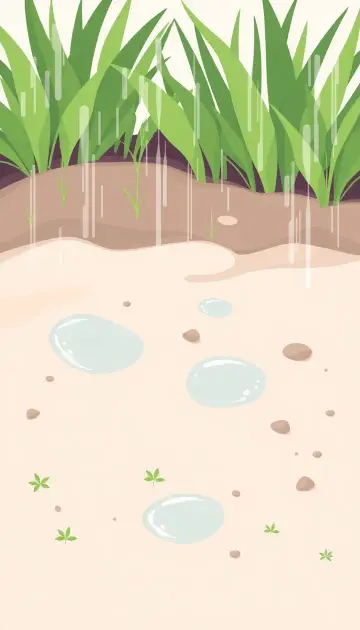
You know that hard-to-describe earthy smell after it rains?

Actually, that smell doesn't come from the soil itself. It's caused by a substance made by certain microbes.

Microbes called actinomycetes make an aroma compound called geosmin, and raindrops kick it up into the air.

The human nose is said to be extremely sensitive to geosmin, able to pick up even the tiniest amounts.

Next time you catch that after-rain smell, think of it as a message from microbes. Kind of fun, right?
Sources
- Geosmin, a Food- and Water-Deteriorating Sesquiterpenoid and Ambivalent Semiochemical, Activates Evolutionary Conserved Receptor OR11A1Ball L. et al., Journal of Agricultural and Food Chemistry, 2024
- A conserved dedicated olfactory circuit for detecting harmful microbes in DrosophilaStensmyr M.C. et al., Cell, 2012
- 水質基準項目と基準値(52項目)Japanese“Drinking Water Quality Standard Items and Standard Values (52 Items)”Ministry of the Environment (Japan)
- 水道水のにおいについてJapanese“About Odors in Tap Water”Hamamatsu City
- 府営水道宇治浄水場の異臭味についてJapanese“About the Unusual Odor and Taste at the Prefectural Waterworks Uji Water Treatment Plant”Kyoto Prefecture
Spotted a mistake in the article or the translation? Let us know.
Report an error (contact form in Japanese, opens in a new tab)