On this page
A closer look
Only the layer just inside the bark is growing
First, let's pin down where a tree actually gets thicker. Here's the explanation from the Faculty of Agriculture at Yamagata University.
Growth rings spread out in concentric circles from the center, and the cambium lies at the boundary with the bark on the outside. The cambium divides its cells, producing wood on the inside and bark on the outside.
The only part doing the work is a thin layer just inside the bark.
The wood on the inside thickens as it builds up in layers, much like geological strata, while the bark flakes off from the outside.
And here's the surprising part.
Looking at a tree as a living organism, the cell growth is happening mainly in the cambium, while most of the wood and bark is made of dead cells.
Most of a thick trunk is no longer alive. The growth rings are a "record" the cambium has stacked up on its inner side, year after year. The comparison to rock layers fits perfectly: older rings sit toward the center of the trunk, and newer ones sit toward the bark.
The lines you see are differences in cell size
So why does a new line appear once a year? The explanation from Japan's Forestry Agency puts it simply.
In regions like Japan that have four seasons, trees grow quickly from spring into summer, producing large cells with thin walls, but from summer into autumn they produce small cells with thick walls, and eventually stop growing in preparation for winter.
And:
The boundary between this year's small cells and the following year's fast-growing large cells looks like a "line," and this is what we call a growth ring.
The tree makes different-sized cells depending on the season. Areas packed tightly with small, thick-walled cells don't let much light through, so they look darker. Where that dark band meets the large, loosely packed cells of the next spring, the boundary shows up as a line.
These parts even have names. Here's Yamagata University again.
The part where fine fibers are lined up is called "latewood," made up of cells formed from summer to autumn. The part with somewhat larger fibers is called "earlywood," made up of cells formed from spring to summer. In actual wood, the latewood looks a little darker, and this is the growth ring.
Earlywood (spring to summer) and latewood (summer to autumn). One set is made each year, so you get one ring per year.
Conifers and broadleaf trees show their rings differently
The same Yamagata University explanation also covers how this differs by type of tree. In conifers, the line comes from the difference in fiber cell size, but broadleaf trees have a different mechanism.
Broadleaf trees, on the other hand, have pipe-like conducting tissue called vessels, which move water and nutrients up and down. Wood in which these vessels line up in a row is called ring-porous wood. In ring-porous wood, the vessels form right after the tree begins growing thicker in spring, so they line up in a row, and this can be seen as a growth ring.
In ring-porous woods like zelkova and chestnut, the wide water pipes made first thing in spring line up in a row, creating a distinct line. That's why their grain looks so bold.
Meanwhile:
Wood in which the vessels don't line up the way they do in ring-porous wood is called diffuse-porous wood. Because the vessels don't line up, growth rings marked by vessels are hard to see, but just as with conifers, the fiber cells formed from summer to autumn look slightly darker.
In diffuse-porous woods like cherry and maple, the rings are subtle and the grain doesn't stand out. The different looks of wooden furniture come from this difference in structure.
Tropical trees have no growth rings
This is the clearest evidence for the "one ring per year" rule. Here's the Forestry Agency's explanation.
For this reason, trees in tropical regions, where there is no change of seasons, grow in much the same way all year round, and so do not form growth rings.
Growth rings don't just appear on their own as time passes. They only form when the speed of growth changes with the seasons. A tree that grows at the same pace all year has no boundaries.
In other words, growth rings are less a record of a tree's age than a record of the climate. That's why measuring ring widths can tell you whether a given year was a good or bad one for the tree.
You can count them without cutting the tree down
The explanation also covers a practical point.
However, if the tree isn't cut down, you can't count its rings, so a tool called an "increment borer" is screwed into the base of the tree and pulled out to extract a piece of the wood, and the age is estimated by counting the rings in it.
An increment borer drills a narrow hole into the trunk and pulls out a pencil-like core. Because it lets you count the rings without felling the tree, it's used to find the age of living giant trees.
There's also a side note on how the cells of conifers and broadleaf trees differ.
First, the tracheids of conifers are groups of fairly short cells (1–6 mm) that serve both as water channels and as support for the whole tree.
Conifers use a single type of cell both to carry water and to hold the tree up, while broadleaf trees split those jobs between vessels and fibers. The difference in how their rings look ultimately comes from this difference in design.
You might also like
What the video says
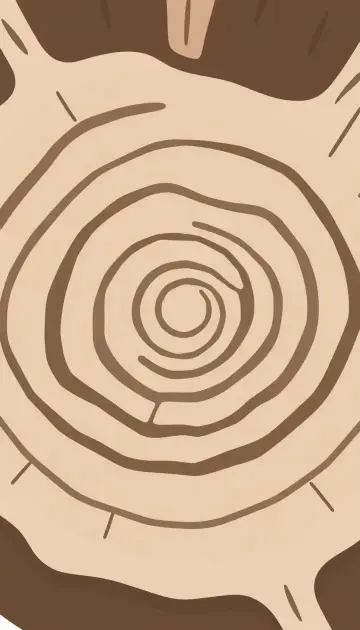
Look at the cross-section of a stump and you'll see ring after ring. Count them, and you can tell how long the tree lived, right?

Each of these rings is actually the trace of one year's growth, stacked up exactly one loop at a time.
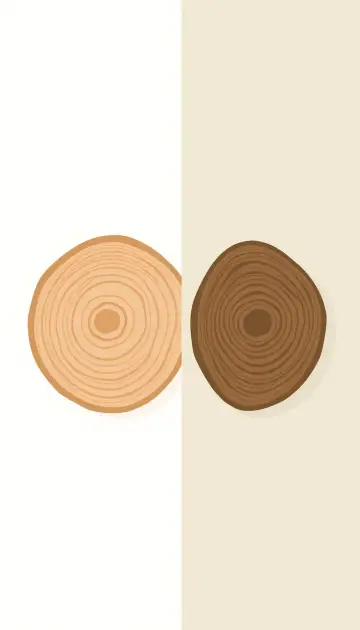
In spring and summer there's plenty of water, so the cells grow large and form a lighter ring. In autumn and winter growth stops, the cells shrink, and they form a darker ring.

One light ring plus one dark ring equals exactly one year. So by counting the rings, you can tell the tree's age precisely.

And by looking at a ring's width, you can even tell whether that year was a good one with plenty of rain, or a harsh, dry one.
Sources
- 森林と木(問7 木の年輪はどうやって出来るのですか)Japanese“Forests and Trees (Q7: How do tree growth rings form?)”Kyushu Regional Forest Office, Forestry Agency (Japan)
- 年輪の構造Japanese“The Structure of Growth Rings”Faculty of Agriculture, Yamagata University
Spotted a mistake in the article or the translation? Let us know.
Report an error (contact form in Japanese, opens in a new tab)