On this page
A closer look
The holes are air that was dissolved in the mixture
The tiny holes that form in custard pudding and chawanmushi (a savory Japanese steamed egg custard) are called "su" in Japanese, and in cooking science the phenomenon has been studied under the name "sudachi."
What they really are is gas that was dissolved in the liquid. Water and egg mixtures have air dissolved in them. Not as much as a carbonated drink, but it's definitely there. And the amount of gas a liquid can hold goes down as the temperature goes up.
So when you heat the mixture, the air that can no longer stay dissolved comes out as bubbles. A study published in the Journal of Home Economics of Japan, "The Sudachi Phenomenon in Cooking (Part 2)," looked at exactly this process. Using a method that captures bubbles on nylon threads, the researchers tracked how bubbles form and grow in water and in dilute egg white solution.
What the study confirmed is that the higher the heating temperature, the faster the bubbles grow. At higher temperatures, the limit on how much gas can stay dissolved drops, and the bubbles themselves also expand.
If bubbles grow before the custard sets, they stay
This is what decides whether you get holes or not.
There's a rough guide to the temperature at which egg mixture sets. "Analysis of Factors Affecting the Physical Properties of Chawanmushi (Part 2)," a study on chawanmushi, used dynamic viscoelasticity measurements and found that the elastic modulus starts rising sharply once the temperature passes about 75°C, estimating that gelling begins at around 77°C.
In other words:
- Set it slowly at around 80°C → the liquid sets and stops moving while the bubbles are still small
- Heat it to 95°C or close to boiling → the bubbles grow large, and the custard sets with them trapped inside
Even with the same ingredients, the result changes depending only on the temperature and speed of heating. A pudding full of holes isn't an ingredient failure; it's a heating failure.
Research on onsen tamago (Japanese "hot spring eggs") also shows how sensitive egg setting is to temperature. "Effects of Heating Temperature and Holding Time on the Coagulation of Onsen Tamago" examined how the yolk and white set differently depending on the combination of heating temperature and holding time. The fact that a difference of just a few degrees changes the outcome ties directly into the pudding story.
Bubbles keep moving even after cooling begins
There's another interesting observation. The sudachi research also tracked what happened to heat-generated bubbles after they were left at room temperature. The bubbles reportedly kept growing in volume for a while until they peaked, and then slowly shrank.
The process doesn't stop the moment you stop heating. That's why residual heat after you turn off the stove can sometimes make the holes spread. That's another reason leaving the pudding in the steamer for a long time works against you.
Three ways to prevent holes
Building solutions from how it works, you get this:
1. Don't let the temperature get too high
If you're using a steamer, leave the lid slightly ajar to let steam escape so the inside doesn't reach 100°C. If you're using an oven, bake in a water bath (bain-marie) and keep the water from getting too hot. A water bath is essentially a device for "not going above 95°C."
2. Get the gas out before heating
Mixing the egg mixture introduces air. Stir gently so it doesn't foam, and pour it through a strainer. Skim off any bubbles on the surface with a spoon. This cuts down on "bubbles that were there before heating."
As for the dissolved gas, it comes out more easily if you warm the egg mixture slightly before mixing.
3. Stop heating at the right time
Stop when the center reaches around 80°C. If you keep heating for "just a bit longer," you give the bubbles time to grow. Check how set it is by giving it a gentle shake, and turn off the heat when the center still jiggles slightly; the residual heat will finish the job.
Holes and wateriness come from the same cause
An overheated pudding usually comes with a second failure: water pooling at the bottom, known as syneresis.
As heating goes on, the network in a protein gel shrinks. The shrunken network can't hold all the water and squeezes it out. That's why an overheated pudding ends up with a double failure: "full of holes, and watery too."
Flip that around, and the fix is the same for both: don't let the temperature get too high. The reason all the tricky points in making pudding come down to this is that egg proteins respond very faithfully to temperature.
Related reading
What the video says
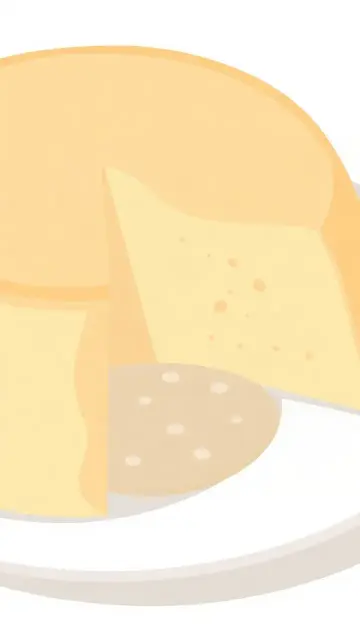
Ever notice a custard pudding that should be silky smooth, but is dotted with tiny holes? That's a phenomenon called "su."
The cause is overheating the egg mixture. Egg proteins set with heat, but if the temperature gets too high, the water inside boils and forms tiny bubbles.

If those bubbles don't escape before cooling and get trapped as the custard sets, you end up with those pockmarked "su" holes.

So the secret to a silky smooth pudding is to steam it slowly and gently at a low temperature. Taking your time with the heat is what gives it that glossy, smooth texture.
Sources
- 加熱調理におけるすだち現象(第2報)溶存気体の気泡化と卵ゲルの「す」形成との関連Japanese“The Sudachi Phenomenon in Cooking (Part 2): The Relationship Between Bubble Formation from Dissolved Gas and the Formation of "Su" in Egg Gels”Journal of Home Economics of Japan, Vol. 35, No. 11
- 茶碗蒸しの物性に及ぼす影響因子の解析(第2報)ゲル化特性に及ぼす調理時の加熱条件、pHおよび食塩濃度の影響Japanese“Analysis of Factors Affecting the Physical Properties of Chawanmushi (Part 2): Effects of Heating Conditions During Cooking, pH, and Salt Concentration on Gelation Properties”Journal of Cookery Science of Japan, Vol. 33, No. 4
- 温泉卵の凝固状態への加熱温度と保持時間の影響 ―好みの温泉卵を作るには―Japanese“Effects of Heating Temperature and Holding Time on the Coagulation of Onsen Tamago: How to Make Your Preferred Onsen Tamago”Journal of Cookery Science of Japan
Spotted a mistake in the article or the translation? Let us know.
Report an error (contact form in Japanese, opens in a new tab)