On this page
- A closer look
- Microwaves bounce around inside the box
- When reflected waves overlap, strong and weak spots form
- The spacing of strong and weak spots depends on wavelength
- So the food gets moved instead
- Flatbed models solve it another way
- Uneven heating never completely disappears
- What microwaves are good and bad at
- Related reading
- What the video says
- Sources
A closer look
Microwaves bounce around inside the box
The inside of a microwave oven is enclosed in metal. Metal reflects microwaves, so the waves bounce back and forth inside the box over and over.
That's also why the door has a metal mesh: to keep microwaves from leaking out. The holes in the mesh are much smaller than the microwaves' wavelength, so the waves can't pass through.
What hits the food are these microwaves that keep reflecting. They aren't beamed from one direction; waves coming from every direction strike the food.
When reflected waves overlap, strong and weak spots form
This is the key point. When waves overlap, they can reinforce each other or cancel each other out.
An explainer from Toho University describes this interference using light as an example.
The light from A2 and B1 interferes with each other, producing effects where they reinforce or cancel each other out. This changes depending on the size of the waves at each wavelength.
Whether it's light or microwaves, the same thing happens with any wave.
Inside a metal box, when waves traveling forward overlap with waves reflecting back, spots with large amplitude and spots with small amplitude become fixed in place. This is called a standing wave (or stationary wave).
It's the same setup as a string on a stringed instrument vibrating strongly at certain points and staying still at others.
The spacing of strong and weak spots depends on wavelength
Household microwave ovens use microwaves at a frequency of 2.45 GHz. The wavelength is about 12 cm.
The distance between strong and weak spots in a standing wave is half the wavelength — about 6 cm. In other words, the inside of the oven has "spots that heat well" and "spots that don't heat well" lined up at roughly 6 cm intervals.
The oven's interior is about 30–40 cm across, so several sets of strong and weak spots fit inside.
This pattern doesn't move. It's determined by the box's shape and the wavelength, so the same spots are always strong and the same spots are always weak.
So the food gets moved instead
If the pattern won't move, move the food. That's the idea behind the turntable.
As the food rotates, every part of it passes through strong and weak spots in turn. On average, the whole thing gets heated about the same amount.
Rather than making the microwave distribution uniform, it makes the time-averaged amount each part of the food receives uniform. It's a clever solution.
Many turntable microwaves emit microwaves from the side or bottom, so the center of the oven isn't necessarily the strongest spot. That's why placing food "off-center, toward the outside" sometimes heats it better.
Flatbed models solve it another way
Microwaves without a turntable (flatbed models) are becoming more common. These even out the distribution in a different way.
Rotating antenna: A spinning vane at the microwave outlet keeps changing the direction the waves are scattered
Stirrer fan: Metal blades spinning on the ceiling or floor of the oven change the direction of reflection
Multiple outlets: Waves are emitted from different positions, making the distribution more complex
All of these take the approach of "changing the wave distribution over time." The turntable moves the food; flatbed models move the waves. The goal is the same.
The advantages of flatbed models are a flat interior that's easy to clean and room for large plates or rectangular bento boxes. The downside is a more complex design.
Uneven heating never completely disappears
With either type, unevenness never drops to zero.
The food itself plays a role too. Microwaves heat by making water molecules vibrate, so parts with more moisture warm up faster.
- Moist parts (fillings, sauces) → heat well
- Dry parts (rice, bread) → heat poorly
- Ice → heats less easily than water (because its molecules are locked in place)
When you thaw frozen food and part of it is boiling while another part is still frozen, this property is why. The melted parts heat up first, and the frozen parts get left behind.
That's why microwaves have a "defrost mode." It lowers the power and heats in bursts, giving heat time to spread by conduction.
What microwaves are good and bad at
Thinking about how they work reveals their strengths and weaknesses.
Good at: Heating moist foods all the way through. Warming milk, reheating rice
Bad at: Browning just the surface. Evenly heating dry foods. Making fried food crispy again
This difference is also why mochi (Japanese rice cakes) puff up when you grill them but don't puff up in the microwave. A microwave heats from the inside, so it can't create the situation where "only the surface hardens first and acts as a lid."
The spinning turntable is a simple, mechanical answer to a physical limitation of waves.
Related reading
What the video says

The microwave you use every day. The plate spinning around inside is so normal, you've probably never even wondered about it.
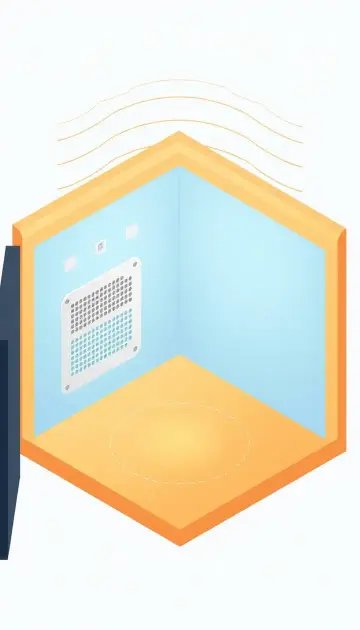
Actually, it's because the microwaves generated inside the oven are "uneven."

The microwaves keep bouncing around inside, creating strong spots and weak spots. Left that way, only parts of your food would get hot.

So by spinning the plate, the whole dish gets exposed to the microwaves evenly, and it heats up without hot and cold patches.
That spinning you've watched without a second thought was actually a clever trick to get rid of uneven heating.
Sources
- 青い魚はなぜ青い-魚の体色変化の不思議を探る-(波の干渉について)Japanese“Why Are Blue Fish Blue? Exploring the Mystery of Color Change in Fish (On Wave Interference)”Toho University Virtual Laboratory
Spotted a mistake in the article or the translation? Let us know.
Report an error (contact form in Japanese, opens in a new tab)