On this page
A closer look
There are only three ways for heat to escape
Heat moves in three ways.
- Conduction: it travels through objects (the handle of a hot frying pan gets hot)
- Convection: a moving fluid carries it (warm air rises)
- Radiation: it flies off as electromagnetic waves (holding your hands near a campfire warms them)
A thermos blocks each of these three in a different way. It's a neat solution to a textbook engineering problem.
Blocking conduction: the vacuum layer
Looking at thermal conductivity shows just how poorly air conducts heat. From material by Osaka Kyoiku University (units are W/m·K):
| Substance | Thermal conductivity |
|---|---|
| Copper | 403 |
| Iron | 83.5 |
| Water (10°C) | 0.582 |
| Dry air (0°C) | 0.0241 |
The same material describes the trend like this:
Thermal conductivity increases in the order of gases, liquids, and solids.
Gases have the lowest. That's why wool sweaters and Styrofoam insulate by trapping air.
But a thermos goes one step further. It takes the air out too.
Conduction works by molecules passing their vibrations on to neighboring molecules. With no molecules, there's nothing to pass them to. In a vacuum, conduction barely happens.
That's why a thermos has double walls: so the space between them can be a vacuum.
Blocking convection: the vacuum again
Convection is when a fluid (a gas or liquid) moves and carries heat with it.
Remove the air, and there's no fluid left to move. So the vacuum layer stops conduction and convection at the same time. One trick blocks two paths.
This is the crucial difference from simply packing in insulation. In a container stuffed with insulation, conduction through the material still remains. With a vacuum, even that is gone.
Blocking radiation: the mirror surface
That leaves radiation. This one is tricky, because a vacuum doesn't stop it.
Radiation travels as electromagnetic waves (mainly infrared), so it gets through even when there's nothing in between. It's the same way the sun's heat crosses the vacuum of space to reach Earth.
The fix is reflection. The mirror-like silver interior of a thermos isn't a design choice. It's there to reflect radiated infrared back inward.
A black surface without a mirror finish would absorb radiation. A mirror finish lowers emissivity, reducing both the infrared going out and the infrared coming in.
Still not perfect
A thermos's weak spots are the parts that can't be fully sealed off.
The mouth. The inner and outer bottles have to be joined at the mouth, or it wouldn't be a container. Metal or plastic runs through there, so it becomes a path for conduction.
The stopper and lid. These can't be made into a vacuum. So if you leave the lid open, heat escapes with the steam through convection.
The spout. Models with an opening-and-closing spout have a more complex structure, which means more paths for heat.
So a thermos's performance comes down to "how narrow the mouth can be, and how poorly its material conducts heat." The differences in heat-retention ratings in catalogs (such as how many degrees after 6 hours) are almost entirely differences in how this part is designed.
How you use it changes how well it works
Once you understand the mechanism, the practical tips make sense.
Preheat it: Before filling it with hot water, warm the inner bottle with a little hot water first. If you pour into a cold inner bottle, heat first gets used up warming the bottle.
Fill it to the top: If there isn't much inside, the air in the space above circulates and carries heat away. And because the contents have a small heat capacity, the same amount of heat loss makes the temperature drop more.
Open it less often: Every time you open it, you bypass the paths the vacuum was blocking and swap out the air.
It works for cold things, too: Insulation doesn't care about direction. It stops heat from moving in or out, so it performs just as well at keeping cold things cold.
Invented in the late 19th century
The prototype of the thermos is the "Dewar flask," made in 1892 by British physicist James Dewar. It was originally built as a device for storing liquefied gases during experiments on liquefying gases.
A piece of lab equipment became a household item. And more than 130 years later, the principle hasn't changed: stop conduction and convection with a vacuum, and send radiation back with a mirror surface. Since there are only three ways for heat to escape, once you've blocked them all, the only room left for improvement is in the details of the structure.
Related reading
What the video says
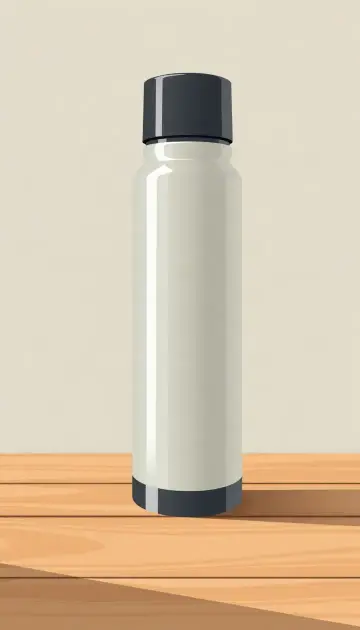
You pour tea in the morning, and it's still hot at lunchtime. Thermoses are pretty amazing, right?
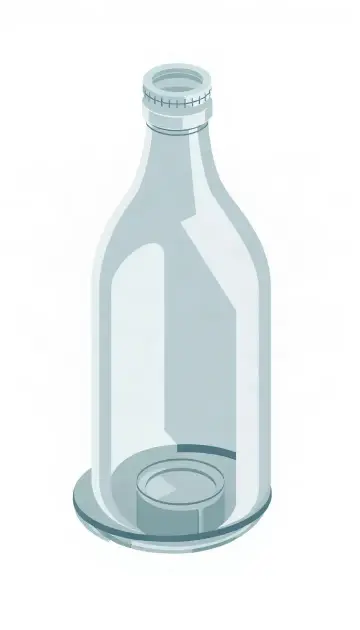
Actually, a thermos has a double-walled structure, and the space between the inner and outer walls is nearly a vacuum.

Heat escapes by traveling through air and objects, so with a vacuum layer in the way, almost no heat gets through.

On top of that, the inner wall is polished to a mirror shine, reflecting heat like light and trapping it inside.
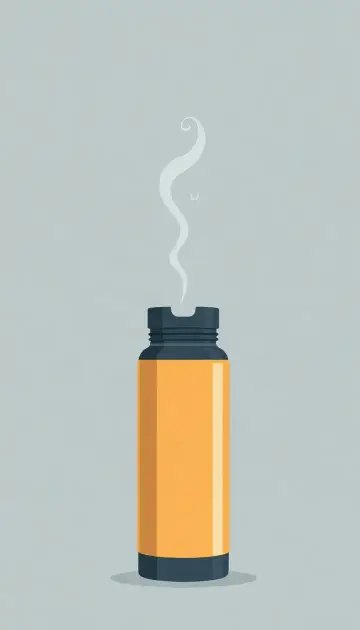
A vacuum wall and a mirror-like interior: thanks to these two, a thermos can stay warm for hours.
Sources
- 熱伝導率(熱の伝わる速さ)Japanese“Thermal Conductivity (How Fast Heat Travels)”Osaka Kyoiku University
Spotted a mistake in the article or the translation? Let us know.
Report an error (contact form in Japanese, opens in a new tab)